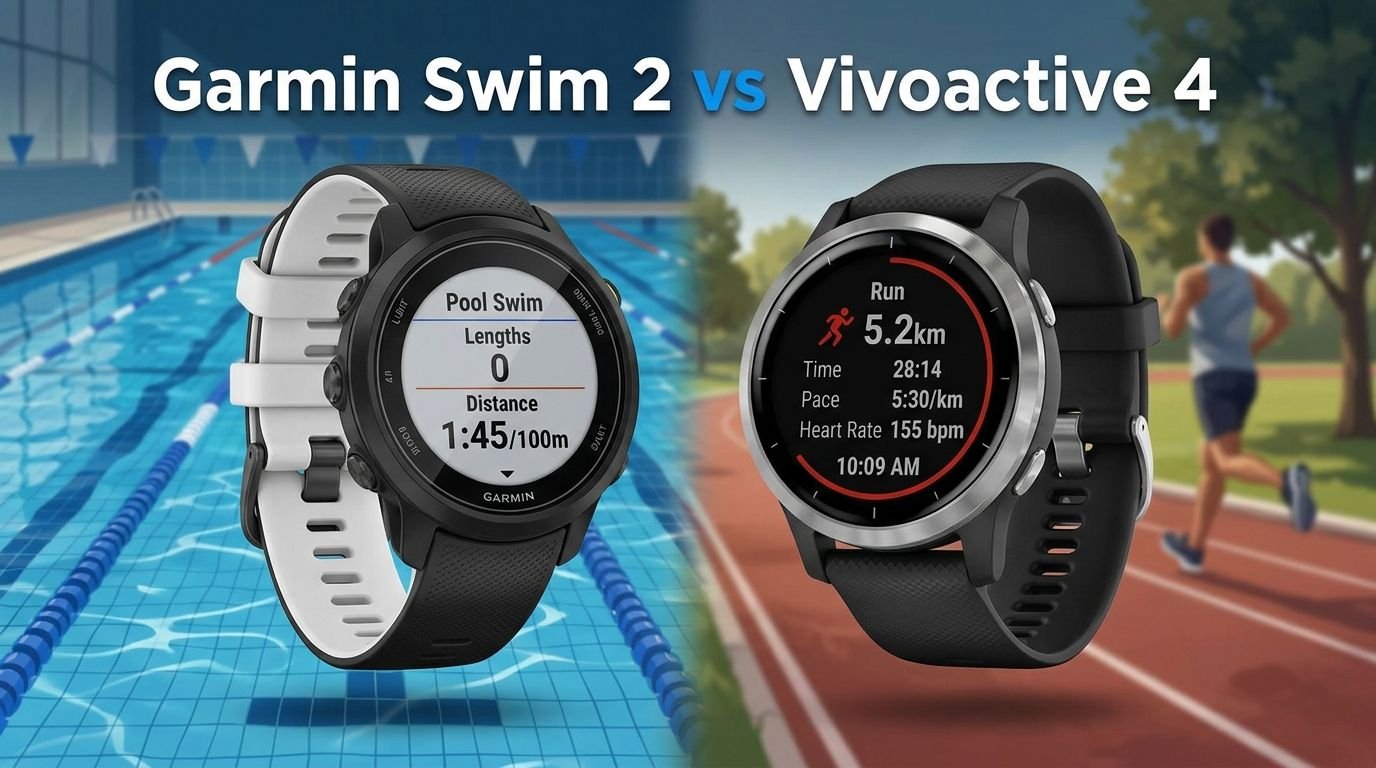
Garmin Swim 2 vs Vivoactive 4: Which to Buy?
Are you stuck choosing between the Garmin Swim 2 and the Garmin Vivoactive 4? You are not alone. Both watches come from one of the most trusted names in GPS sports watches. But they serve very different types of athletes.
The Garmin Swim 2 is a purpose built swimming watch. It tracks pool laps, open water distance, stroke type, and underwater heart rate. The Vivoactive 4 is a full featured GPS smartwatch. It covers over 20 sports, plays music, and monitors your health all day long.
So which one should you buy? That depends on your workout habits, your budget, and how much you value smartwatch features outside the pool. This post breaks down every difference between these two watches. By the end, you will know exactly which one matches your goals.
Key Takeaways
- The Garmin Swim 2 is the better choice for dedicated swimmers. It offers advanced pool swim metrics like drill logging, auto rest detection, critical swim speed, and pace alerts that the Vivoactive 4 does not have.
- The Garmin Vivoactive 4 is the better all around smartwatch. It supports music storage, Garmin Pay through NFC, a touchscreen display, animated on screen workouts, and over 20 preloaded sport profiles.
- Both watches track open water swimming with GPS and pool swimming with accelerometer based lap counting. However, the Swim 2 provides more detailed swim specific data like SWOLF scores and stroke count with higher accuracy.
- Battery life is similar on both watches. The Swim 2 lasts up to 7 days in smartwatch mode and 13 hours in GPS mode. The Vivoactive 4 lasts up to 8 days in smartwatch mode and 18 hours in GPS mode.
- The Vivoactive 4 includes Pulse Ox, Body Battery, and a stress tracking widget. The Swim 2 has Body Battery but lacks Pulse Ox and some of the deeper health monitoring tools.
- The Swim 2 is lighter and thinner at 36 grams. The Vivoactive 4 weighs 50.5 grams. If comfort in the water matters most, the Swim 2 has a clear edge.
Garmin Swim 2 Overview

Last update on 2026-08-04 / Affiliate links / Images from Amazon Product Advertising API Some of the links on this website are affiliate links, which means that at no additional cost to you, I earn a commission if you click through and make a purchase. I only recommend products and services that I believe will add value to my readers. Thank you for your support!
The Garmin Swim 2 launched in October 2019 as a dedicated swimming smartwatch. It replaced the original Garmin Swim and added GPS plus optical heart rate tracking. The watch weighs only 36 grams and measures 42 mm across with a thickness of 11.4 mm.
Its 1.04 inch sunlight readable color display has a resolution of 208 x 208 pixels. The screen is always on, so you can glance at your data mid stroke. Garmin built this watch for people who swim regularly and want deep swim analytics without paying for a high end multisport watch.
The Swim 2 tracks both pool and open water swims. In the pool, it records distance, pace, stroke count, stroke type, SWOLF, and rest intervals. In open water, it uses GPS to map your route and measure distance. It also supports basic running, cycling, and cardio activities.
Pros:
- Excellent swim tracking with drill logging and auto rest
- Lightweight and comfortable at 36 grams
- Underwater wrist based heart rate monitoring
- Affordable price compared to multisport watches
- Up to 13 hours of GPS battery life
Cons:
- No touchscreen, buttons only navigation
- No music storage or playback
- No NFC for Garmin Pay
- Limited sport profiles compared to Vivoactive 4
- No Pulse Ox sensor
Garmin Vivoactive 4 Overview

Last update on 2026-08-04 / Affiliate links / Images from Amazon Product Advertising API Some of the links on this website are affiliate links, which means that at no additional cost to you, I earn a commission if you click through and make a purchase. I only recommend products and services that I believe will add value to my readers. Thank you for your support!
The Garmin Vivoactive 4 arrived in September 2019 as a lifestyle GPS smartwatch. It sits between Garmin’s basic fitness trackers and its premium multisport watches. The watch weighs 50.5 grams and features a 1.3 inch display with 260 x 260 resolution.
Garmin uses Corning Gorilla Glass 3 on the screen. The watch has both a touchscreen and two physical buttons for navigation. It stores up to 500 songs and supports Spotify, Amazon Music, and Deezer for offline playback through Bluetooth headphones.
The Vivoactive 4 includes over 20 preloaded sport profiles. These cover running, cycling, swimming, yoga, pilates, strength training, golf, and more. It also offers animated workouts directly on screen. Health tracking features include Pulse Ox, Body Battery, stress monitoring, respiration tracking, and menstrual cycle tracking.
Pros:
- Over 20 sport profiles for varied training
- Touchscreen plus button navigation
- Music storage with Spotify and Deezer support
- NFC for contactless Garmin Pay
- Pulse Ox and advanced health monitoring
Cons:
- Heavier at 50.5 grams, less ideal for long swims
- Touchscreen can be tricky to use in water
- Lacks advanced swim metrics like drill logging
- No auto rest detection in pool swim mode
- Thicker at 12.8 mm
Design and Build Quality
The Garmin Swim 2 has a compact, lightweight design built for water. At 42 mm and 36 grams, it sits flat on your wrist. The slim 11.4 mm profile means it slides under a wetsuit easily. It comes in two colors: Whitestone and Slate.
The Vivoactive 4 is a more traditional looking smartwatch. At 45.1 mm and 50.5 grams, it is noticeably larger. The stainless steel bezel gives it a polished look that works with everyday outfits. It comes in several color combinations like Black, Silver with Gray, and Shadow Gray.
Both watches use silicone bands with quick release pins. The Vivoactive 4 has a 22 mm band, and the Swim 2 uses a standard watch band. The Vivoactive 4 looks better as a daily wear watch. The Swim 2 looks more like a sports tool.
Display Comparison
The Swim 2 features a 1.04 inch sunlight readable color display. Its resolution is 208 x 208 pixels. The screen is small but clear enough for reading swim data at a glance. It uses a transflective memory in pixel (MIP) technology that stays visible in bright light.
The Vivoactive 4 has a larger 1.3 inch transflective MIP display. Its 260 x 260 pixel resolution provides sharper text and icons. The bigger screen makes it easier to read animated workout instructions and notifications. Colors appear more vibrant on the Vivoactive 4.
Both displays are always on by default. Neither watch uses an AMOLED screen, so you will not get deep blacks or vivid contrast. But both perform well outdoors. The Vivoactive 4 wins here because of its larger size and higher resolution.
Swimming Features
This is where the Swim 2 dominates. It was built from the ground up for swimmers. In pool mode, it records distance, pace, stroke count, stroke type, SWOLF score, and interval timers. It detects all four stroke types automatically: freestyle, backstroke, breaststroke, and butterfly.
The Swim 2 also includes auto rest detection. It knows when you stop at the wall and logs your rest intervals. You can also log drill sets manually, which is a big deal for structured training. The Critical Swim Speed feature estimates your threshold pace for training zones.
The Vivoactive 4 supports pool and open water swimming. It tracks distance, pace, stroke count, and stroke type. But it lacks drill logging, auto rest, and Critical Swim Speed. Its touchscreen can also be hard to use when your hands are wet. For serious swimmers, the Swim 2 is the clear winner.
Health and Wellness Tracking
The Vivoactive 4 offers a deeper health monitoring suite. It includes Pulse Ox readings that estimate blood oxygen saturation. It also tracks Body Battery, all day stress levels, respiration rate, and hydration logging. The menstrual cycle tracker is another useful addition.
The Swim 2 includes Body Battery and basic activity tracking. It counts steps, monitors sleep, and tracks calories. But it does not have Pulse Ox, stress tracking, or respiration monitoring. Health features on the Swim 2 are limited compared to the Vivoactive 4.
Both watches track sleep duration and sleep stages. Both connect to the Garmin Connect app for detailed reports. If you want a watch that doubles as a daily health monitor, the Vivoactive 4 has a significant advantage.
GPS and Sensor Performance
Both watches use GPS and GLONASS for satellite positioning. The Swim 2 uses GPS in open water swim mode to map your route and measure distance. The Vivoactive 4 uses GPS across all outdoor activities including running, cycling, and swimming.
The Swim 2 has an optical heart rate sensor that works underwater. This was a major upgrade from the original Garmin Swim. You can view your heart rate in real time during pool and open water sessions. The Vivoactive 4 also has a wrist based optical heart rate sensor.
The Vivoactive 4 adds a few extra sensors. It includes a barometric altimeter for elevation tracking, a compass, a gyroscope, and a thermometer. The Swim 2 lacks these sensors. If you hike, trail run, or do outdoor sports beyond swimming, the Vivoactive 4 gives you more data.
Smart Features and Connectivity
The Vivoactive 4 is the smarter watch of the two. It supports NFC for Garmin Pay, which lets you make contactless payments from your wrist. It stores up to 500 songs and connects to Bluetooth headphones for music playback. It also supports Wi Fi for syncing and downloading music.
The Swim 2 has basic smart notifications. It shows texts, calls, emails, and calendar alerts from your phone. But it has no music storage, no NFC, and no Wi Fi. You navigate the watch entirely through five buttons with no touchscreen.
Both watches connect to the Garmin Connect app on iOS and Android. Both support Connect IQ for downloading watch faces, widgets, and data fields. The Vivoactive 4 offers a much richer smartwatch experience for daily use outside of training.
Battery Life Comparison
The Garmin Swim 2 lasts up to 7 days in smartwatch mode. In GPS mode, it runs for about 13 hours. In pool mode with optical heart rate, it provides approximately 72 hours of tracking. That is enough for several weeks of pool sessions.
The Vivoactive 4 lasts up to 8 days in smartwatch mode. In GPS mode with music, battery life drops to about 6 hours. Without music, GPS mode lasts around 18 hours. The Vivoactive 4 has a slight edge in daily wear battery life.
Both watches charge through a proprietary Garmin cable. A full charge takes about an hour for the Swim 2 and slightly longer for the Vivoactive 4. Battery life on both watches is solid for their price range.
Sports and Activity Tracking
The Swim 2 supports a small set of sport profiles. These include pool swimming, open water swimming, running, cycling, and generic cardio. You will not find yoga, strength training, golf, or ski modes. It is a specialized tool, not a general fitness tracker.
The Vivoactive 4 includes over 20 preloaded sport profiles. You get modes for running, cycling, swimming, yoga, pilates, elliptical, stair stepper, rowing, golf, skiing, and more. Animated workouts guide you through exercises directly on the watch screen.
If you train in multiple sports, the Vivoactive 4 is the better pick. If you only swim or swim as your primary workout, the Swim 2 delivers deeper data. Your training routine should guide this decision.
Water Resistance and Swim Rating
Both watches carry a 5 ATM water resistance rating. This means they handle water pressure equal to 50 meters of depth. They are safe for pool swimming, open water swimming, showering, and water sports. Neither watch is suitable for scuba diving.
The Swim 2 has been tested specifically for swim performance. Garmin optimized its heart rate sensor and accelerometer for underwater accuracy. The watch sits lower on the wrist and creates less drag. Its button only design avoids accidental screen taps from water.
The Vivoactive 4 is also pool and open water safe. But its touchscreen can register false inputs from water droplets and wrist movements. You can lock the screen during swim activities. Still, the Swim 2 provides a smoother in water experience overall.
Price and Value for Money
The Garmin Swim 2 originally retailed around $249. The Vivoactive 4 launched at about $349. Both watches have dropped in price since their release, and you can often find deals on both models through Amazon and other retailers.
The Swim 2 offers excellent value for swimmers on a budget. You get advanced pool and open water metrics, GPS, and heart rate tracking at a lower cost. The Vivoactive 4 offers more value for people who want a versatile daily smartwatch with fitness features.
Think about how you plan to use the watch. A dedicated swimmer gets more from the Swim 2. Someone who runs, cycles, swims, and wants music and payments on their wrist gets more from the Vivoactive 4. Both deliver strong value for their price points.
Which Watch Should You Buy?
Choose the Garmin Swim 2 if swimming is your main sport. It tracks every detail of your pool and open water sessions. The lightweight build feels great in the water. You save money and get swim focused features that the Vivoactive 4 simply does not offer.
Choose the Garmin Vivoactive 4 if you want a do everything smartwatch. It handles swimming well enough for casual and moderate swimmers. It also tracks dozens of other sports. Music storage, Garmin Pay, and deep health monitoring make it a great daily companion.
If you swim competitively or follow structured swim plans, the Swim 2 is the right call. If you swim a few times a week and also run, bike, or hit the gym, the Vivoactive 4 covers all your needs in one watch.
Frequently Asked Questions
Can the Garmin Swim 2 track running and cycling?
Yes, the Garmin Swim 2 has basic running and cycling profiles. It uses GPS to track distance, pace, and heart rate during these activities. However, it lacks advanced running dynamics and cycling specific metrics. It is best suited for swimming first.
Does the Garmin Vivoactive 4 count pool laps accurately?
The Vivoactive 4 counts pool laps using its built in accelerometer. It detects stroke type and counts distance. Most users report accurate lap counting. However, it does not offer drill logging or auto rest detection like the Swim 2.
Can you play music on the Garmin Swim 2?
No, the Garmin Swim 2 does not support music storage or playback. It has no speaker, no onboard music storage, and no Wi Fi. If you want music from your watch, you need the Vivoactive 4 or another Garmin model with music support.
Is the Garmin Vivoactive 4 good for open water swimming?
Yes, the Vivoactive 4 tracks open water swims with GPS. It records your route, distance, pace, and stroke data. It is a solid option for recreational open water swimmers. Competitive open water swimmers may prefer the Swim 2 for its more detailed metrics.
Do both watches work with the Garmin Connect app?
Yes, both the Swim 2 and Vivoactive 4 sync with the Garmin Connect app on iOS and Android. You can view workout summaries, health stats, sleep data, and training history. Both also support Connect IQ for additional watch faces and apps.
Which watch has better heart rate accuracy in water?
The Garmin Swim 2 tends to be more accurate for underwater heart rate readings. Garmin optimized its sensor placement and algorithm for swimming. The Vivoactive 4 also tracks heart rate in water but may be slightly less consistent during fast paced swimming sets.

Hello, i’m Ivoria i am the face behind Tech Tracker Blog. I am passionate about my work and love to explore gadgets and share about my experience.