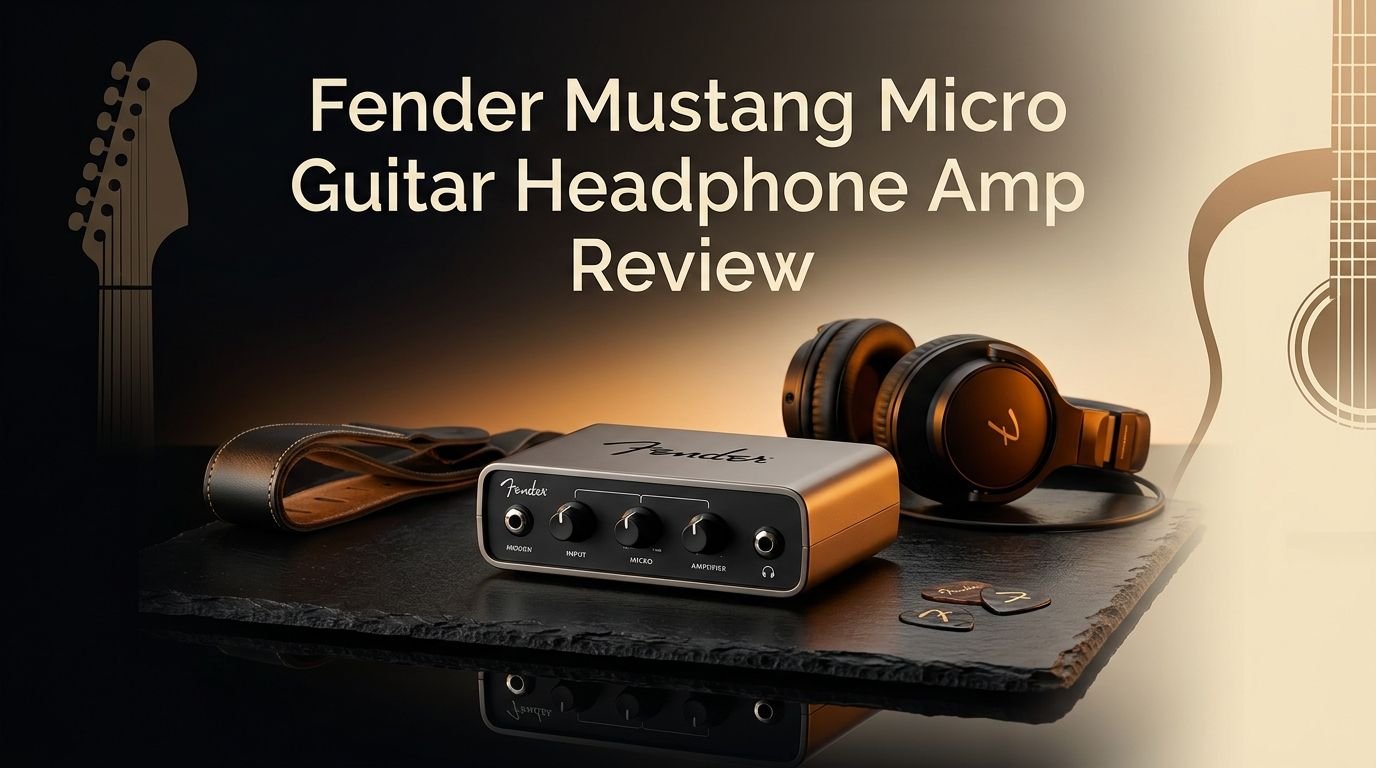
Fender Mustang Micro Guitar Headphone Amp Review 2026
Have you ever wished you could plug into a full amp rig and play electric guitar without waking up the entire house? The Fender Mustang Micro promises exactly that.
This pocket-sized headphone amplifier packs 12 amp models, 12 effect combinations, Bluetooth audio streaming, and USB recording into a unit that weighs just 1.8 ounces.
Fender introduced the Mustang Micro a few years ago. It quickly became one of the most popular silent practice tools on the market. Players loved the instant plug-and-play design and the wide variety of tones.
Key Takeaways:
- The Fender Mustang Micro plugs directly into your guitar’s output jack. It uses a rotating 1/4″ plug that fits most electric guitars and basses. You connect your wired headphones to the 1/8″ stereo output and start playing immediately.
- You get 12 amp models and 12 effect combinations. These range from clean Fender Tweed tones to modern high-gain distortion sounds. You can also adjust EQ and modify effect parameters using onboard buttons.
- Bluetooth 5.0 streaming lets you play along with music or lessons. The built-in Audio/Video sync feature keeps your playing and backing tracks perfectly aligned. This makes it a great practice companion.
- The rechargeable lithium-ion battery lasts about 4 hours on a full charge. Some users report getting closer to 5 or 6 hours depending on volume levels. You recharge it through the USB-C port.
- It doubles as a USB audio interface for recording. Connect it to your Mac or PC via USB-C and record your guitar tone directly into a DAW. This adds serious value for home recording enthusiasts.
- The current retail price sits around $109.99, making it one of the most affordable full-featured headphone amps from a major brand. It competes well with options from NUX, Boss, and Vox.

Fender Mustang Micro Guitar Headphone Amp: What Is It?
The Fender Mustang Micro is a personal headphone guitar amplifier with built-in digital signal processing (DSP). It plugs directly into your guitar’s 1/4″ output jack. You then connect any pair of wired headphones to the 1/8″ stereo output on the device.
The entire unit measures just 3.15 inches tall and 1.5 inches wide. It weighs only 1.8 ounces (51 grams). You can toss it in your pocket, gig bag, or guitar case without adding any noticeable weight.
Fender built this product around the same amp modeling engine found in the popular Mustang GTX series. This gives you access to 12 different amp voices and 12 effect combos. The tones cover everything from sparkly clean Fender sounds to thick, saturated high-gain tones.
The device also supports Bluetooth 5.0 for wireless audio streaming from your phone, tablet, or computer. You can play along with songs, backing tracks, or video lessons in real time. The USB-C port handles battery charging, firmware updates, and audio recording to a computer.
Design and Build Quality
The Mustang Micro has a sleek, compact design wrapped in a matte black finish. Fender kept the look minimal and professional. The body features the iconic Fender logo on one side.
All the controls sit on the top edge of the unit. You get dedicated buttons for amp selection, EQ adjustment, effect selection, and effect modification. A master volume wheel sits on the side. The button layout is intuitive and easy to learn.
The 270-degree rotating input plug is one of the best design features. It lets the Mustang Micro sit comfortably on almost any guitar body style. Whether you play a Stratocaster, Les Paul, Telecaster, or SG, the plug adjusts to keep the unit in a usable position.
Build quality feels solid for a product at this price point. The plastic housing is durable and lightweight enough to avoid putting stress on your guitar’s output jack. The buttons have a satisfying click. The volume wheel turns smoothly with good resistance.
Amp Models and Tone Quality
The Fender Mustang Micro provides 12 amp models pulled from the Mustang GTX amp collection. These models span a wide range of musical styles.
The clean tones sound rich and full. You get classic Fender sparkle from models based on the Deluxe Reverb and Twin Reverb. These are great for jazz, blues, funk, and country playing. The low-end response stays tight, and the highs shimmer without harshness.
The crunch tones deliver solid midrange bite. These models cover classic rock and blues-rock territory well. They respond nicely to your picking dynamics and guitar volume adjustments.
The high-gain models push into modern rock and metal territory. They provide thick distortion with reasonable note clarity. For a headphone amp, the gain tones are impressive. You can hear individual notes in chords without excessive mud or fizz.
There is also a “direct” mode that sends your dry guitar signal straight to the output. This is useful if you want to use external software plugins for your tone shaping.
One limitation is that you cannot tweak individual amp parameters like gain, treble, or bass for each model. The EQ adjustment applies globally. This keeps things simple but may frustrate players who want deep control.
Top 3 Alternatives for Fender Mustang Micro
1. NUX Mighty Plug Pro MP-3

2. Boss Waza-Air Wireless Guitar Headphones

3. Vox amPlug 3 AC30

Effects and Sound Shaping Options
The Mustang Micro gives you 12 effect combinations to pair with the amp models. These effects include reverbs, delays, modulation effects, and combination presets.
The reverb effects range from subtle room ambiance to lush hall reverbs. They add depth and dimension to your tone. The stereo imaging through headphones makes these reverbs sound especially immersive.
The delay effects include standard digital delay and rhythmic patterns. They sit well in the mix and do not overpower the dry guitar signal. You can adjust the delay parameters using the modify button.
Modulation effects cover chorus, flanger, and tremolo flavors. The chorus adds a nice shimmer to clean tones. The flanger gives you classic jet-plane sweep sounds. Tremolo pulsates smoothly across the stereo field.
The combination presets layer multiple effects together for ready-to-play sounds. These are perfect for players who want a complete tone without cycling through individual effects.
Each effect has a modify parameter that you can adjust with the onboard buttons. This typically controls the effect intensity or speed. It gives you enough control to fine-tune your sound without needing an app or external editor.
Bluetooth Audio Streaming
One of the most useful features of the Fender Mustang Micro is Bluetooth 5.0 audio streaming. This lets you wirelessly connect your smartphone, tablet, or computer to the device.
Once paired, you can stream music, backing tracks, or video lessons directly into your headphones alongside your guitar tone. This is a game-changer for practice sessions. You can jam along with your favorite songs without needing a separate speaker or mixer setup.
Fender built in an automatic Audio/Video sync feature. This compensates for Bluetooth latency and keeps the audio from your device aligned with what you see on screen. The result is a smooth experience when following along with YouTube lessons or instructional videos.
The Bluetooth connection is stable and pairs quickly after the initial setup. The range is solid enough for typical practice scenarios. You can leave your phone on a nearby table without dropouts.
One thing to note is that you cannot use wireless headphones with the Mustang Micro. The headphone output is a wired 1/8″ jack only. The Bluetooth function is strictly for streaming audio from external devices, not for connecting wireless headphones.
USB Audio Interface and Recording
The Fender Mustang Micro works as a USB audio interface through its USB-C connection. This adds significant value to the product beyond silent practice.
Connect the Mustang Micro to your Mac or PC with a USB-C cable. Your computer recognizes it as an audio input device. You can then record your processed guitar tone directly into any DAW (Digital Audio Workstation) like GarageBand, Logic Pro, Ableton Live, or Audacity.
The recording quality is clean and free of noise. The processed amp and effect tones transfer faithfully through USB. This makes the Mustang Micro a surprisingly capable tool for laying down demo tracks, scratch recordings, or even finished parts.
You can also record the Bluetooth audio stream along with your guitar signal. This is handy if you want to capture yourself playing along with a backing track in a single pass.
Fender provides a free Universal ASIO Audio Driver for Windows users. Mac users can typically use the device without additional driver installation. The setup process is straightforward and takes only a few minutes.
For bedroom producers and songwriters, this USB interface capability makes the Mustang Micro much more than a practice toy. It becomes a genuine recording tool.
Battery Life and Charging
The Fender Mustang Micro includes a rechargeable lithium-ion battery. Fender rates the battery life at approximately 4 hours of continuous play time.
In real-world use, many players report getting between 4 and 6 hours per charge. Battery life depends on your volume level, Bluetooth usage, and effect selection. Playing at moderate volume without Bluetooth tends to extend the battery life.
Charging happens through the USB-C port on the bottom of the device. A full charge takes roughly 2 to 3 hours. You can play the Mustang Micro while it charges from a USB power source, which is a nice convenience.
The LED indicators on the device show the current battery status. They change color as the battery drains, so you always know roughly how much playing time you have left.
Compared to competitors that rely on disposable AAA batteries, the rechargeable battery is a major advantage. You save money on batteries and reduce waste over time. The USB-C charging standard also means you likely already have compatible cables at home.
Compatibility with Guitars and Basses
The Fender Mustang Micro works with almost any electric guitar or bass that has a standard 1/4″ output jack. The 270-degree rotating plug adjusts to fit different jack positions on various guitar body styles.
Fender designed the plug to work with popular guitar shapes like Stratocasters, Telecasters, Les Pauls, SGs, and PRS guitars. It also fits most bass guitars. The rotating mechanism ensures the unit sits at a comfortable angle regardless of where the output jack is located on your instrument.
Some players with top-mounted jacks (common on certain Stratocaster styles) may find the unit hangs slightly away from the body. This is normal and does not affect performance or stability.
Semi-hollow and hollow-body guitars work fine with the Mustang Micro as well. The lightweight design puts minimal stress on the jack. You do not need to worry about the device pulling on or damaging your guitar’s output jack.
The device also works with electric-acoustic guitars that have a standard 1/4″ output. However, the amp models are voiced for electric guitar tones. Acoustic players may find the modeling less useful.
Who Should Buy the Fender Mustang Micro?
The Mustang Micro is an excellent choice for several types of guitar players. Its versatility and low price make it appealing to a broad audience.
Beginners benefit from the simple plug-and-play design. There is no app required and no complicated setup. You plug it in, put on headphones, and start playing. The Bluetooth streaming feature also pairs perfectly with online lessons from platforms like Fender Play or YouTube.
Apartment dwellers and late-night players love the silent practice capability. You get full amp tone through headphones without disturbing roommates, family members, or neighbors. The experience feels natural and responsive with no noticeable latency.
Traveling musicians appreciate the extreme portability. The Mustang Micro fits in a pocket. You can practice in hotel rooms, backstage areas, or anywhere you have your guitar and headphones.
Home recording enthusiasts gain a compact USB audio interface for quick recordings. The ability to capture processed tones directly into a DAW saves time and money compared to setting up microphones and a physical amp.
Intermediate and advanced players may find the tone options somewhat limiting over time. The fixed amp model parameters and lack of deep editing could feel restrictive. These players might prefer the Mustang Micro Plus or a more full-featured modeling solution.
Fender Mustang Micro vs. Mustang Micro Plus
Fender now offers the Mustang Micro Plus alongside the original Mustang Micro. The Plus model costs about $139.99 and adds several notable upgrades.
The biggest difference is the number of sounds. The Micro Plus includes 25 amp models and 25 effect models compared to the original’s 12 and 12. This gives you more variety for different musical styles and genres.
The Plus also features an integrated display screen. This screen shows the current preset name, amp model, and effect settings. The original Mustang Micro uses LED lights only, which makes it harder to know exactly which amp or effect you have selected.
Another key addition is 100 editable preset slots on the Plus model. You can save and recall your favorite tone combinations. The Plus also works with the Fender Tone app for deeper sound editing on your phone or tablet.
The Plus includes a built-in tuner accessed through the tap/tuner button. The original Mustang Micro does not have a tuner.
Both models share the same form factor, rotating plug design, Bluetooth streaming, and USB-C connectivity. If you want the simplest, most affordable option, the original Mustang Micro delivers great value. If you want more sounds, presets, and an app experience, the Plus is worth the extra $30.
Pros and Cons of the Fender Mustang Micro
Every product has strengths and weaknesses. Here is an honest look at what the Fender Mustang Micro does well and where it falls short.
The sound quality is excellent for a device this size and price. The Mustang GTX amp models sound convincing through quality headphones. Clean and crunch tones especially shine. High-gain tones are solid, though dedicated metal players may want something with more flexibility.
The portability is unmatched. At 1.8 ounces, you barely notice it in your pocket. The compact design takes up no space in a guitar case.
The USB recording feature adds value that many competitors at this price do not offer. The ability to record processed tones into a DAW is a genuine bonus.
The Bluetooth streaming works reliably and makes practice sessions more enjoyable. The Audio/Video sync is a thoughtful touch.
On the downside, the lack of deep amp parameter editing limits tone customization. You cannot adjust gain, treble, mid, or bass for individual amp models beyond the global EQ.
The wired-only headphone output may disappoint players who prefer wireless headphones. You must use earbuds or headphones with a 1/8″ cable.
The 4-hour battery life is adequate but not exceptional. Heavy users may need to recharge daily.
Sound Quality Through Different Headphones
The Fender Mustang Micro’s output quality depends heavily on your headphones. This is true for any headphone amplifier, but it is worth discussing here.
With studio-quality over-ear headphones like the Audio-Technica ATH-M50x or Sony MDR-7506, the Mustang Micro sounds fantastic. You hear the full frequency range with clear bass, defined mids, and smooth highs. The stereo effects come alive with wide imaging.
With budget earbuds, the tone quality drops noticeably. Cheap earbuds often lack bass response and have recessed midrange. The amp models sound thin and less inspiring through low-quality headphones.
In-ear monitors (IEMs) provide a good middle ground. Quality IEMs deliver clear sound in a compact package. They are also comfortable for long practice sessions.
Fender rates the headphone output at 30mW with a recommended headphone impedance range. Most consumer headphones and earbuds fall within this range. You should have no trouble driving your headphones to a comfortable volume level.
The takeaway is simple. Invest in decent headphones to get the most from your Mustang Micro. A $30 to $50 pair of quality headphones will dramatically improve your experience compared to the cheap earbuds that came with your phone.
Is the Fender Mustang Micro Worth Buying in 2026?
The Fender Mustang Micro remains a strong buy in 2026. Its combination of quality amp tones, built-in effects, Bluetooth streaming, and USB recording makes it one of the best values in the headphone amp category.
At $109.99, it is priced competitively against alternatives from NUX, Vox, and others. The Fender brand name and the Mustang GTX tone engine give it an edge in sound quality and trustworthiness.
If you need a no-fuss, plug-and-play practice solution, the Mustang Micro delivers. It sounds great, charges easily, and fits anywhere. The USB interface adds recording capability that many competitors lack.
Players who want more features should look at the Mustang Micro Plus for $30 more. The added display, app support, tuner, and expanded tone library make the Plus a better long-term investment.
The original Mustang Micro is best for players who value simplicity and affordability above all else. It does what it promises and does it well. For silent practice, travel playing, and quick recording, it is hard to beat at this price.
Final Verdict
The Fender Mustang Micro earns a solid recommendation as a headphone guitar amplifier in 2026. It delivers impressive tone quality, practical features, and genuine portability in an incredibly small package.
The 12 amp models cover enough ground for most practice scenarios. The effects sound good through quality headphones. Bluetooth streaming and USB recording elevate this device beyond a simple practice tool.
It is not perfect. The lack of deep editing, wired-only headphone output, and modest battery life are real limitations. But at $109.99, these trade-offs are reasonable.
Whether you are a beginner looking for your first practice solution or an experienced player who needs a silent option for late-night sessions, the Fender Mustang Micro is a smart purchase. It has earned its place as one of the best-selling headphone amps for good reason.
Frequently Asked Questions
Can the Fender Mustang Micro work with bass guitars?
Yes, the Fender Mustang Micro works with bass guitars. The rotating 1/4″ plug fits standard bass output jacks. However, the amp models are primarily voiced for electric guitar. Bass players may find the low-end response less optimized compared to bass-specific headphone amps.
Does the Fender Mustang Micro require a phone app to use?
No, the Fender Mustang Micro does not require any app. All controls are on the device itself. You adjust amp models, effects, EQ, and volume using the physical buttons. The Bluetooth feature is optional for audio streaming only.
Can I use wireless Bluetooth headphones with the Mustang Micro?
No, you cannot use wireless headphones with the Mustang Micro. The headphone output is a wired 1/8″ stereo jack only. The Bluetooth functionality is limited to streaming audio from external devices like phones and tablets.
How do I update the firmware on the Fender Mustang Micro?
You update the firmware by connecting the Mustang Micro to your computer via the USB-C cable. Visit the Fender support website to download the latest firmware file. Follow the instructions provided with the download to complete the update process.
Is the Fender Mustang Micro loud enough for practice?
Yes, the Mustang Micro provides plenty of volume for headphone practice. The 30mW output drives most standard headphones and earbuds to comfortable listening levels. You can adjust the master volume wheel to find your preferred level.
What is the difference between the Fender Mustang Micro and the Mustang Micro Plus?
The Mustang Micro Plus costs about $30 more and includes 25 amp models, 25 effects, an integrated display, 100 editable presets, a built-in tuner, and Fender Tone app support. The original Mustang Micro has 12 amp models, 12 effects, and no screen or app connectivity.