Garmin Fenix 7S Pro Sapphire Solar Review 2026
You want a GPS smartwatch that can handle trail runs, open water swims, and backcountry hikes without adding bulk to your wrist. You also want a screen that won’t crack on rock faces and a battery that lasts for weeks.
The Garmin Fenix 7S Pro Sapphire Solar promises all of this in a compact 42mm case. But with the Fenix 8 and newer competitors on the market, does this watch still deserve your money in 2026?
I put this watch through months of real world use. I tested it across trail running, cycling, gym sessions, and multi day backpacking trips. This review covers every angle.
Key Takeaways:
- The 42mm case size is ideal for smaller wrists and people who want full Fenix features without the weight. It weighs just 2.6 ounces and sits comfortably during long runs and sleep tracking.
- Sapphire crystal lens provides excellent scratch resistance. After months of heavy use, the display showed zero visible scratches. This makes it a strong choice for outdoor activities with rough terrain.
- Battery life reaches up to 11 days in smartwatch mode and up to 14 days with regular solar exposure. GPS mode lasts up to 37 hours, or 46 hours with solar charging. These numbers hold up well even in 2026.
- Multi band GPS delivers accurate tracking for trail running, hiking, and cycling. The multi frequency satellite connection reduces signal bounce in dense forests and urban canyons.
- The built in LED flashlight is more useful than expected. It offers a steady beam and a red safety strobe. Early morning runners and late night hikers will use this feature daily.
- Training readiness and HRV status features give actionable fitness data. The watch analyzes your sleep, recovery, and training load to suggest whether you should push hard or rest. This feature alone can improve your training consistency.

Garmin Fenix 7S Pro Sapphire Solar: Design and Build Quality
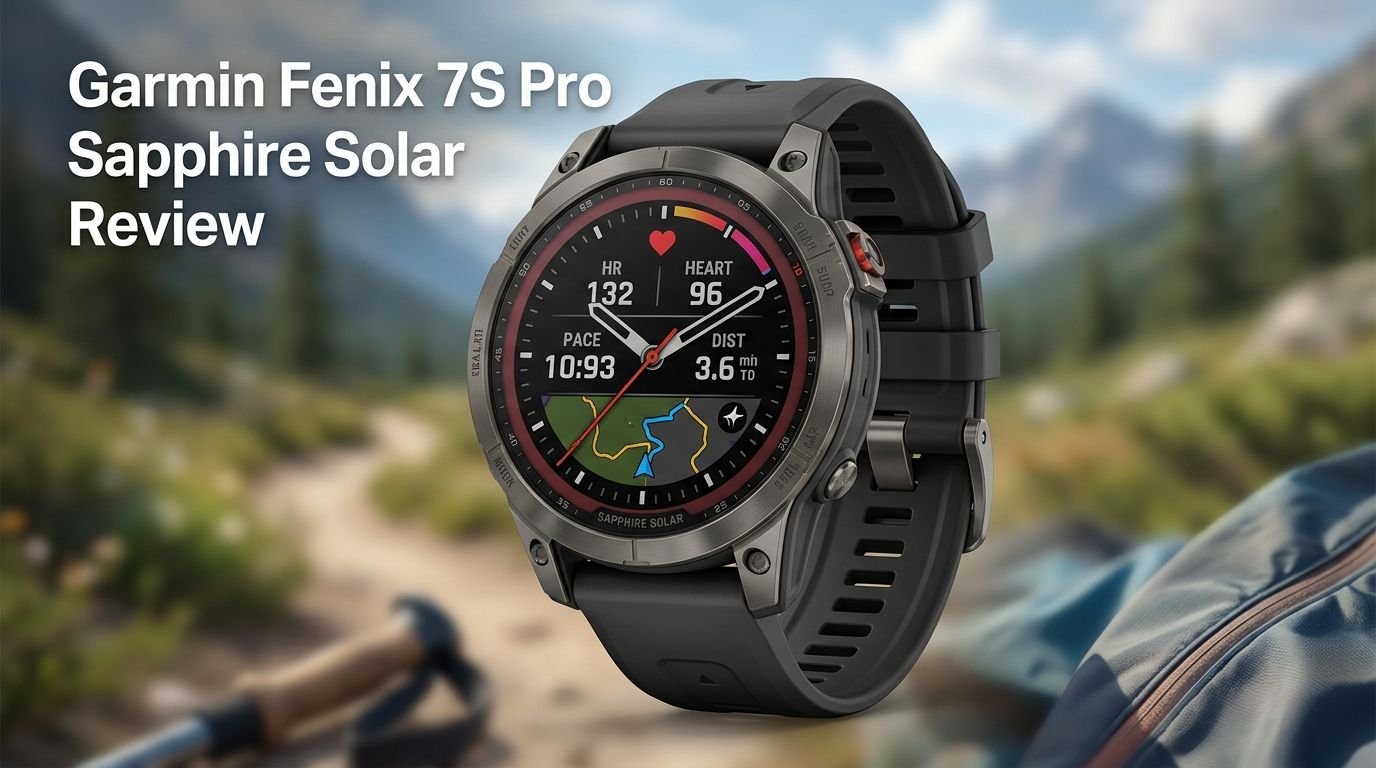
The Garmin Fenix 7S Pro Sapphire Solar uses a fiber reinforced polymer case with a titanium bezel and rear cover. This combination keeps the watch light at just 58 grams while maintaining serious durability. The 42mm diameter fits wrists between 5.5 and 7 inches comfortably.
The sapphire crystal lens sits on top of the 1.2 inch MIP (memory in pixel) display. Sapphire rates a 9 on the Mohs hardness scale. This means everyday bumps against rocks, doorframes, and gym equipment will not scratch the screen. The Power Sapphire lens also integrates the solar charging cells directly into the glass.
The physical buttons feel crisp and responsive. You get five side buttons that work in any condition, including wet hands, muddy gloves, or extreme cold. The touchscreen adds convenience for scrolling through widgets and maps. You can disable the touchscreen during activities to avoid accidental input.
The watch passes MIL STD 810 testing for thermal shock, humidity, and vibration. It also carries a 10 ATM water resistance rating, which means it handles swimming, snorkeling, and water sports without issues.
The overall fit and finish matches watches twice its price. The silicone band is soft enough for all day wear and dries quickly after a swim. Garmin also sells titanium and leather band options for a more polished look.
Display and Visibility in Different Conditions
The 1.2 inch MIP transflective display measures 240 x 240 pixels. This is not an AMOLED screen. The colors are more muted, and you won’t get deep blacks or vibrant hues. However, this screen type has a major advantage: it performs brilliantly in direct sunlight.
The brighter the sun, the easier the screen is to read. Runners and cyclists will appreciate this during midday outdoor sessions. There is no need to cup your hand over the display or crank up the backlight.
For indoor and low light conditions, the watch uses an LED backlight. You can set it to activate on wrist turn or button press. The backlight is strong enough for quick glances in dark rooms but does not match the clarity of an AMOLED panel in dim settings.
The always on display shows time, date, and key metrics without any button press. This feature uses minimal battery. You can customize watch faces through the Garmin Connect IQ store, which offers thousands of free and paid options.
Font sizes on the data screens are large and legible during activities. Garmin allows you to configure up to six data fields per screen during workouts. The layout stays clean even with multiple metrics visible at once.
Battery Life and Solar Charging Performance
Battery life is one of the biggest strengths of this watch. In smartwatch mode, the Fenix 7S Pro Sapphire Solar lasts up to 11 days without solar and 14 days with regular solar exposure. Solar charging assumes about 3 hours of 50,000 lux sunlight per day, which is typical for outdoor activities.
In GPS only mode, you get up to 37 hours without solar. Add solar charging, and that extends to roughly 46 hours. For multi band GPS mode, expect around 20 hours, or 26 hours with solar input.
I tested the battery during a 4 day backpacking trip. The watch tracked 6 to 8 hours of hiking per day with multi band GPS active. It finished the trip with 31% battery remaining. That is impressive for a 42mm watch.
The solar charging widget on the watch shows real time solar input and cumulative charging data. It helps you understand how much extra battery you gain from sun exposure. On a sunny summer day, I observed gains of about 10 to 15% additional battery compared to indoor only use.
Charging from zero to full takes about 90 minutes using the included Garmin proprietary cable. The cable snaps magnetically to the back of the watch. It is a secure connection that won’t disconnect accidentally.
Multi Band GPS and Navigation Accuracy
Every Fenix 7 Pro model includes multi band GNSS support. This means the watch connects to multiple satellite constellations, including GPS, GLONASS, Galileo, and BeiDou, on multiple frequencies. The result is significantly better positioning accuracy in challenging environments.
I tested GPS accuracy in dense forest trails, deep canyons, and urban areas with tall buildings. The multi band mode reduced track drift and produced cleaner, more accurate route lines compared to standard GPS mode. Trail runs that previously showed the track jumping across a river now stayed precisely on the path.
The watch includes preloaded topographic maps with 32GB of onboard storage. You can view terrain contours, trails, roads, and points of interest directly on the watch screen. The turn by turn navigation feature works well for following saved routes or imported GPX files.
Breadcrumb navigation lets you retrace your steps if you get lost. The back to start feature calculates the shortest route back to your starting point. These features are genuinely useful for backcountry exploration.
The ClimbPro feature shows upcoming climbs during activities. It displays the gradient, distance remaining, and elevation gain for each climb segment. Hikers and trail runners will find this feature extremely valuable on unfamiliar routes.
Top 3 Alternatives for Garmin Fenix 7S Pro Sapphire Solar
If the Fenix 7S Pro Sapphire Solar does not match your needs or budget, these three watches offer strong competition.
Garmin Epix Pro (Gen 2) 42mm Sapphire Edition

This watch shares the same 42mm case size and feature set as the Fenix 7S Pro. The key difference is its stunning AMOLED display. You trade solar charging for a brighter, more colorful screen.
COROS Vertix 2S

The COROS Vertix 2S offers 40 days of battery life, offline maps, and dual frequency GPS. It costs less than the Fenix 7S Pro Sapphire Solar and delivers excellent GPS accuracy. The training features are slightly less deep than Garmin’s ecosystem.
Suunto Vertical Titanium Solar

Suunto’s flagship offers solar charging, free offline maps, and a large display. It pairs well with third party apps and supports dual band GPS. The titanium build keeps it lightweight and durable for extended outdoor use.
Health and Wellness Monitoring Features
The Garmin Fenix 7S Pro Sapphire Solar packs a fourth generation Garmin Elevate optical heart rate sensor. This sensor tracks your heart rate 24 hours a day. It also supports wrist based Pulse Ox (SpO2) monitoring, which measures blood oxygen saturation levels.
HRV status is a standout health feature. The watch measures your heart rate variability during sleep and presents a 7 day rolling average. This data shows your overall stress and recovery trends. A balanced or improving HRV indicates good recovery. A declining HRV suggests your body needs rest.
The Body Battery energy monitor assigns a score from 0 to 100. It combines heart rate variability, stress, sleep quality, and activity data to estimate your energy reserves throughout the day. I found this feature surprisingly accurate. On mornings after poor sleep, the Body Battery score reflected my fatigue consistently.
Sleep tracking records light, deep, and REM sleep stages. The watch also provides a sleep score and sleep quality insights through the Garmin Connect app. The morning report feature delivers a summary of your sleep, HRV, training readiness, and weather forecast when you wake up.
Stress tracking runs continuously during the day. A dedicated widget shows your current stress level and historical trends. You can use the built in breathwork activity to lower stress levels with guided breathing exercises.
Training and Fitness Tracking Capabilities
This watch supports over 30 built in activity profiles. These include running, cycling, swimming, hiking, skiing, strength training, yoga, climbing, golf, and more. Each activity profile provides specific data fields and metrics relevant to that sport.
Training readiness is one of the most valuable features. It analyzes your sleep, recovery time, HRV status, acute training load, and stress to produce a daily readiness score. A high score means your body is prepared for hard training. A low score suggests an easy day or rest day.
The race predictor estimates your finish times for 5K, 10K, half marathon, and marathon distances. It uses your VO2 max estimate, training history, and recent performance data. These predictions become more accurate over time as the watch collects more data.
PacePro offers advanced pacing strategies for races. You can create a pacing plan based on a course’s elevation profile. The watch then guides you through each segment with real time pace targets.
Real time stamina tracking shows your current energy level during an activity. It displays both your potential stamina (maximum effort capacity) and actual stamina (current energy based on your pace). This helps you avoid going out too fast in a race.
Hill score and endurance score are training metrics that track your performance trends over time. Hill score measures your ability on steep terrain. Endurance score evaluates your performance during long efforts.
Built In LED Flashlight: A Practical Advantage
The integrated LED flashlight sits at the 12 o’clock position on the watch case. It sounds like a gimmick, but it is one of the most used features in daily life. The flashlight offers multiple modes: steady white light, pulsing white light, and a red safety strobe.
The steady white beam provides enough light to see a trail in pitch darkness for several meters ahead. It won’t replace a headlamp on technical terrain, but it covers those moments when you need quick illumination. Finding a keyhole, checking a trail marker, or reading a map at camp becomes effortless.
The red strobe mode is a genuine safety feature. Runners who train on roads before sunrise or after sunset can activate the red strobe to increase visibility to drivers. The flashing red light is bright enough to be seen from a distance.
You can set the flashlight to activate automatically during certain events. For example, the flashlight pulses at cadence during a nighttime run to signal your presence to others. You can also program it to turn on at sunset and off at sunrise.
Battery drain from flashlight use is moderate. Using the steady white light for 10 minutes drains roughly 1% of battery. This is acceptable for occasional use. Daily extended use will affect overall battery life.
Garmin Connect App and Ecosystem
The Garmin Connect app is where all your data lives. It syncs automatically with the watch via Bluetooth and provides detailed analysis of every activity, health metric, and trend. The app is available on iOS and Android.
The app dashboard shows a daily summary of steps, calories, stress, Body Battery, sleep, and active minutes. You can drill down into each metric for historical charts and trend analysis. The training status feature in the app tells you if you are productive, peaking, maintaining, or overreaching.
Garmin Connect IQ is the app store for the watch. You can download custom watch faces, data fields, widgets, and full apps. Popular additions include weather apps, custom workout creators, and navigation tools.
The watch supports music storage and streaming. You can load up to 2,000 songs or sync playlists from Spotify, Amazon Music, or Deezer. Pair Bluetooth headphones with the watch and leave your phone at home during runs.
Garmin Pay offers contactless payments through supported banks. Tap your watch at payment terminals for quick purchases during a run or commute. The NFC chip works reliably with most contactless readers.
Swimming and Water Sports Performance
The Fenix 7S Pro Sapphire Solar handles swimming with confidence. It tracks pool swimming and open water swimming as separate activities. Pool swim mode detects your stroke type, lap count, distance, pace, and SWOLF score automatically.
Open water swimming uses GPS to track your route and distance. The watch records stroke count, stroke rate, and distance per stroke. After the swim, you can view your route on the map in the Garmin Connect app.
The watch also supports surfing activity tracking with data on wave count and distance. Stand up paddleboarding, kayaking, and rowing profiles are included as well. Each profile provides relevant data fields for that specific water sport.
With 10 ATM water resistance, the watch handles depths of up to 100 meters. Showering, swimming, and snorkeling present no risk. The buttons work underwater, though the touchscreen is disabled during swim activities to prevent water interference.
The quick dry silicone band sheds water within minutes after a swim. There is no uncomfortable moisture trapped under the watch during the transition to a run in a triathlon.
Music, Payments, and Smart Features
Beyond fitness, the Fenix 7S Pro Sapphire Solar works as a capable smartwatch. Smart notifications from your phone appear on the watch screen. You can read texts, emails, and app alerts. You can reply to messages on Android with preset responses.
Calendar and weather widgets keep you informed at a glance. The weather widget shows current conditions, hourly forecasts, and multi day outlooks. It pulls data from your connected phone or from a Wi Fi connection.
The watch supports Wi Fi connectivity for syncing activities, downloading maps, and updating software without relying on your phone. This is convenient for large data transfers like map updates or music downloads.
Safety and tracking features include incident detection, which can alert emergency contacts if the watch detects an accident during an activity. LiveTrack lets friends and family follow your activity in real time on a map. The assistance feature sends a manual SOS alert with your GPS coordinates.
You also get a find my phone feature that triggers your phone to ring. The reverse works too. Use the Garmin Connect app to make your watch vibrate and beep when it goes missing in your house.
Who Should Buy the Garmin Fenix 7S Pro Sapphire Solar in 2026?
This watch is perfect for a specific type of user. If you want the full Garmin Fenix feature set in a smaller size, this is the best option available. People with wrists under 7 inches will appreciate the comfortable 42mm case.
Trail runners, hikers, and backpackers benefit the most from multi band GPS, topographic maps, ClimbPro, and solar charging. The long battery life means you can track multi day adventures without carrying a charger.
Triathletes get seamless transitions between swim, bike, and run activities. The multisport activity profile handles brick workouts and race day transitions automatically.
If you train outdoors frequently and value screen readability in sunlight, the MIP display is better than AMOLED for this purpose. The solar charging also rewards outdoor athletes with bonus battery life.
However, if you prefer a vibrant AMOLED display and spend most of your time indoors, the Garmin Epix Pro Gen 2 may suit you better. If budget matters, the COROS Vertix 2S delivers similar features at a lower price.
The Fenix 7S Pro Sapphire Solar remains a strong purchase in 2026 for outdoor athletes who need a small, tough, feature rich GPS watch with outstanding battery life.
Pros and Cons of the Garmin Fenix 7S Pro Sapphire Solar
What this watch does well:
The sapphire crystal provides true peace of mind for daily wear and outdoor abuse. The multi band GPS accuracy is excellent across all terrain types. Battery life is among the best in the 42mm category. The LED flashlight adds daily utility. The training and health features are deep, accurate, and actionable. The 32GB storage holds maps, music, and apps without compromise.
Where this watch falls short:
The MIP display looks dated compared to AMOLED screens on the Epix Pro and Apple Watch Ultra. The $899.99 price tag is high, especially with newer models available. The Garmin Connect IQ store has some low quality third party apps. Touchscreen responsiveness can feel sluggish compared to phone grade screens. The charging cable is proprietary, so you need to carry a Garmin specific cable on trips.
The watch also lacks a built in speaker and microphone. You cannot take calls from the watch. LTE connectivity is absent, so the watch depends on your phone for notifications and connected features.
Final Verdict: Is the Garmin Fenix 7S Pro Sapphire Solar Worth It in 2026?
The Garmin Fenix 7S Pro Sapphire Solar is a mature, proven, and capable multisport watch. It does not carry the newest technology on the market, but it delivers reliable performance across every feature. The sapphire lens, solar charging, multi band GPS, LED flashlight, and deep training metrics form a complete package.
For outdoor athletes with smaller wrists, this watch has no equal at its size. The 42mm case delivers every feature found in the larger 47mm and 51mm Fenix models. You lose nothing except screen size and battery capacity.
The price has dropped since launch. You can find this watch for $650 to $750 at many retailers in 2026. At that price, it offers strong value compared to the $900 plus Fenix 8. If you don’t need the AMOLED display or the latest sensor updates, the Fenix 7S Pro Sapphire Solar is a smart buy.
I recommend this watch for trail runners, hikers, backpackers, triathletes, and anyone who spends significant time training outdoors. It will serve you well for years.
Frequently Asked Questions
Is the Garmin Fenix 7S Pro Sapphire Solar good for small wrists?
Yes. The 42mm case and 20mm band width fit wrists as small as 5.5 inches comfortably. The watch weighs only 58 grams, so it does not feel heavy during long activities or sleep. Many users with wrists between 5.5 and 6.5 inches report an excellent fit.
How much battery life does the solar charging actually add?
Solar charging adds roughly 3 extra days in smartwatch mode with typical outdoor use (about 3 hours of direct sunlight per day at 50,000 lux). In GPS mode, solar adds about 9 extra hours. The benefit is greatest for people who spend several hours outdoors daily.
Can this watch play music without a phone?
Yes. The watch stores up to 2,000 songs or about 32GB of audio. You can sync offline playlists from Spotify, Amazon Music, and Deezer. Pair Bluetooth earbuds directly to the watch and leave your phone behind.
Does the Garmin Fenix 7S Pro Sapphire Solar have an AMOLED display?
No. It uses a MIP (memory in pixel) transflective display. This screen excels in bright sunlight but looks less vibrant than AMOLED in indoor or low light settings. If you want AMOLED, look at the Garmin Epix Pro Gen 2.
Is this watch still worth buying in 2026 with the Fenix 8 available?
Yes, especially at current discounted prices. The Fenix 7S Pro Sapphire Solar has received ongoing software updates that keep its features current. The core hardware, including multi band GPS, sapphire lens, and solar charging, remains highly competitive. The Fenix 8 adds improvements, but the price premium may not justify the upgrade for most users.
Does the watch support contactless payments?
Yes. Garmin Pay supports contactless NFC payments. You can add compatible credit and debit cards through the Garmin Connect app. Check Garmin’s website for a list of supported banks in your region.