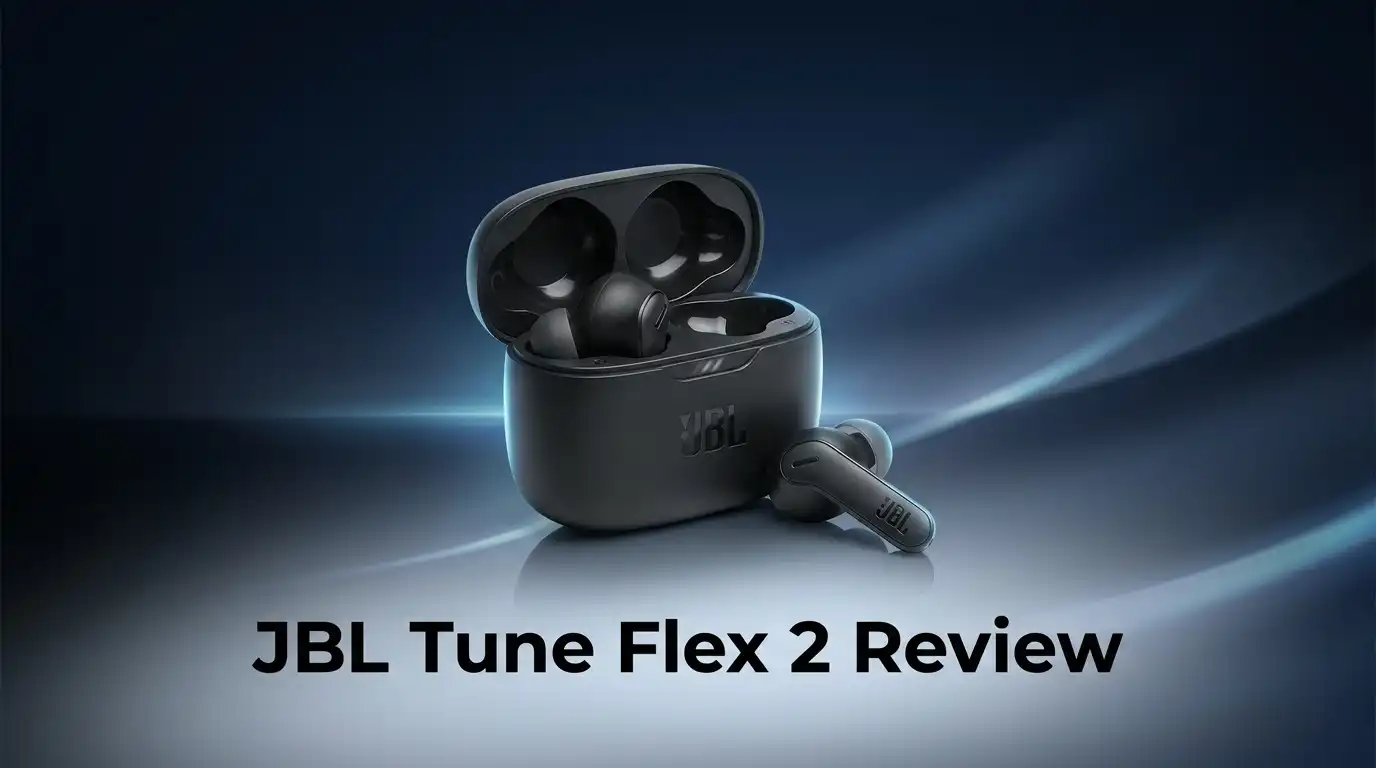
JBL Tune Flex 2 Review 2026: Worth Buying?
The JBL Tune Flex 2 sits in a crowded price bracket, yet it keeps showing up in best seller lists. It promises adaptive noise cancelling, spatial sound, six microphones and up to 48 hours of playback for under a hundred dollars. That combination sounds almost too generous for the money.
I spent weeks with these earbuds on trains, at a desk, during workouts and on long calls. Some features impressed me right away.
Others fell short of the marketing copy. This review covers both sides honestly, so you know exactly what you get before you spend.
In a Nutshell:
- Battery life is the strongest feature. You get 8 hours per bud with ANC on and 24 more in the case. Turn ANC off and that stretches to 12 hours plus 36 hours, for 48 hours total. Very few earbuds near this price match that number.
- The dual tip design is genuinely clever. JBL includes open ear tips and three sizes of sealing tips. You choose isolation or awareness. That flexibility gives the Tune Flex 2 its name and its main advantage.
- Sound leans warm and bass heavy out of the box. The 12mm drivers push low end hard. The JBL Headphones app fixes this with a full equalizer and Personi Fi 3.0, which builds a hearing profile that suits your ears.
- Noise cancelling is decent, not class leading. It flattens engine hum and office chatter. It struggles with sharp voices and clattering keyboards. Buyers expecting Sony or Bose silence will feel let down.
- Call quality is solid but not flawless. Six microphones and echo suppression keep your voice clear indoors. Heavy wind still creeps into recordings.
- Value depends on the price you pay. At the $109.95 list price the buds feel average. At the frequent $59 to $70 sale price they become one of the smartest budget picks of 2026.
JBL Tune Flex 2 Overview


Last update on 2026-10-07 / Affiliate links / Images from Amazon Product Advertising API Some of the links on this website are affiliate links, which means that at no additional cost to you, I earn a commission if you click through and make a purchase. I only recommend products and services that I believe will add value to my readers. Thank you for your support!
The Tune Flex 2 replaced the original Tune Flex in 2025 and carried into 2026 as JBL’s flexible fit budget model. The stem design stays. The internals changed in meaningful ways.
JBL fitted 12mm dynamic drivers, up from the 12mm units in the previous generation but with retuned acoustics. Sensitivity sits at 98dB and impedance at 13 ohms. Frequency response covers 20Hz to 20kHz.
Bluetooth 5.3 handles the connection. You get multipoint pairing, Fast Pair by Google and touch controls on both buds. The IP54 rating protects the earbuds from dust and light rain, though the case has no rating at all.
The headline upgrade is battery. The original Tune Flex managed 8 hours with ANC off. The Tune Flex 2 delivers 12 hours in the same mode. That is a 50 percent jump in one generation.
JBL also added Spatial Sound, which upmixes stereo into a wider soundstage for movies and games. It is not head tracked spatial audio like Apple offers. It is a virtual widening effect you toggle in the app.
Total weight comes in at 41.7g for the whole kit. Each earbud weighs 4.4g and the case weighs 32.9g. These numbers matter because they explain why the buds disappear in your ears after a few minutes.
Unboxing the JBL Tune Flex 2
The box is small, recyclable cardboard with an orange and black JBL print. No plastic clamshell, no wasted space. Sliding the inner tray out takes one pull.
The charging case greets you first, seated in a moulded pulp insert. It feels lighter than expected, almost hollow, though the lid snaps shut with a satisfying magnetic click.
Underneath sits a short USB C charging cable, roughly 20cm long. It works for topping up at a desk. It is too short to reach a wall socket comfortably.
The ear tips live in a paper folder. You get three sizes of sealing tips plus one pair of open tips already attached to the buds. That folder is easy to miss, so check before you recycle the packaging.
Paperwork includes a quick start guide, a safety sheet and warranty details. Nothing else. No carry pouch, no wireless charging pad, no extra cable.
First impressions were positive. The buds sit flush in the case, the pairing light blinks the moment you open the lid, and my phone found them in under five seconds through Fast Pair.
The plastic finish deserves a mention. It looks glossy in photos but feels matte and slightly grippy in hand. Fingerprints show up on the case within a day, which is my only cosmetic complaint from the unboxing.
Design, Fit and Comfort
The stem shape borrows heavily from the original Tune Flex. Short stems, angled nozzles and a rounded body that tucks into the outer ear.
Comfort is excellent for long sessions. I wore these for a four hour flight without pressure pain. The 4.4g weight per bud helps enormously here.
The dual tip system is the real story. Open tips rest against your ear canal without sealing it, so you hear traffic, announcements and colleagues. Sealing tips block the outside and boost the bass.
Switching tips changes the entire character of these earbuds. With open tips they feel like casual runabout buds. With sealing tips they turn into proper commuter earbuds.
Fit security is good but not perfect. During sprint intervals the left bud loosened twice. Runners with smaller ears should use the smallest sealing tip and check fit in the app.
The IP54 rating handles sweat and drizzle. It does not handle immersion. Do not swim in them and do not rinse them under a tap.
Touch panels sit on the flat outer surface of each stem. They are easy to find by feel, which matters when you cannot see what you are pressing.
One design gripe stands out. The case lid opens with a light spring, so it pops open in a pocket occasionally. A firmer magnet would have solved that.
Top 3 Alternative for JBL Tune Flex 2

Last update on 2026-10-07 / Affiliate links / Images from Amazon Product Advertising API Some of the links on this website are affiliate links, which means that at no additional cost to you, I earn a commission if you click through and make a purchase. I only recommend products and services that I believe will add value to my readers. Thank you for your support!
JBL Tune Buds 2

Last update on 2026-10-07 / Affiliate links / Images from Amazon Product Advertising API Some of the links on this website are affiliate links, which means that at no additional cost to you, I earn a commission if you click through and make a purchase. I only recommend products and services that I believe will add value to my readers. Thank you for your support!
Soundcore by Anker Liberty 4 NC

Last update on 2026-10-07 / Affiliate links / Images from Amazon Product Advertising API Some of the links on this website are affiliate links, which means that at no additional cost to you, I earn a commission if you click through and make a purchase. I only recommend products and services that I believe will add value to my readers. Thank you for your support!
JBL Tune Flex
Sound Quality Tested Across Genres
The Tune Flex 2 arrives tuned for JBL Pure Bass Sound. That means a strong low end lift and a slightly recessed upper midrange.
Hip hop and electronic music benefit most. Kick drums land with real weight and sub bass extends lower than the price suggests.
Rock and acoustic tracks show the weakness. Guitars sound a little thin against that heavy bass. Vocals sit behind the mix rather than in front of it.
Podcasts and audiobooks are fine with open tips, which naturally trim bass and lift clarity. Speech sounds cleaner in that configuration than with sealing tips.
The equalizer in the JBL Headphones app rescues the tuning. Dropping the 60Hz and 120Hz bands by roughly three decibels and lifting 2kHz slightly produces a much more balanced signature.
Detail retrieval is average. Cymbals lose texture in busy passages and layered orchestral music turns mushy. This is normal at this price and not a flaw unique to JBL.
Spatial Sound widens the stage for films. It works well on movie dialogue and ambient effects. On music it thins the bass and adds a hollow echo, so I left it off for listening.
Maximum volume is generous. I never went past 70 percent indoors. There is no hiss at low volume, which some budget earbuds suffer from.
Codec support covers SBC and AAC only. There is no aptX and no LDAC. Android users who care about high resolution streaming will notice this omission.
Adaptive Noise Cancelling Performance
JBL calls this Adaptive Noise Cancelling, and it adjusts strength based on your surroundings and ear fit.
Low frequency noise is where it works best. Bus engines, train rumble, aircraft cabin drone and air conditioning all drop noticeably.
Midrange and high frequency noise survive. Office chatter, keyboard clicks and cafe clatter still reach you at reduced volume. You hear them, just quieter.
Compared with premium earbuds this is a clear step down. Compared with other earbuds around $70 it holds its own comfortably.
Sealing tips do most of the heavy lifting. Fit matters more than the electronics here, so run the fit test in the app before you judge the ANC.
With open tips, ANC becomes almost pointless. Physics wins. Without a seal there is nothing for the algorithm to work against.
Smart Ambient mode is very good. Ambient Aware pipes in outside sound naturally, and TalkThru drops music volume so you can hold a short conversation.
I noticed mild cabin pressure with ANC at maximum during the first minutes. It faded quickly and never became uncomfortable.
There is no wind detection mode. Cycling with ANC on produced turbulence noise that made the feature unusable outdoors on breezy days.
Call Quality With Six Microphones
Each earbud carries two beamforming outer microphones and one inner microphone. That is six total across the pair.
Indoor calls sounded clear to every person I spoke with. My voice came through natural, with no robotic compression.
Outdoor calls were mixed. Traffic noise stayed mostly suppressed, but strong wind punched through the algorithm and clipped the start of sentences.
Voice Aware is a genuinely useful feature. It lets you control how much of your own voice you hear during calls, which stops you shouting without realising it.
Video calls on Zoom and Google Meet worked without lip sync issues. Latency stayed low enough that I never noticed a delay.
The maximum talk time is rated at 5 hours. In practice I got just over four and a half hours before the low battery warning.
Call controls work reliably. One tap answers, two taps rejects. I had no accidental hangups during testing.
Compared with the AirPods 4, call clarity is a step behind in noisy places. Compared with earbuds at the same price, it is above average.
Battery Life and Charging
Battery is the strongest argument for buying these earbuds in 2026.
With ANC on you get 8 hours per charge and three extra charges in the case for 32 hours total.
With ANC off that rises to 12 hours per charge and 36 hours in the case, giving the advertised 48 hour figure.
My real world numbers came close. At 60 percent volume with ANC on I averaged 7 hours 40 minutes. That is honest performance for a claimed 8 hours.
A full charge from empty takes about 2 hours through USB C. Speed charge gives you roughly 2 hours of playback from a 10 minute top up.
There is no wireless charging on this model. At this price that omission is fair, but worth knowing if your desk runs on a charging pad.
The case shows battery status through small LEDs rather than a digital display. The app gives you exact percentages for both buds and the case.
Standby drain was minimal. After leaving the case untouched for a week it lost around 4 percent.
For most people this means charging the case once every week or two. That is the kind of battery behaviour that makes earbuds easy to live with.
JBL Headphones App and Personi Fi 3.0
The free JBL Headphones app is where these earbuds gain most of their value.
You get a 10 band equalizer, preset profiles, ANC level control, gesture customization and a find my buds function.
Personi Fi 3.0 is the standout tool. It plays a series of test tones and builds a personal hearing curve, then applies it to your music.
The result was subtle but real. Upper midrange detail improved for me and the bass felt tighter without losing power.
The fit test checks your seal in seconds and tells you if a different tip size would help. Run it before you form an opinion on ANC.
Gesture customization lets you assign single, double and triple taps plus a long press per earbud. Volume control is available if you sacrifice another function.
The app is not perfect. It occasionally fails to connect on first launch and requires you to reopen it. Firmware updates also take longer than they should.
Account creation is optional, which I appreciate. You can use every feature without signing up.
Android and iOS both get full functionality. iPhone users lose nothing here, which is not true of every competing brand.
Connectivity, Controls and Daily Use
Bluetooth 5.3 kept a steady connection across a typical apartment. I walked about 12 metres through two walls before stuttering began.
Multipoint pairing works well. I kept a laptop and a phone connected at once, and calls interrupted music without manual switching.
Fast Pair by Google makes Android setup a one tap process. iPhone setup uses the standard pairing menu and takes about 20 seconds.
Touch controls are responsive but sensitive. Adjusting the buds in my ear triggered playback pauses several times during the first week.
You can disable specific gestures in the app to reduce accidental taps. I turned off single tap and the problem largely disappeared.
Wear detection is included. Removing one bud pauses music and replacing it resumes playback, usually within a second.
Latency in video playback was low enough for YouTube and Netflix. Competitive mobile gaming still showed a slight lag.
There is no low latency gaming mode, which some rivals now include at this price.
What the JBL Tune Flex 2 Does Not Do Well
Honest reviews cover the misses, so here are mine after weeks of use.
Noise cancelling underperforms the marketing. Adaptive ANC sounds premium on the box. In practice it is mid tier and leaves higher frequency noise audible.
Codec support is basic. SBC and AAC only means no high resolution wireless listening for Android owners.
The default tuning is too bass heavy for acoustic, jazz and classical music. You will need the equalizer to enjoy those genres.
The charging case has no water resistance rating and no wireless charging. It also pops open too easily in a pocket.
Touch controls misfire when you adjust the fit. Disabling gestures solves it but costs you functionality.
Wind noise defeats the microphones outdoors and makes ANC unusable while cycling.
Fit security during hard exercise is average. These are not dedicated sport earbuds and JBL does not market them that way.
Finally, the included USB C cable is too short for practical use away from a computer.
None of these issues are dealbreakers at sale prices. At full retail they matter more, because stronger options exist near $110.
Pros and Cons of the JBL Tune Flex 2
Pros
- Outstanding battery life with up to 48 hours total playback and speed charging that delivers 2 hours from a 10 minute charge.
- Dual tip design gives you a genuine choice between open awareness and sealed isolation, which almost no rival offers at this price.
- Very comfortable for long sessions thanks to the 4.4g earbud weight and angled nozzles.
- Excellent companion app with a 10 band equalizer, Personi Fi 3.0 hearing profiles, fit testing and gesture customization.
- Reliable multipoint pairing and Fast Pair by Google for quick switching between phone and laptop.
- Strong, punchy bass that suits hip hop, pop and electronic music straight out of the box.
- IP54 dust and water resistance covers sweat and light rain.
- Clear indoor call quality from the six microphone array with useful Voice Aware sidetone control.
Cons
- Noise cancelling only handles low frequency noise well and leaves voices and clicks audible.
- No aptX or LDAC support, so Android users miss out on higher quality streaming.
- Default sound signature is bass heavy and needs equalizer work for balanced genres.
- No wireless charging and no water resistance rating for the case.
- Touch controls trigger accidentally when adjusting the fit.
- Wind noise affects both calls and ANC performance outdoors.
- Case lid opens too easily in a pocket.
- The supplied USB C cable is very short.
JBL Tune Flex 2 vs JBL Tune Flex
The generational jump is bigger than the name suggests.
Battery is the headline difference. The original Tune Flex offered 8 hours per bud and 32 hours total. The Tune Flex 2 offers 12 hours per bud and 48 hours total.
Spatial Sound is new. The first Tune Flex had no virtual soundstage feature at all.
Microphone count rose from four to six, and JBL added stronger echo suppression algorithms for calls.
Personi Fi moved from version 2.0 to 3.0, which produces a more detailed hearing profile with a friendlier setup process.
Bluetooth stepped up from 5.2 to 5.3, bringing slightly better connection stability and lower idle power draw.
Comfort and shape stay almost identical. If you liked the fit of the original, the sequel will feel familiar the moment you put it in.
Sound tuning shifted slightly warmer. Some listeners prefer the older, flatter presentation, though most will find the new tuning more fun.
Should original owners upgrade? Only if battery life frustrates you. The sound improvement alone does not justify the cost.
For new buyers the choice is simple. The Tune Flex 2 costs a little more and gives you noticeably more.
Ghost Edition and Colour Options

Last update on 2026-10-07 / Affiliate links / Images from Amazon Product Advertising API Some of the links on this website are affiliate links, which means that at no additional cost to you, I earn a commission if you click through and make a purchase. I only recommend products and services that I believe will add value to my readers. Thank you for your support!
JBL sells the Tune Flex 2 in black, white, purple, blue and turquoise, plus a Ghost Edition with a semi transparent shell.
The Ghost Edition shows internal components through frosted plastic. It is a styling choice only. Specifications match the standard model exactly.
Colour choice affects visible wear. The black finish hides scuffs best. White and turquoise cases pick up pocket marks fastest.
Prices occasionally differ by colour on Amazon. Checking two or three variants before buying can save you real money.
Price and Value in 2026
List price sits at $109.95, but the Tune Flex 2 rarely stays there.
Sale prices through 2025 and into 2026 dropped as low as $44.95 to $69.95 at major retailers.
At $60 these earbuds are an easy recommendation. Battery life, comfort and app features outclass most rivals at that number.
At full price the picture changes. Competitors with better ANC and higher quality codecs live in the same bracket.
My advice is simple. Set a price alert and buy during a sale event rather than paying list price.
Who Should Buy the JBL Tune Flex 2
Commuters gain the most. Long battery life, multipoint pairing and a choice of tips suit daily travel perfectly.
Office workers benefit too. Ambient Aware and TalkThru let you stay reachable without removing an earbud.
Students on a budget get app features and battery life normally found on far more expensive models.
Skip these if noise cancelling is your top priority. Spend more and buy earbuds built specifically for silence.
Skip them if you run marathons or lift heavy. Look for earbuds with hooks or wings instead.
Final Verdict
The JBL Tune Flex 2 is a genuinely good pair of budget earbuds with one great feature and several honest compromises.
Battery life, comfort and the app experience are excellent. Noise cancelling, codec support and case features are ordinary.
Buy them on sale and you will feel you got a bargain. Buy them at full price and you may wonder what your extra money bought.
For most people looking to spend under $70 on wireless earbuds in 2026, these deserve a place on the shortlist.
Frequently Asked Questions
Does the JBL Tune Flex 2 have good noise cancelling?
It handles low frequency noise like engines and air conditioning well. Voices and keyboard clicks still come through at reduced volume. It is decent for the price, not premium level.
How long does the JBL Tune Flex 2 battery last?
You get 8 hours per charge with ANC on and 12 hours with ANC off. The case adds 24 or 36 hours, giving a 48 hour maximum total.
Is the JBL Tune Flex 2 waterproof?
The earbuds carry an IP54 rating for dust and splash resistance. The charging case has no rating. Do not submerge either part.
Does the JBL Tune Flex 2 work with iPhone?
Yes. It pairs normally over Bluetooth and the JBL Headphones app works fully on iOS. Fast Pair is Android only.
Can you use only one earbud?
Yes. Either bud works alone in mono mode, and the other keeps charging in the case.
Does it support wireless charging?
No. The case charges over USB C only.
What is the difference between the Tune Flex 2 and Tune Buds 2?
The Tune Flex 2 has a stem design with open and sealing tip options. The Tune Buds 2 uses a compact sealed only shape. Battery specifications are similar.
Is Spatial Sound worth using?
It helps films and games feel wider. On music it thins the bass, so most listeners will leave it off.

Hello, i’m Ivoria i am the face behind Tech Tracker Blog. I am passionate about my work and love to explore gadgets and share about my experience.