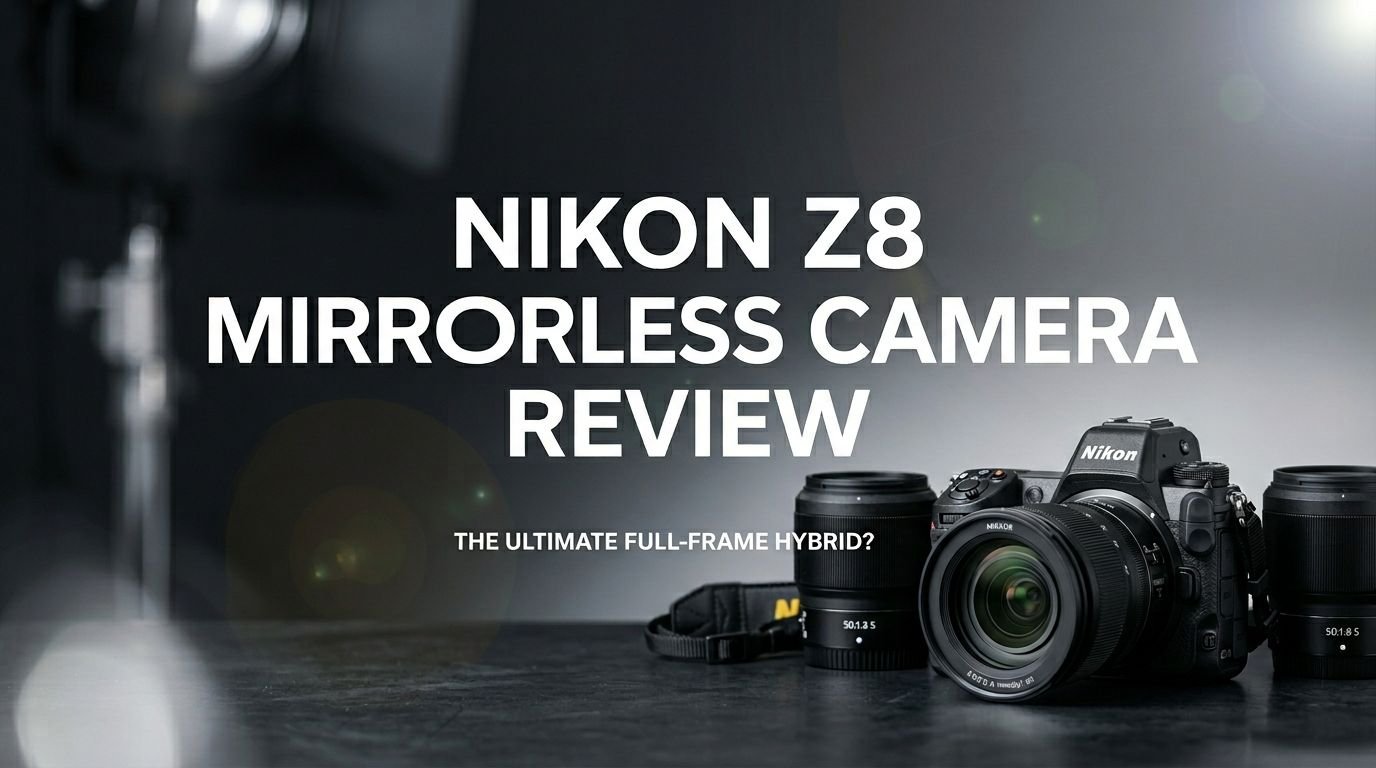
Nikon Z8 Mirrorless Camera Review 2026: Worth Your Money?
The Nikon Z8 has been on the market for a while now. It still turns heads in 2026. This full frame mirrorless camera packs the power of the flagship Nikon Z9 into a smaller, lighter body.
Photographers and videographers continue to praise its 45.7MP stacked CMOS sensor, blazing fast autofocus, and stunning 8K video recording.
But does it hold up against newer competitors? Should you invest $3,500 in a camera that first launched in 2023? You probably have these questions. This review covers every detail you need to make a smart buying decision.
Key Takeaways
- The Nikon Z8 delivers flagship performance at a lower price than the Nikon Z9. You get a 45.7MP stacked CMOS sensor, the EXPEED 7 processor, and 493 phase detection AF points. This combination produces sharp images with excellent dynamic range across all lighting conditions.
- Autofocus speed and accuracy remain among the best in the industry. The deep learning AF system tracks subjects like eyes, faces, birds, cars, bikes, and trains. Firmware updates have only made it better over time.
- Video shooters will love the 8K30 and 4K120 capabilities. The camera records internal 8K N RAW footage and supports professional codecs. However, extended 8K recording may cause overheating in hot environments.
- Battery life is the biggest weakness. The EN EL15c battery provides roughly 340 shots per charge (CIPA rating). This falls far short of the Nikon Z9’s 740 shot rating. Carry spare batteries for long shoots.
- Build quality is professional grade with full weather sealing and a magnesium alloy body. The camera weighs 910 grams with the battery and a memory card. It feels solid but manageable during extended use.
- At around $3,497 for the body in 2026, the Nikon Z8 offers exceptional value. It gives you nearly everything the $5,500 Nikon Z9 offers in a more compact form factor.

Nikon Z8 Overview and First Impressions
The Nikon Z8 sits just below the flagship Z9 in Nikon’s mirrorless lineup. It shares the same 45.7MP stacked CMOS sensor and EXPEED 7 image processor. Nikon essentially put the Z9’s brain into a smaller body.
The camera arrived in a well packed box with the EN EL15c battery, a USB C cable, a body cap, and documentation. First impressions were positive. The body felt compact compared to the Z9, yet it still had a professional, serious feel in hand.
The grip is deep and comfortable. You can hold the camera for hours without fatigue. Every button falls within natural reach. Nikon’s ergonomic design shows years of refinement here.
The 3.2 inch tilting touchscreen is bright and responsive. It provides excellent visibility in bright sunlight. The electronic viewfinder (EVF) uses a 3.69 million dot OLED panel with a smooth 120fps refresh rate. This viewfinder rivals the best available on any mirrorless camera today.
Overall, the Nikon Z8 made a strong first impression. It looks, feels, and performs like a high end tool built for serious work.
Nikon Z8 Design and Build Quality
Nikon built the Z8 with a magnesium alloy body that feels premium in every way. The camera features full weather sealing at every joint, dial, and button. You can shoot confidently in rain, dust, and cold temperatures.
The body measures approximately 144 x 118.5 x 83.5mm. It weighs 910 grams with a battery and memory card. That is noticeably lighter than the Nikon Z9, which tips the scales at around 1,340 grams. This weight difference matters during long shoots.
The top plate features a clean layout with the mode dial, shutter button, front and rear command dials, and a small OLED info display. The rear panel offers a well organized button layout. You get dedicated buttons for playback, delete, menu, AF ON, and a joystick for focus point selection.
One important design decision is the removal of the integrated vertical grip. The Z9 has a built in grip, but the Z8 does not. You can add the optional MB N12 power battery pack if you need vertical shooting comfort and extra battery power.
The dual card slots accept one CFexpress Type B card and one SD UHS II card. This gives you flexibility for backup or overflow recording.
Nikon Z8 Image Quality and Sensor Performance
The 45.7 megapixel stacked CMOS sensor inside the Nikon Z8 produces outstanding image quality. This is the same sensor found in the Nikon Z9. It captures incredible detail at base ISO and maintains excellent performance at higher sensitivities.
At ISO 64, images are virtually noise free with superb color accuracy. The dynamic range stretches to approximately 14+ stops. This means you can recover deep shadows and bright highlights in post processing with ease. Landscape and studio photographers will appreciate this flexibility.
High ISO performance is impressive. Images remain clean and usable up to ISO 6400 with very fine grain. Even at ISO 12800 and 25600, the noise remains manageable for professional work. The EXPEED 7 processor handles noise reduction smartly without destroying fine detail.
Color reproduction is accurate and natural straight out of the camera. Nikon’s color science produces pleasing skin tones for portrait work. Landscape colors appear vibrant but true to life.
The stacked sensor design also eliminates rolling shutter distortion during fast panning and action shots. This is a huge advantage over cameras that use standard BSI CMOS sensors. You get clean, distortion free images even at 20 frames per second.
Top 3 Alternatives for Nikon Z8
1. Sony Alpha 1 II

2. Canon EOS R5 Mark II

3. Sony Alpha 7R V

Nikon Z8 Autofocus System
The Nikon Z8 uses 493 phase detection autofocus points that cover nearly 100% of the frame. This AF system is powered by deep learning algorithms. Nikon developed it using machine learning technology, and it shows in real world use.
The camera recognizes and tracks people, dogs, cats, birds, airplanes, trains, bicycles, and cars. Bird detection AF is particularly impressive. It locks onto birds in flight and maintains focus even during erratic movements.
Eye detection AF works brilliantly for both humans and animals. The system detects eyes at remarkable distances and tracks them smoothly as subjects move. Portrait photographers will find this feature invaluable. It simply works.
In low light, the AF system performs down to approximately EV minus 7. This means the camera can focus accurately in very dark environments. Wedding photographers and event shooters will benefit from this capability.
Focus speed is essentially instantaneous in good light. There is no visible hunting or hesitation. The AF system switches between subjects smoothly and predictably. 3D tracking mode allows you to place the focus point on a subject and let the camera follow it across the frame.
Firmware updates from Nikon have continued to improve AF performance since launch. The 2025 and 2026 firmware updates brought noticeable improvements in bird and animal detection accuracy.
Nikon Z8 Burst Shooting and Speed
Speed is one of the Nikon Z8’s greatest strengths. The camera shoots at 20 frames per second with full RAW files and 14 bit depth. If you switch to JPEG only, the burst rate jumps to 30 frames per second.
There is also a pre release capture mode. This feature records frames before you fully press the shutter button. The camera buffers images at up to 120fps in JPEG mode. You can capture the exact moment a bird takes flight or a player catches a ball.
The buffer depth is generous. You can fire long bursts of RAW files before the camera slows down. The CFexpress Type B card slot provides fast write speeds. This keeps the buffer clear and ready for the next burst.
Blackout free shooting is another benefit of the electronic shutter. The EVF never goes dark during continuous shooting. You can track fast moving subjects without losing sight of them.
The Nikon Z8 does not have a mechanical shutter. It uses an electronic shutter exclusively. Thanks to the stacked sensor design, rolling shutter artifacts are minimal. Most photographers will never notice any distortion, even during fast action.
Sports, wildlife, and event photographers will find the Nikon Z8’s speed truly satisfying. It keeps up with the fastest subjects and gives you the best possible chance of capturing that perfect moment.
Nikon Z8 Video Capabilities
The Nikon Z8 is a serious video machine. It records internal 8K video at 30 frames per second in N RAW format. It also captures 4K at 120fps for smooth slow motion footage.
For standard production work, you get 4K at 60fps with full frame oversampled output from the 8.3K sensor. This produces incredibly detailed 4K footage. The level of detail rivals many dedicated cinema cameras.
The camera supports 10 bit N Log and HLG recording for maximum dynamic range in post production. ProRes 422 HQ is available for internal recording. This is a codec that many professional editors prefer because it offers excellent quality with manageable file sizes.
Audio recording supports external microphones through the 3.5mm input. There is also a headphone jack for monitoring. The camera records 24 bit linear PCM audio internally.
One concern with extended 8K recording is heat management. In warm environments, the camera may overheat and stop recording after prolonged 8K sessions. Nikon has improved thermal management through firmware updates, but it remains a consideration for long form video projects.
HDMI output supports 8K RAW output to external recorders like the Atomos Ninja. This opens up even more flexibility for professional video workflows.
Nikon Z8 Electronic Viewfinder and LCD Screen
The EVF on the Nikon Z8 uses a 3.69 million dot OLED panel. It offers a 0.8x magnification and a 120fps refresh rate. The image inside the viewfinder looks smooth, detailed, and natural.
Color accuracy in the EVF is excellent. What you see in the viewfinder closely matches the final image output. This makes exposure and white balance adjustments easy to judge in real time.
The 3.2 inch rear LCD tilts vertically. It is a touchscreen with a resolution of 2.1 million dots. The screen is sharp and bright enough for outdoor use. Touch AF and menu navigation both work smoothly.
One limitation is that the LCD does not fully articulate. It tilts up and down but does not flip out to the side. Vloggers who shoot facing the camera may prefer a fully articulating screen. The Nikon Z9 shares this same design choice.
The touch interface responds quickly to swipes, taps, and pinch to zoom gestures. You can review images, set focus points, and adjust settings through the touchscreen. It adds a level of convenience that traditional button only cameras cannot match.
Both the EVF and LCD display all relevant shooting information clearly. Histograms, level indicators, focus peaking, and zebra highlights are all available as overlays.
Nikon Z8 Battery Life and Power Management
Battery life is the Nikon Z8’s biggest weakness. The camera uses the EN EL15c battery. Nikon rates it at approximately 340 shots per charge using the viewfinder and 370 shots using the LCD. In eco mode, you can stretch this to about 400 shots.
These numbers are low for a professional camera. The Nikon Z9 uses a larger EN EL18d battery and achieves 740 shots per charge. The Z8’s smaller body simply cannot accommodate a bigger battery.
In real world use, the battery performs a bit better than the CIPA rating suggests. Casual shooting sessions can yield 500 or more frames. However, heavy burst shooting, 8K video recording, and constant EVF use drain the battery quickly.
The solution is simple. Carry extra batteries. Most working professionals keep two or three spare EN EL15c batteries in their bag. The batteries are compact and affordable.
You can also attach the MB N12 battery grip for extended power. This grip holds an additional EN EL15c battery and effectively doubles your shooting time. It also adds a vertical shutter release and control buttons.
USB C charging is supported. You can charge the battery inside the camera using a standard USB C power source. This is convenient for travel, but a dedicated charger charges the battery faster.
Nikon Z8 Connectivity and Workflow
The Nikon Z8 offers Wi Fi, Bluetooth, and USB C connectivity. These features make it easy to transfer files, control the camera remotely, and integrate it into modern workflows.
The Nikon SnapBridge app connects your smartphone to the camera via Bluetooth. You can transfer low resolution images automatically to your phone for quick social media sharing. The app also allows remote shooting and camera control.
USB C provides fast data transfer speeds. You can tether the camera to a computer for studio work. The USB C port also supports charging, as mentioned in the battery section.
The built in Wi Fi offers faster file transfers than Bluetooth. You can send full resolution images to your phone or computer wirelessly. For professional work, a wired connection is still faster and more reliable.
The dual card slot setup supports various recording workflows. You can write RAW to the CFexpress card and JPEG to the SD card simultaneously. You can also set one card as overflow or backup.
FTP transfer is supported for photojournalists and sports photographers who need to send images from the field immediately. The camera can connect to FTP servers over Wi Fi or a wired ethernet adapter.
GPS data can be embedded through the SnapBridge app using your phone’s location services. This is useful for travel and landscape photographers who want location data in their EXIF information.
Nikon Z8 Lens Compatibility and Z Mount System
The Nikon Z8 uses the Nikon Z mount. This mount has a large 55mm diameter and a short 16mm flange distance. These specifications allow Nikon to design fast, sharp lenses with compact form factors.
Nikon’s Z mount lens lineup has grown significantly since its introduction. In 2026, you can choose from a wide range of primes and zooms. Options include the popular Z 24 70mm f/2.8 S, the Z 70 200mm f/2.8 VR S, and the Z 400mm f/4.5 VR S for wildlife work.
The Z 28 400mm f/4 8 VR is a standout travel lens. It covers an enormous focal range in a single lens. Paired with the Z8, it creates a versatile all in one kit.
For photographers who own older Nikon F mount lenses, the FTZ II adapter provides full compatibility. Autofocus, VR stabilization, and aperture control all work seamlessly through the adapter. This protects your investment in existing Nikon glass.
Third party lens manufacturers like Tamron, Sigma, and Viltrox now offer native Z mount lenses. This further expands your options and provides more affordable alternatives to Nikon’s own glass.
The large Z mount diameter delivers superior optical performance. Lens designers can create wider apertures and reduce aberrations more effectively. This benefits every image you capture with the Nikon Z8.
Nikon Z8 Firmware Updates and Long Term Support
Nikon has shown exceptional long term support for the Z8 through firmware updates. Since its launch, multiple firmware versions have added new features and improved existing ones.
Recent firmware updates brought improved autofocus algorithms. Bird detection became more accurate. Subject tracking improved in challenging backgrounds. These updates added real, measurable value to the camera.
Nikon also added new video features through firmware. Frame rate options, color profiles, and recording formats have been expanded over time. This approach gives Z8 owners new capabilities without buying new hardware.
Pixel shift shooting was added through firmware. This mode captures multiple images with slight sensor shifts and combines them for ultra high resolution output. It is excellent for product photography and architectural work.
Nikon has also addressed user complaints through firmware. Menu organization, button customization options, and overall responsiveness have improved. The camera you buy today is significantly better than the one that launched in 2023.
This ongoing firmware support makes the Nikon Z8 a smart long term investment. You can expect Nikon to continue refining the camera for years to come.
Who Should Buy the Nikon Z8?
The Nikon Z8 suits a wide range of photographers and videographers. It is not a niche product. Its versatility makes it an excellent choice for many shooting styles.
Wildlife photographers will love the fast autofocus, bird detection, and 20fps burst speed. The 45.7MP sensor provides enough resolution for heavy cropping. This lets you reach distant subjects without extreme telephoto lenses.
Wedding and event photographers benefit from the reliable AF, excellent high ISO performance, and dual card slots. The smaller body compared to the Z9 reduces fatigue during long events. You need extra batteries, though.
Landscape photographers get outstanding dynamic range, high resolution files, and weather sealed construction. The pixel shift mode delivers extreme detail for prints and large displays.
Video professionals gain access to 8K and 4K recording with professional codecs. The N RAW and ProRes options meet broadcast and cinema standards.
Sports photographers will appreciate the blackout free shooting, 3D tracking AF, and fast burst rates. The electronic shutter eliminates mechanical wear during high volume shooting.
If you are a hobbyist or casual shooter, the Z8 might be more camera than you need. The Nikon Zf or Z6III could be better choices at lower price points. But if you want the best performance Nikon offers without the Z9’s size and price, the Z8 is the clear answer.
Nikon Z8 Pros and Cons
Understanding the strengths and weaknesses of the Nikon Z8 helps you make a balanced decision. No camera is perfect, and honest evaluation matters.
The pros are significant. Image quality from the 45.7MP stacked sensor is superb at all ISO levels. The autofocus system is fast, accurate, and intelligent. Burst shooting at 20fps with RAW files keeps you competitive. Video capabilities rival dedicated cinema cameras. Build quality is professional grade with full weather sealing. Firmware updates continue to add value over time.
The cons are worth considering too. Battery life with the EN EL15c is limited at 340 shots CIPA. Extended 8K recording can cause thermal issues in warm conditions. The tilting LCD does not fully articulate for vlogging. There is no in body image stabilization synergy with unstabilized lenses. The electronic shutter sound lacks the tactile satisfaction of a mechanical shutter.
The price of approximately $3,497 is a significant investment. However, it delivers near flagship performance at roughly $2,000 less than the Z9. This value proposition remains strong in 2026.
For most professional and serious enthusiast photographers, the pros far outweigh the cons. The battery issue is easily solved with spare batteries. The thermal limitation affects only a small percentage of users who shoot 8K for extended periods.
Nikon Z8 Final Verdict
The Nikon Z8 remains one of the best mirrorless cameras available in 2026. Its combination of resolution, speed, autofocus intelligence, and video capability is hard to beat at its price point.
Nikon packed nearly everything from the flagship Z9 into this smaller body. You lose the integrated vertical grip and the larger battery. You gain portability and save around $2,000. For most photographers, that is a trade worth making.
The ongoing firmware support from Nikon adds confidence to this purchase. Your camera improves over time. New features arrive without extra cost. That level of support shows Nikon’s commitment to Z8 owners.
Competing cameras like the Sony A1 II and Canon EOS R5 Mark II offer strong alternatives. Each has its own strengths. But the Nikon Z8 holds its ground firmly. It offers a unique balance of image quality, speed, video power, and value that few cameras match.
If you shoot Nikon or plan to invest in the Z mount system, the Z8 is the camera to get. It will serve you well for years to come. We give the Nikon Z8 a strong recommendation in 2026.
Frequently Asked Questions
Is the Nikon Z8 still worth buying in 2026?
Yes, the Nikon Z8 is absolutely worth buying in 2026. Nikon’s ongoing firmware updates have improved autofocus, video features, and overall performance since launch. The 45.7MP stacked sensor and EXPEED 7 processor still deliver top tier results. At its current price of around $3,497, it offers excellent value compared to newer competitors.
How does the Nikon Z8 compare to the Nikon Z9?
The Nikon Z8 shares the same sensor, processor, and autofocus system as the Z9. The main differences are the smaller body, the absence of an integrated vertical grip, and the smaller EN EL15c battery. The Z9 offers better battery life and a built in grip. The Z8 saves you about $2,000 and reduces weight by over 400 grams.
What memory cards does the Nikon Z8 use?
The Nikon Z8 has two card slots. The first slot accepts CFexpress Type B cards for maximum speed. The second slot accepts SD UHS II cards. For the best performance during burst shooting and 8K video, use a fast CFexpress Type B card in the primary slot.
Does the Nikon Z8 have in body image stabilization?
Yes, the Nikon Z8 features a 5 axis in body image stabilization (IBIS) system. It provides up to 6 stops of compensation with compatible lenses. This helps you shoot at slower shutter speeds without a tripod and produces smoother handheld video.
Can the Nikon Z8 use older Nikon F mount lenses?
Yes. The Nikon FTZ II adapter allows you to use most Nikon F mount lenses on the Z8. Autofocus, VR stabilization, and electronic aperture control all function through the adapter. This makes the transition from Nikon DSLR systems smooth and cost effective.
How long does the Nikon Z8 battery last?
The Nikon Z8 uses the EN EL15c battery. Nikon rates it at 340 shots per charge using the viewfinder (CIPA standard). Real world performance often exceeds this number during mixed use. For professional shoots, carry at least two or three spare batteries to avoid running out of power.