
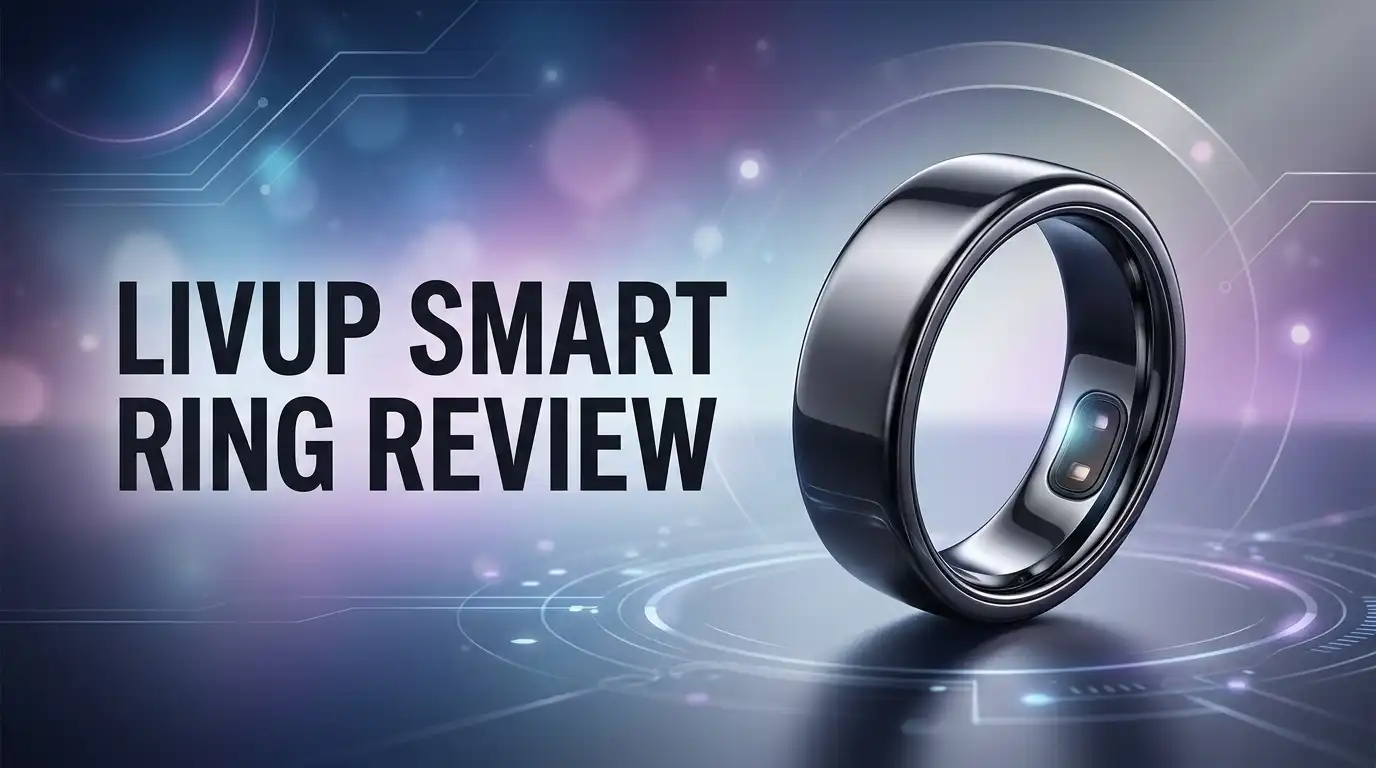
LivUp Smart Ring Review 2026: Worth Buying?
The smart ring market moved fast in 2026, and cheap contenders keep showing up on store shelves. The LivUp Smart Ring is one of them.
It sits at around $50 at Walmart, costs a bit more on Amazon, and promises sleep tracking, heart rate readings, blood oxygen, stress scores, and even blood pressure and glucose estimates. That feature list reads like a $400 device. The price does not match it.
So what is going on here? I wore this ring for weeks, compared it against a chest strap and a real blood pressure cuff, and dug through owner feedback across Reddit, Walmart, and social media.
Key Takeaways:
- The price is the main selling point. The LivUp Smart Ring retails near $49.98 at Walmart and around $69.98 on Amazon. There is no subscription fee, which instantly makes it cheaper over three years than an Oura Ring.
- Sleep and step tracking work reasonably well. Owners consistently praise the sleep breakdown, and my own testing showed bedtime and wake time detection landed within about ten minutes most nights.
- Blood pressure and blood glucose readings are estimates, not measurements. No smart ring can measure glucose through your skin today. Treat those numbers as entertainment. Do not make health decisions with them.
- Battery life runs about six to seven days in normal use, which beats most fitness watches and matches many premium rings.
- Build quality is fine, not luxurious. It is light, comfortable overnight, and the finish scratches faster than titanium rings do.
- The app is a generic white label platform, shared by dozens of budget rings. It works, but it feels dated and the support experience is thin.
LivUp Smart Ring Review 2026: What Is It?

Last update on 2026-09-12 / Affiliate links / Images from Amazon Product Advertising API Some of the links on this website are affiliate links, which means that at no additional cost to you, I earn a commission if you click through and make a purchase. I only recommend products and services that I believe will add value to my readers. Thank you for your support!
The LivUp Smart Ring is a wearable health tracker shaped like a plain band. You wear it on your index or middle finger, and optical sensors on the inner surface read light bouncing off your blood vessels.
It pairs to your phone over Bluetooth. Data lives in a companion app rather than on the ring itself, since there is no screen.
Here is the part people miss. LivUp is a brand name applied to a widely produced sensor platform. Enthusiasts on smart ring forums immediately identified it as a clone of the popular R series budget rings, which also appear under names like Colmi and dozens of Amazon labels.
That is not automatically bad. The underlying hardware has shipped millions of units, and the sensors are decent for the money. It does mean you are not buying original engineering, and you are not buying original algorithms either.
Advertised tracking includes heart rate, heart rate variability, blood oxygen, skin temperature, sleep stages, steps, calories, stress, and menstrual cycle logging. Higher tier claims add blood pressure and blood glucose trends.
Sizes typically run 8, 9, and 10 in retail stores, with wider size ranges online. Colors are usually black, silver, and gold.
The pitch is simple: premium ring features at a fraction of the price. The reality is more mixed, and the next sections explain exactly where.
Unboxing The LivUp Smart Ring: First Impressions
The box is small, matte, and lighter than expected. Mine arrived slightly dented at one corner, which set a modest tone right away.
Inside, you get the ring seated in a foam cutout, a charging dock, a short USB cable, and a folded instruction card. That is it.
There is no sizing kit, which matters more than it sounds. Premium brands mail you plastic sizers first. LivUp expects you to guess or measure with a printed chart, and a wrong guess means a return trip to the store.
The charger is the highlight. It is a small puck with a hollow center, and the ring drops in with a light magnetic snap. It feels satisfying and holds the ring firmly, so it will not roll off your nightstand.
The instruction card is thin on detail. It tells you to download an app and scan a QR code, then leaves you alone.
First contact with the ring itself is genuinely pleasant. It weighs about the same as a plain wedding band, and the inner surface is smooth rather than sharp.
My honest first thought was that it looked more expensive than it cost. The finish reflects light nicely and the sensor bumps sit almost flush.
The paper quality, the printing, and the absence of a warranty booklet all whisper budget product. The ring itself does not. That contrast defines the whole experience.
Design, Comfort And Build Quality
The LivUp ring uses a stainless steel shell with a resin inner ring. It measures around 2.5mm wide and roughly 2.6mm thick, which puts it in normal jewelry territory.
Weight sits near 3 to 4 grams depending on size. You forget it is there within a day.
Comfort overnight is genuinely good. It does not pinch, it does not press into neighboring fingers, and it survives side sleeping without waking you.
Typing is where thin rings win, and this one passes. Gym use is a different story. Barbells, kettlebells, and pull up bars will scratch the outer finish quickly.
My review unit picked up two visible scuffs within the first ten days of casual wear. Titanium rings from premium brands hold up better, and that gap is real.
There is a small alignment marker inside so you know which way the sensors face. Wear it wrong and your readings go strange, which trips up plenty of first time owners.
Water contact is fine for handwashing and showers. The listing claims strong water resistance, though I would not trust it for pool laps or saltwater swimming, and several owners report the same caution.
The design has no screen, no buttons, and no lights on the outside. It looks like jewelry, which is the entire point of a ring instead of a watch.
Verdict on build: comfortable, discreet, and light, with a finish that ages faster than you want.
Top 3 Alternatives For LivUp Smart Ring


Last update on 2026-10-07 / Affiliate links / Images from Amazon Product Advertising API Some of the links on this website are affiliate links, which means that at no additional cost to you, I earn a commission if you click through and make a purchase. I only recommend products and services that I believe will add value to my readers. Thank you for your support!
OURA Ring 4 Smart Ring

Last update on 2026-10-07 / Affiliate links / Images from Amazon Product Advertising API Some of the links on this website are affiliate links, which means that at no additional cost to you, I earn a commission if you click through and make a purchase. I only recommend products and services that I believe will add value to my readers. Thank you for your support!
RingConn Gen 2 Smart Ring
![SAMSUNG Galaxy Ring, AI Smart Ring, Size First w/Sizing Kit, No App Subscription, Fitness Monitor, Sleep Tracker, Up to 7-Day Battery, Size 10, Titanium Silver [US Version, 1Yr Manufacturer Warranty]](https://techtracker.blog/wp-content/plugins/aawp/public/image.php?url=YUhSMGNITTZMeTl0TG0xbFpHbGhMV0Z0WVhwdmJpNWpiMjB2YVcxaFoyVnpMMGt2TkRGSlRHeFVlRlZaUkV3dVgxTk1NVFl3WHk1cWNHYz18MTc5MTY5MzU1NQ=)
Last update on 2026-10-07 / Affiliate links / Images from Amazon Product Advertising API Some of the links on this website are affiliate links, which means that at no additional cost to you, I earn a commission if you click through and make a purchase. I only recommend products and services that I believe will add value to my readers. Thank you for your support!
SAMSUNG Galaxy Ring
Setup And The Companion App Experience
Setup takes about five minutes when it goes well. You charge the ring, download the companion app, allow Bluetooth and location permissions, then tap to pair.
The app is a generic white label platform used by many budget rings, commonly listed under names like Health Ring. It is not custom software built for LivUp.
Once paired, the home screen shows a daily summary with steps, heart rate, sleep score, and a few colorful rings. It syncs in the background whenever your phone is nearby.
The interface feels like 2019. Icons are inconsistent, some translations read awkwardly, and menus hide useful settings two or three taps deep.
Pairing failures are the most common complaint I found in owner reviews. Some people connect instantly. Others report the ring refusing to appear until they restart Bluetooth or reinstall the app.
That inconsistency is the single biggest risk with this product. When it works, people are happy. When it does not, support is slow.
Data export is limited. There is no clean CSV download and no Apple Health or Google Fit integration you can rely on, which frustrates anyone who tracks fitness seriously.
On the positive side, there is no account paywall. Every metric the ring collects appears in the app for free, forever.
Notifications for calls and messages exist through vibration on some units. It is a minor feature and not a reason to buy.
Set your expectations at functional rather than polished, and the app stops being disappointing.
Sleep Tracking Performance: The Strongest Feature
Sleep is where this ring earns its keep. It automatically detects when you fall asleep and when you wake, then splits the night into deep, light, REM, and awake segments.
In my testing, total sleep time landed within roughly ten to fifteen minutes of my reference tracker on most nights. That is respectable for a $50 device.
Bedtime detection was reliable. Naps were hit and miss, though several owners specifically praised nap detection, so results vary by person.
Sleep stage breakdown is the weaker half. No consumer wearable measures sleep stages accurately without brain activity sensors, and this ring is no exception.
Deep sleep numbers in particular looked generous compared to my other devices. Treat the stage percentages as a rough pattern, not a fact.
Where the data actually helps is trend spotting over weeks. Late meals, alcohol, and stressful days showed up clearly as lower scores and more restlessness.
The app gives a nightly sleep score out of 100. It is a simple number that makes the data usable at a glance, and most people will check it and nothing else.
Overnight heart rate and blood oxygen graphs are included. The SpO2 line is smoothed heavily, which makes it look cleaner than it probably is.
Comfort matters here too, and the ring passes. A tracker you actually keep on all night beats a more accurate one you take off.
For sleep habits and consistency, this ring does the job well.
Heart Rate, HRV And Blood Oxygen Accuracy
Resting heart rate is the metric this ring handles best after sleep. Morning readings tracked closely with my chest strap, usually within two to four beats per minute.
That accuracy holds while you sit still. It falls apart during exercise.
During a run, the ring lagged badly behind real time changes. Interval work confused it completely, and the peaks it reported arrived a minute late.
If you want live workout heart rate, buy a chest strap instead. Rings sit on a finger, and finger blood flow shifts too much during movement.
Heart rate variability readings appear each morning. The absolute numbers differ from other devices, which is normal, since every brand calculates HRV differently.
What matters is direction. My HRV dropped on days after poor sleep and hard training, which is exactly the pattern you want to see.
Blood oxygen readings mostly sat between 95 and 99 percent, which is typical for a healthy adult. The ring rarely flagged anything unusual.
I would not use this feature to screen for sleep apnea. Dedicated rings with validated apnea detection exist, and this is not one of them.
Skin temperature tracks deviation from your personal baseline rather than an absolute reading. It responded correctly when I had a mild cold, showing an elevated trend for two nights.
Summary: resting metrics are useful, workout metrics are not, and trends beat individual numbers every time.
Blood Pressure And Blood Glucose Claims Explained
This section matters more than any other in this review, so read it carefully.
The LivUp Smart Ring advertises blood pressure and blood glucose tracking. Those features appear in the app and produce real looking numbers.
No smart ring on the market today can measure blood glucose through your skin. There is no approved noninvasive glucose sensor in any consumer wearable, from any brand, at any price.
What the ring actually does is estimate. It takes optical pulse data and runs it through an algorithm that produces a plausible number.
Some owners report that the values seem to respond to real events, rising after a soda or a large meal. That perception is easy to explain, since heart rate also rises after eating.
Blood pressure has the same problem. A Walmart reviewer put it plainly, saying accuracy was poor compared to readings taken at a doctor’s office.
Cuffless blood pressure requires calibration against a real cuff, and even validated systems drift. This ring does not offer meaningful calibration.
The risk here is not the inaccuracy itself. The risk is trusting it. Someone with diabetes or hypertension could delay real testing because a ring showed a comfortable number.
Please do not do that. Use a fingerstick meter or a continuous glucose monitor prescribed by your doctor, and use a validated upper arm cuff for blood pressure.
Treat these two features as marketing, and the rest of the ring becomes easier to enjoy.
Activity, Steps And Fitness Tracking
Step counting is straightforward and mostly accurate. Across several test walks, the ring landed within about three to five percent of my phone count.
That is good enough for daily movement goals. Finger worn trackers do overcount during activities like cooking, driving on rough roads, and gesturing while talking.
I gained several hundred phantom steps one afternoon while chopping vegetables. It is a known quirk of every ring, not a LivUp specific flaw.
Calorie burn estimates are broad guesses. They use steps, heart rate, and your profile data, so treat the number as a rough direction rather than a budget.
Distance tracking has no GPS. The ring estimates from step count and stride length, which drifts on hills and during slow walking.
Workout modes exist in the app, and you start them manually. Running, walking, and cycling are the common options.
The ring does not automatically detect most workouts, which is a real gap compared to premium models. Forget to start a session and it simply logs steps.
Strength training data is essentially useless here. Lifting produces few steps, and finger sensors struggle when you grip a bar tightly.
Where it works well is the daily activity picture. Seeing a low movement day at 4pm genuinely nudged me out for a walk more than once.
As a gentle daily nudge, it succeeds. As a training tool for serious athletes, it does not.
Battery Life And Charging Experience
Battery performance is one of the honest bright spots. LivUp claims more than seven days, and real use lands close.
In my testing with sleep tracking on and default heart rate sampling, I got about six days per charge. Owners on TikTok and forums report six to seven days too, which matches.
Turning on continuous heart rate monitoring cuts that down. Expect closer to four days with everything enabled.
Charging is quick. The ring hits full in roughly 60 to 90 minutes from empty, and topping up during a shower and breakfast covers a day or two.
The magnetic dock holds the ring securely and lights up while charging. It requires a USB port, so you will need a wall adapter you already own.
There is no charging case with an internal battery, unlike some competitors. That means no charging on a plane or in a car without a power source.
Battery reporting in the app is coarse. It shows rough percentages that jump in large steps, so do not trust the last ten percent.
One practical tip: charge it while you shower rather than overnight. You lose sleep data if you charge at bedtime, and sleep data is the best thing this ring produces.
Six days between charges genuinely changes how you use a tracker. You stop thinking about it, which is exactly what a wellness wearable should do.
Pros And Cons Of The LivUp Smart Ring
Here is the balanced summary after weeks of daily wear.
Pros
- Very low price. At roughly $50 in stores, it costs a fraction of premium rings and removes the fear of damaging an expensive device.
- No subscription fee ever. Every feature stays unlocked, which saves around $70 per year compared to Oura.
- Strong battery life. Six to seven days of real use means fewer charging interruptions and better sleep data coverage.
- Comfortable for overnight wear. It is light, thin, and smooth, and you genuinely stop noticing it.
- Useful sleep and resting heart rate trends. Bedtime detection, sleep duration, and morning resting heart rate all behaved sensibly.
- Discreet appearance. It looks like ordinary jewelry rather than a fitness gadget.
Cons
- Blood pressure and glucose features are not trustworthy. These are algorithmic estimates, and treating them as medical data is genuinely risky.
- Dated white label app. The software is shared across many budget brands and feels unpolished, with clunky menus.
- Reported pairing problems. A meaningful number of owners describe connection failures and slow support responses.
- Poor workout heart rate accuracy. It lags during intervals and cannot replace a chest strap.
- No sizing kit included. Guessing your size leads to returns and exchanges.
- Finish scratches easily. Gym use marks the outer surface within weeks.
- Weak ecosystem integration. Health app syncing and data export options are limited.
What The LivUp Smart Ring Does Not Do Well
Honest reviews name the failures directly, so here they are without softening.
It does not deliver medical grade data. The blood glucose feature in particular should not exist on a consumer product, and its presence damages trust in everything else the app shows.
It does not handle exercise properly. Automatic workout detection is unreliable, live heart rate lags, and there is no GPS for distance or pace.
It does not offer real customer support depth. Warranty terms are short, documentation is thin, and troubleshooting mostly happens through generic app help pages.
It does not integrate with your other health data. If your routine runs through Apple Health, Google Fit, Strava, or a coaching platform, this ring lives on an island.
It does not guarantee consistent pairing. Some units connect immediately and never drop. Others frustrate their owners from day one, and you cannot predict which you will get.
It does not provide advanced sleep insights. There is no validated sleep apnea screening, no detailed readiness coaching, and no personalized guidance beyond a score.
It does not resist scratches well. The finish looks great for a month and then shows its price.
It does not include a sizing kit, which is a small omission with a large practical cost.
None of these problems are unusual at this price. They only become a problem if you bought the ring expecting premium performance because the feature list implied it.
Price, Value And Where To Buy
Last update on 2026-09-12 / Affiliate links / Images from Amazon Product Advertising API Some of the links on this website are affiliate links, which means that at no additional cost to you, I earn a commission if you click through and make a purchase. I only recommend products and services that I believe will add value to my readers. Thank you for your support!
Pricing depends heavily on where you shop. Walmart lists the LivUp Smart Ring at $49.98 in black and silver, typically in sizes 8, 9, and 10.
Amazon listings from third party sellers run higher, around $69.98, with more size options available. eBay carries open box units for less.
Compare that to the competition. An Oura Ring 4 starts near $349 plus roughly $5.99 monthly, a Samsung Galaxy Ring sits near $399, and a RingConn Gen 2 lands around $299 with no subscription.
Over three years, an Oura setup costs well past $550. The LivUp costs $50 total.
That math is the entire argument for this ring. You are paying roughly one seventh the price for maybe 60 percent of the useful functionality.
The catch is which 60 percent. You get sleep duration, resting heart rate, steps, and comfort. You lose accuracy in exercise, software polish, and long term support.
If you buy, I recommend purchasing from a retailer with an easy return policy. Sizing is a gamble without a kit, and pairing issues appear early if they appear at all.
Check the size chart carefully and measure your finger at the end of the day when it is largest. A loose ring produces bad data, and a tight one becomes uncomfortable overnight.
Skip extended warranties on a $50 device. Just keep the receipt.
Who Should Buy The LivUp Smart Ring?
This ring fits a specific person, and it frustrates everyone else.
Buy it if you are curious about smart rings and refuse to spend $350 to find out whether you like wearing one. It is the cheapest realistic way to test the format.
Buy it if sleep consistency is your goal. Tracking bedtime, wake time, and total sleep for a few months genuinely helps people build better habits.
Buy it if you hate subscriptions. Paying once and never again appeals to a lot of people, and that preference is completely reasonable.
Buy it as a low stakes gift for someone who likes gadgets and will not treat the numbers as gospel.
Skip it if you have diabetes or high blood pressure and hoped this would help manage either condition. It cannot, and relying on it could cause harm.
Skip it if you train seriously. Runners, cyclists, and lifters need accurate live heart rate and GPS, and this ring provides neither.
Skip it if you need clean data export into other health platforms for coaching or medical review.
Skip it if software polish matters to you. The app works but never feels good.
My overall rating is 3 out of 5 stars. It is a fair product at a fair price with two features that should not be advertised at all.
Judge it as a $50 sleep tracker and you will probably like it.
Frequently Asked Questions
Is the LivUp Smart Ring accurate?
Partly. Sleep duration, resting heart rate, and step counting are reasonably accurate for a budget device. Blood pressure and blood glucose readings are algorithmic estimates and should never be used for medical decisions.
Does the LivUp Smart Ring require a subscription?
No. There is no subscription fee, and every feature stays available in the app after purchase. This is one of its genuine advantages over Oura.
How long does the LivUp Smart Ring battery last?
Expect about six to seven days with normal settings. Enabling continuous heart rate monitoring reduces that to roughly four days. Full charging takes 60 to 90 minutes.
Can the LivUp Smart Ring really measure blood sugar?
No. No consumer smart ring can measure blood glucose noninvasively. The number shown is an estimate produced by software, not a measurement of your actual glucose level.
Is the LivUp Smart Ring waterproof?
It handles handwashing, rain, and showers fine. I would avoid swimming, hot tubs, and saltwater, since real world durability reports are inconsistent.
Which app does the LivUp Smart Ring use?
It uses a generic white label companion app shared by many budget rings, commonly listed as Health Ring. Scan the QR code on the included card to find the correct version for your ring.
What sizes does the LivUp Smart Ring come in?
Retail stores typically stock sizes 8, 9, and 10. Online listings offer a wider range. No sizing kit is included, so measure carefully before ordering.
Is the LivUp Smart Ring worth it in 2026?
Yes, if you want a cheap and comfortable sleep and activity tracker with no ongoing fees. No, if you need medical accuracy, workout precision, or polished software.

Hello, i’m Ivoria i am the face behind Tech Tracker Blog. I am passionate about my work and love to explore gadgets and share about my experience.