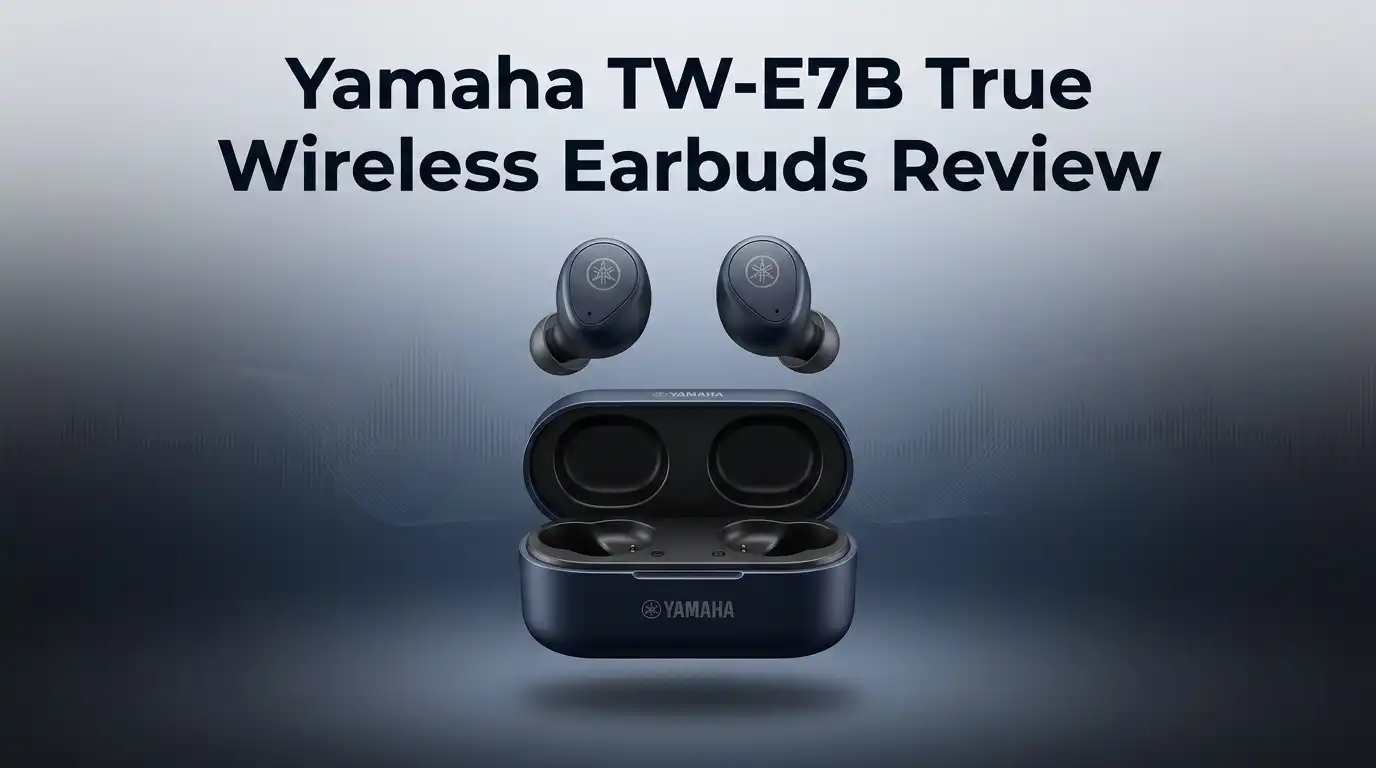
Yamaha TW-E7B True Wireless Earbuds Review 2026
Yamaha has built pianos, guitars, amplifiers, and concert hall gear for more than a century. So when the company puts its tuning fork logo on a pair of tiny wireless earbuds, people pay attention.
The Yamaha TW-E7B arrived as the brand’s flagship true wireless model. It launched near $280, sat above almost every rival, and promised concert grade audio in a plastic shell the size of a coffee bean.
Fast forward to 2026, and the picture looks different. Prices have dropped hard, sometimes below $150. That changes the entire value story.
Key Takeaways
- Sound quality is the main reason to buy. The 10mm dynamic drivers deliver natural tone, controlled bass, and clean treble. Vocals sound honest rather than pumped up. Acoustic music, jazz, and orchestral recordings shine here.
- Noise cancellation is the biggest weakness. The Advanced ANC trims low rumble from planes and buses, but chatter, clatter, and higher pitched noise still leak through. Bose and Apple do this much better.
- Battery life is average, not impressive. You get roughly 6 hours per charge and about 16 more from the case, for around 22 hours total. Newer rivals push 30 hours or more.
- The app stays simple and useful. Yamaha Headphones Control offers a five band equaliser, Listening Care, Listening Optimizer, and Gaming Mode without bloat or forced accounts.
- Physical buttons replace touch panels. That means fewer accidental taps from rain or hair, but you will press buttons by mistake while seating the buds.
- Value depends entirely on price. At $280 these were hard to recommend. At $130 to $180 they become a genuinely tempting audio first option.
Yamaha TW-E7B True Wireless Earbuds Overview

Last update on 2026-08-19 / Affiliate links / Images from Amazon Product Advertising API Some of the links on this website are affiliate links, which means that at no additional cost to you, I earn a commission if you click through and make a purchase. I only recommend products and services that I believe will add value to my readers. Thank you for your support!
The TW-E7B sits at the top of Yamaha’s earbud family. It uses 10mm dynamic drivers, Bluetooth 5.2, and a frequency response of 20 Hz to 20 kHz.
Codec support covers SBC, AAC, and Qualcomm aptX. Android owners get a real benefit here, since aptX carries more data than plain AAC.
The feature list includes Advanced Active Noise Cancelling, Ambient Sound, Listening Care, Listening Optimizer, Gaming Mode, and in ear detection. Yamaha also includes Qualcomm cVc technology for call clarity.
Water resistance sits at IPX5, which means the buds survive sweat and light rain but never a dunk or a rinse under the tap. Each bud weighs 7.3 grams, which feels normal for this class.
You get four colour options: black, dark blue, gold, and white. The gold version looks surprisingly classy in person and avoids the cheap chrome look that plagues many earbuds.
Yamaha aimed this model at listeners who care about tone above all else. The tuning philosophy is called True Sound, and the goal is to reproduce music the way the artist mixed it.
That focus shapes everything. The TW-E7B does not chase gimmicks like spatial audio tricks or head tracking. It puts almost all of its engineering budget into the drivers and the tuning.
Unboxing The Yamaha TW-E7B Experience
The box feels serious. Yamaha uses a matte outer sleeve with a large product photo and the tuning fork logo pressed into the corner.
Slide the sleeve off and you find a black inner box with a magnetic style lift lid. The charging case sits in a moulded tray right at the top, facing you.
It is a confident presentation. Nothing rattles, nothing feels loose, and no plastic clamshell fights back.
Under the case tray you find a small cardboard envelope. Inside sit five pairs of silicone ear tips in XS, S, M, L, and XL sizes, already sorted and labelled.
The included cable measures only 20 centimetres and runs USB A to USB C. That short cable is the first small disappointment. It works for a laptop port but feels cramped behind a desk.
Paper documentation covers the quick start guide, warranty card, and safety notes. Yamaha keeps it brief and points you to the app for the full manual.
The buds themselves feel dense when you pick them up. The speckled finish looks like fine stone rather than glossy plastic, and it hides fingerprints well.
First pairing took about fifteen seconds. Open the case, hold the buds near your phone, accept the Bluetooth prompt, and you are playing music.
The whole unboxing takes two minutes and feels like opening a piece of hifi gear rather than a gadget. That matters when you spend real money.
Design And Build Quality Assessment
These are chunky earbuds. The housings stick out noticeably from your ears, and nobody will mistake them for something discreet.
The outer face carries a circular ring detail below the button area. Yamaha says it aids acoustics, but it reads mostly as styling.
Build quality feels genuinely good. Panel gaps stay tight, the speckled coating resists scuffs, and nothing creaks under pressure.
The charging case is bulky. It swallows pocket space and looks large next to an AirPods Pro case or a Sennheiser case.
The lid uses a flip open hinge with a satisfying snap. Status LEDs sit on the front edge, and the USB C port sits on the back.
One design miss stands out. The case gives you battery LEDs but the app never reports case charge level, so you guess how much reserve you have.
Yamaha chose small physical buttons instead of touch panels. One button sits on the left bud, and two sit on the right bud.
I like buttons. They ignore rain, they ignore hair, and they never trigger from a stray brush.
The tradeoff appears when you adjust fit. You will accidentally press a button while pushing a bud into place, which pauses your track or bumps the volume.
At least the buttons sit on the top edge, so pressing them does not jam the tip deeper into your canal. Many rivals fail that basic test.
Comfort And Fit For Long Listening
Despite the bulk, the TW-E7B sits well. Weight distribution keeps pressure off the outer ear and spreads it across the canal entrance.
I wore them for three hour stretches without hot spots. That surprised me given the size.
Five ear tip sizes make a real difference here. Most brands ship three, so people with narrow or wide canals get a better shot at a proper seal with Yamaha.
Seal quality controls both bass response and noise blocking. A loose tip drains the low end and ruins whatever ANC performance exists.
The buds hold position during walking, cycling, and light gym work. They do shift slightly during running, and the extra mass makes itself known on impact.
These are not sport earbuds. IPX5 covers sweat, but the shape lacks wing tips or fins to lock into your ear ridge.
Yamaha sells the cheaper TW-ES5A for workouts, and that model includes silicone fins plus an IPX7 rating. Buy that one if the gym is your main use.
Glasses wearers should have no issue since nothing touches the temple arms. Side sleepers will find the housings far too thick.
In ear detection works reliably. Pull one bud out and music pauses within a second, then resumes when you replace it.
Top 3 Alternatives For Yamaha TW-E7B
If the TW-E7B does not fit your needs, these three models cover the gaps.


Last update on 2026-06-03 / Affiliate links / Images from Amazon Product Advertising API Some of the links on this website are affiliate links, which means that at no additional cost to you, I earn a commission if you click through and make a purchase. I only recommend products and services that I believe will add value to my readers. Thank you for your support!
Sony WF-1000XM5
No products found.
Sennheiser MOMENTUM True Wireless 4

Last update on 2026-08-19 / Affiliate links / Images from Amazon Product Advertising API Some of the links on this website are affiliate links, which means that at no additional cost to you, I earn a commission if you click through and make a purchase. I only recommend products and services that I believe will add value to my readers. Thank you for your support!
Bose QuietComfort Ultra Earbuds
Sound Quality And Yamaha True Sound
This is where the TW-E7B earns its place. The tuning aims for balance rather than spectacle.
Bass arrives with weight but never bloats. On tracks with heavy sub bass content, the low notes stay firm and clean at high volume without distortion.
The deepest sub bass notes do fade slightly. Push below roughly 40 Hz and you feel the driver reaching its floor.
Midrange is the highlight. Male vocals get real body, female vocals stay clear, and guitars keep their texture instead of blurring into the mix.
Treble stays bright without turning harsh. Cymbals shimmer, acoustic strums sparkle, and long sessions never produce listening fatigue.
Soundstage feels wider than average for closed earbuds. Instruments occupy distinct positions rather than piling into the centre.
Orchestral recordings sound convincing. Strings and brass hold their place while lower registers get a gentle lift that adds warmth.
The default signature is close to neutral with mild low end emphasis. That suits jazz, classical, folk, rock, and acoustic recordings best.
Bass heads should look elsewhere. Hip hop and electronic fans who want chest thumping slam will find these polite.
The app equaliser helps but only slightly. Boosting the lowest bands adds a hint of richness, not a transformation.
Volume headroom is generous and the buds stay composed when pushed hard. Distortion never appeared during testing, even at levels I would not recommend for your hearing.
Active Noise Cancellation Performance Tested
Here comes the honest part. The Advanced ANC on the TW-E7B underperforms for a flagship product.
Low frequency rumble drops noticeably. Aircraft cabin drone, bus engine hum, and air conditioning noise all lose energy when you switch ANC on.
Everything above that range survives. Office chatter, keyboard clicks, restaurant clatter, and crying children come through with most of their volume intact.
The passive seal from the ear tips does a lot of the work. Swap to a bad tip size and the cancellation collapses further.
Compare this against a Bose QuietComfort Ultra or an AirPods Pro and the gap is embarrassing. Those models cut mids and highs too, creating that sealed vault feeling.
The Yamaha simply lowers the volume of the world by a modest amount. It helps on a plane and does very little in a busy cafe.
No pressure discomfort appears, which some listeners will prefer. Aggressive cancellation causes ear pressure sensations for many people, and the TW-E7B avoids that entirely.
There is also no adaptive mode. The ANC level stays fixed, so the buds never adjust to changing surroundings the way rivals do.
If noise cancellation ranks first on your list, skip these. If it ranks fourth behind sound, comfort, and build, they remain viable.
Ambient Sound And Listening Optimizer Features
Ambient Sound lets outside noise through the microphones so you can hear announcements or conversation. It works, though not gracefully.
The mode sounds bright and slightly thin. A faint high frequency hiss sits in the background whenever you enable it.
It also amplifies close sounds too eagerly. Typing on a keyboard turns into a clattering percussion section.
Voices remain fully intelligible, which is the main job. You can order coffee or hear a platform announcement without removing a bud.
Listening Optimizer is the more interesting feature. It measures your ear canal shape and the seal quality, then adjusts output to compensate.
The effect is subtle but real. Bass tightens slightly and the midrange feels a touch more even after it runs.
Listening Care sits alongside it and lowers the maximum volume while preserving detail at quiet levels. This is genuinely useful for hearing protection and reflects Yamaha’s professional audio background.
The idea is simple. At low volumes, human ears lose bass and treble perception, so Listening Care compensates and lets you enjoy full sound without cranking the dial.
I left it on most of the time. It encourages safer listening habits without making music sound flat.
Gaming Mode reduces latency for video and games. Lip sync improves clearly, though a small delay remains for competitive shooters.
Battery Life And Charging Reality
Yamaha rates the buds at 6 hours of playback with the case adding 16 hours, for 22 hours total.
My results tracked close. At moderate volume with ANC active, I averaged just over 5 hours before a low battery warning.
Turn ANC off and 6 hours becomes achievable. Push volume high and the number drops toward 4 and a half hours.
Talk time reaches about 5 and a half hours, which handles a full day of scattered calls.
Fast charging works well. Ten minutes in the case delivers roughly one hour of playback, enough to rescue a commute.
Full charging takes about 2 hours for the buds and 3 hours for the case. Those numbers feel slow by 2026 standards.
The real disappointment is the total figure. Sennheiser offers 30 hours, and plenty of midrange models beat 22 hours comfortably.
There is no wireless charging. At the original price that omission stung badly, and it still annoys today.
The case also lacks any battery percentage readout in the app. You get three LEDs and a rough guess.
Standby drain is well controlled, so the case holds charge for weeks between uses. Auto power off works properly and prevents wasted energy when you leave buds outside the case.
Call Quality And Microphone Performance
Yamaha built in Qualcomm cVc Clear Voice Capture for call handling. The system works better than expected.
Callers described my voice as clear and natural on both mobile and desktop calls. Consonants stayed sharp without that underwater compression many earbuds produce.
One flaw appears consistently. The microphone signal runs slightly quiet, so recipients sometimes ask you to speak up.
Wind handling is average. A moderate breeze produces rumble that the processing only partly removes.
Background noise suppression works well indoors. Air conditioning, distant traffic, and keyboard clicks get filtered without chopping up your speech.
Busy environments cause trouble. Nearby conversation bleeds into the call because the microphones cannot separate voices reliably.
Sidetone is missing. You cannot hear your own voice during calls, which pushes people to talk louder than needed.
Video calls sync well thanks to low latency, and Gaming Mode tightens that further if you need it.
For a product from a company known for studio microphones, the results feel merely competent rather than class leading. Solid for daily work calls, weak for calls from a train platform.
Yamaha Headphones Control App Review
The Yamaha Headphones Control app deserves praise for restraint. No account signup, no advertising, no social features.
You open it and see the product image with battery levels for each bud. Everything else sits within one scroll.
The equaliser gives you five adjustable bands plus presets. The preset names are the weak spot, since labels like energy, gentle, groove, and openness explain nothing.
Changes take effect immediately so you can hear adjustments while you slide the bands. That saves a lot of guesswork.
Below the equaliser sits the ANC and Ambient Sound toggle. Three states exist: cancelling, ambient, or both off.
The listening mode section holds Listening Care, Listening Optimizer, and Gaming Mode. Each includes a brief explanation of what it does.
Settings cover firmware updates, in ear detection, auto power off, and the digital user guide. Firmware updates installed without failure during my testing.
Two features are missing that hurt in 2026. There is no multipoint pairing to connect two devices at once, and there is no button remapping.
Multipoint absence is the bigger loss. Switching between a laptop and a phone means disconnecting manually every time.
The app works on both Android and iOS with identical layouts. Stability was fine across weeks of use with no crashes.
Pros And Cons Of The Yamaha TW-E7B
Pros
- Excellent natural sound tuning with balanced bass, rich midrange, and clean treble that suits acoustic and orchestral music beautifully
- Five ear tip sizes included, which greatly improves the chance of a proper seal compared with rivals that ship only three
- Physical buttons instead of touch panels, so rain, sweat, and stray brushes never trigger unwanted commands
- Clean and fast app with a working five band equaliser and no account requirement or bloat
- Listening Care and Listening Optimizer add genuine hearing protection value backed by Yamaha’s professional audio experience
- Strong build quality with a durable speckled finish that resists fingerprints and scuffs
- aptX codec support gives Android users better wireless audio quality than AAC alone
- IPX5 water resistance handles sweat and rain safely
- Great current pricing after repeated discounts makes the audio performance a bargain
Cons
- Weak noise cancellation that only reduces low rumble and lets voices and clatter through easily
- No multipoint pairing, so switching between devices requires manual reconnection every time
- 22 hour total battery life falls behind current rivals that reach 30 hours or more
- No wireless charging on a case that is already bulky
- Bright and hissy Ambient mode that overamplifies nearby sounds
- Accidental button presses happen often while seating the buds in your ears
- Quiet microphone output during calls despite otherwise clear voice reproduction
- No case battery readout in the app or on the phone
- Large housings that look bulky and rule out side sleeping
- No LDAC or high resolution codec support for hifi streaming subscribers
What The Yamaha TW-E7B Does Not Do Well
Let me be blunt about the failures, because glossing over them helps nobody.
Noise cancellation is the headline problem. Yamaha labelled it Advanced, and that label oversells the result significantly.
You will still hear the person on the phone next to you. You will still hear the espresso machine.
The second failure is connectivity. No multipoint in 2026 feels outdated on a product that once cost $280.
Anyone who juggles a work laptop and a personal phone will feel this daily. Budget earbuds handle it now.
Battery life sits below par. Twenty two hours total was acceptable in 2022 and looks thin today.
The bulk is another real complaint. Both the buds and the case take up more room than they should.
Ambient Sound quality disappoints. The hiss is audible and the amplification of close sounds feels unnatural.
There is no spatial audio, no head tracking, and no adaptive noise control. Yamaha skipped modern software features to focus on tone.
Call microphones are merely fine. They will not impress anyone taking calls outdoors.
Finally, the equaliser lacks power. Small adjustments are possible, but you cannot reshape the sound signature dramatically if the default tuning does not suit you.
Who Should Buy The Yamaha TW-E7B In 2026
These earbuds now serve a specific listener rather than a broad audience.
Buy them if sound quality ranks first for you. The tuning competes with anything in the price range and beats plenty of pricier models.
Buy them if you listen to acoustic, jazz, classical, folk, or rock. The neutral balance flatters real instruments and honest vocals.
Buy them if you use an Android phone. aptX support and the clean app give you a better experience than iPhone owners get.
Buy them if you want hearing protection features. Listening Care genuinely helps people who worry about long term volume exposure.
Buy them if you find them heavily discounted. Under $180 the value equation flips in your favour.
Skip them if you commute through loud environments. The noise cancellation will frustrate you within a week.
Skip them if you need multipoint pairing for work between two devices.
Skip them if you want maximum battery endurance on long haul flights. Twenty two hours will not carry you far enough.
Skip them if you run or train hard. The TW-ES5A serves that purpose better with fins and an IPX7 rating.
Skip them if you want bass that hits like a subwoofer. These stay composed and refined instead.
Final Verdict On The Yamaha TW-E7B

Last update on 2026-08-19 / Affiliate links / Images from Amazon Product Advertising API Some of the links on this website are affiliate links, which means that at no additional cost to you, I earn a commission if you click through and make a purchase. I only recommend products and services that I believe will add value to my readers. Thank you for your support!
The Yamaha TW-E7B is a specialist product wearing a generalist price tag. That mismatch defined its launch and defines it still.
As an audio product it succeeds. The 10mm drivers produce natural, balanced, engaging sound that many rivals cannot match.
As a complete package it stumbles. Weak noise cancellation, missing multipoint, average battery, and a bulky case all pull it down.
At the original $280 price I would have said no without hesitation. Bose and Sony offered far more for the money.
At current street prices the answer changes. Around $150, you are buying flagship level tuning with midrange level features.
That trade suits people who use earbuds mostly at a desk, at home, or on quiet walks. It suits people who care about how music sounds more than how quiet the train feels.
Yamaha built earbuds for listeners, not commuters. Understand that and the TW-E7B makes sense.
I still reach for them when I want to actually enjoy an album. I reach for something else when I board a plane.
That is the honest summary. Great ears, weak armour, and a price that finally matches what it delivers.
Frequently Asked Questions
Does the Yamaha TW-E7B have good noise cancellation?
No, not by flagship standards. The Advanced ANC reduces low frequency rumble such as engine drone and air conditioning noise, but voices, keyboard clicks, and higher pitched sounds pass through with most of their volume. Bose and Apple models block far more across the full frequency range.
How long does the Yamaha TW-E7B battery last?
The buds last about 6 hours per charge and the case holds roughly 16 more hours, giving around 22 hours total. Expect closer to 5 hours with noise cancellation active at moderate volume. Ten minutes of charging delivers about one hour of playback.
Does the Yamaha TW-E7B support multipoint pairing?
No. You cannot connect the buds to two devices at the same time. Switching between a phone and a laptop requires disconnecting from one device before pairing with the other, which is a notable omission at this price level.
Is the Yamaha TW-E7B waterproof?
The rating is IPX5, which covers sweat and light rain from any direction. Do not rinse the buds under a tap, submerge them, or wear them in the shower. The cheaper TW-ES5A offers a stronger IPX7 rating if water resistance matters more to you.
Which codecs does the Yamaha TW-E7B support?
It supports SBC, AAC, and Qualcomm aptX over Bluetooth 5.2. Android users benefit from aptX. There is no LDAC or aptX Adaptive support, so high resolution streaming subscribers will not get full detail from their libraries.
Are the Yamaha TW-E7B good for running and the gym?
They are acceptable for light workouts but not ideal. The housings are large, they lack wing tips or fins, and they shift during running. Yamaha’s TW-ES5A model includes silicone fins and better water resistance for exercise use.
Is the Yamaha TW-E7B worth buying in 2026?
Yes, if you find it discounted and you prioritise sound quality. The tuning remains excellent for acoustic, jazz, classical, and rock listening. Look elsewhere if you need strong noise cancellation, long battery life, or multipoint connectivity.

Hello, i’m Ivoria i am the face behind Tech Tracker Blog. I am passionate about my work and love to explore gadgets and share about my experience.