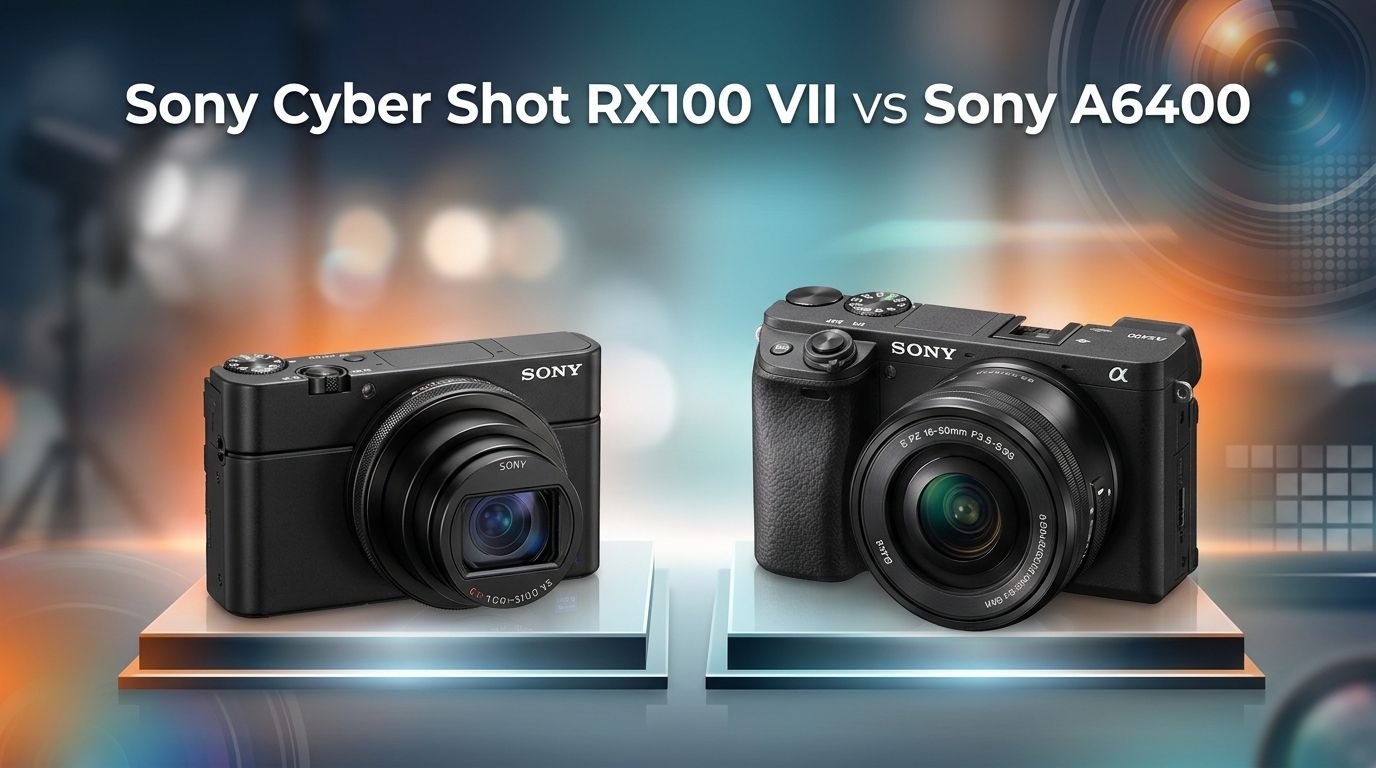
Sony Cyber Shot RX100 VII vs Sony A6400
Choosing between the Sony Cyber Shot RX100 VII and the Sony A6400 can feel like picking between two completely different photography lifestyles. One slips into your jacket pocket.
The other offers interchangeable lenses and a much larger sensor. Both cameras share Sony’s excellent autofocus technology, shoot crisp 4K video, and deliver stunning images. But they serve very different photographers.
If you are a travel photographer who values portability above everything, the RX100 VII is hard to beat. If you want room to grow with different lenses and better low light performance, the A6400 pulls ahead.
Key Takeaways
- The Sony A6400 has a larger APS C sensor (23.5 x 15.6mm) compared to the RX100 VII’s 1 inch sensor (13.2 x 8.8mm). This gives the A6400 a clear advantage in dynamic range, low light performance, and background blur.
- The RX100 VII is incredibly compact at just 302 grams and fits in a pocket. The A6400 body alone weighs 403 grams, and you still need to add a lens on top of that.
- Both cameras share Sony’s Real Time Tracking AF and Real Time Eye AF, making them excellent for fast moving subjects and portrait photography.
- The RX100 VII shoots at 20 fps with its electronic shutter, while the A6400 tops out at 11 fps. For action and sports, the RX100 VII has the speed advantage.
- The A6400 offers interchangeable lenses, giving you creative flexibility that no fixed lens compact can match. The RX100 VII is limited to its built in 24 200mm equivalent zoom.
- Video shooters should note that both cameras record 4K at 30fps, but the A6400 can record without a time limit. The RX100 VII caps recordings at around 5 minutes in 4K due to heat concerns.
Sony Cyber Shot RX100 VII Overview

The Sony Cyber Shot RX100 VII launched in 2019 as the seventh generation of Sony’s legendary compact camera line. It packs a 20.1 megapixel 1 inch stacked CMOS sensor with a BIONZ X processor. The built in Zeiss Vario Sonnar T* lens covers a focal range of 24 200mm equivalent at f/2.8 to f/4.5.
This camera borrows autofocus technology straight from Sony’s flagship Alpha A9. It features 357 phase detection AF points and 425 contrast detection AF points. The result is lightning fast subject acquisition and reliable tracking across the frame.
Sony also built in a pop up electronic viewfinder and a tilting LCD screen that flips up 180 degrees. This makes the RX100 VII a strong choice for vloggers and content creators who need to see themselves while recording.
Pros:
- Ultra compact and pocketable design at only 302 grams
- Impressive 24 200mm zoom range for a compact camera
- 20 fps blackout free shooting for action scenes
- Built in ND filter and pop up EVF
- 4K video recording with S Log2 and S Log3
Cons:
- Small 1 inch sensor limits low light performance
- Battery life rated at only 260 shots (CIPA)
- 4K video recording limited to around 5 minutes due to overheating
- No external microphone jack without an adapter
- Premium price for a compact camera
Sony A6400 Overview

The Sony A6400 arrived in early 2019 as a mid range mirrorless camera with an APS C sensor. It carries a 24.2 megapixel Exmor CMOS sensor paired with the same BIONZ X image processor. Sony built this camera for photographers and videographers who want serious performance in a compact mirrorless body.
The A6400 supports 425 phase detection AF points and 425 contrast detection AF points that cover about 84% of the image area. Sony’s Real Time Tracking AF and Real Time Eye AF work here just as well as they do on the RX100 VII.
One standout feature is the 180 degree tilting touchscreen, which makes this camera popular with vloggers. The body uses a magnesium alloy construction and features weather resistance for shooting in challenging conditions.
Pros:
- Larger APS C sensor delivers better image quality and dynamic range
- Interchangeable lens system with access to Sony’s full E mount library
- No video recording time limit for extended shoots
- 180 degree flip up screen for vlogging
- Weather sealed magnesium alloy body
- Lower starting price than the RX100 VII (body only)
Cons:
- No in body image stabilization (IBIS)
- Battery life rated at 360 shots, still modest
- Heavier at 403 grams body only, plus lens weight
- 4K video has a slight crop factor
- Single SD card slot
Image Quality Comparison
The sensor size difference is the biggest factor here. The Sony A6400’s APS C sensor measures 23.5 x 15.6mm. The RX100 VII’s 1 inch sensor measures 13.2 x 8.8mm. That makes the A6400’s sensor roughly 2.7 times larger in surface area.
This size difference translates into real world results. The A6400 captures more light per pixel, which means cleaner images at higher ISO settings. You will notice less grain in dimly lit restaurants, evening street scenes, and indoor events.
The A6400 also produces images with greater dynamic range. This means you can recover more detail from shadows and highlights in post processing. If you shoot in RAW format and edit your photos, the A6400 gives you more flexibility.
The RX100 VII still produces excellent images in good light. Its 20.1 megapixel sensor paired with the sharp Zeiss lens delivers crisp, detailed shots during daytime. But push the ISO above 1600, and you will start to see the A6400 pull ahead clearly.
Autofocus Performance
Both cameras use Sony’s Real Time Tracking AF system. This technology uses artificial intelligence to recognize subjects and stick to them as they move through the frame. The system tracks faces, eyes, and general objects with impressive accuracy.
The RX100 VII features 357 phase detection points while the A6400 offers 425 phase detection points. Both cameras cover a wide area of the sensor with these AF points. In practice, both cameras lock onto subjects almost instantly.
Eye AF works on both cameras for humans and animals. This feature is a game changer for portrait and pet photography. The camera identifies and focuses on the subject’s eye, keeping portraits tack sharp even as the subject moves.
The RX100 VII has a slight edge in AF acquisition speed, rated at 0.02 seconds. Sony claims this is the fastest AF speed in any compact camera. The A6400 is also extremely fast, rated at 0.02 seconds as well. In daily use, you will struggle to tell the difference between these two cameras in autofocus speed.
Video Recording Capabilities
Both the RX100 VII and A6400 record 4K video at 30 frames per second. They also support 1080p at 120fps for smooth slow motion footage. Sony includes S Log2 and S Log3 gamma profiles on both cameras for color grading in post production.
The A6400 has a major advantage for video creators. It records 4K video with no recording time limit. You can shoot interviews, events, or long form content without worrying about the camera stopping. The RX100 VII, however, can overheat during 4K recording and typically limits 4K clips to about 5 minutes.
The RX100 VII does include built in optical image stabilization, which helps smooth out handheld footage. The A6400 lacks in body stabilization, so you need a lens with optical steady shot or an external gimbal for smooth video.
For audio, the A6400 has a 3.5mm microphone input built into the body. The RX100 VII requires a special adapter accessory to connect an external microphone. This makes the A6400 the better choice for videographers who need clean audio.
Lens Flexibility and Zoom Range
The RX100 VII comes with a fixed 24 200mm f/2.8 to f/4.5 Zeiss zoom lens. This covers wide angle to telephoto in a single package. You get impressive reach for wildlife, sports, and distant subjects without carrying extra glass.
The A6400, on the other hand, uses Sony’s E mount lens system. This opens the door to dozens of lenses from Sony, Sigma, Tamron, and other manufacturers. You can attach a fast prime lens for portraits, a wide angle lens for landscapes, or a super telephoto for wildlife.
This flexibility comes with a trade off. Buying lenses adds cost and weight. A basic kit lens like the Sony 16 50mm f/3.5 to 5.6 adds size and expense. But a high quality prime lens like the Sony 35mm f/1.8 can produce images that no compact camera can match.
If you prefer a simple, all in one solution, the RX100 VII delivers everything in a tiny package. If you want to build a system over time and push your creative limits, the A6400 is the smarter long term investment.
Portability and Build Quality
The RX100 VII measures just 102 x 58 x 43mm and weighs 302 grams with battery and card. It fits in a coat pocket, a small purse, or even a large pants pocket. This is the camera you will always carry with you because it takes up almost no space.
The A6400 body measures 120 x 66.9 x 59.7mm and weighs 403 grams with battery and card. Add a kit lens and the total weight easily exceeds 500 grams. It is still compact for a mirrorless camera, but you will need a camera bag or neck strap.
Build quality is strong on both cameras. The RX100 VII uses a metal chassis that feels premium in hand. The A6400 features a magnesium alloy body with dust and moisture resistance. The A6400 feels more rugged and better suited for outdoor adventures.
The A6400 also has a deeper grip that makes it easier to hold for extended shooting sessions. The RX100 VII’s flat body can feel slippery, and many users buy a grip accessory for better handling.
Battery Life and Shooting Endurance
Battery life is a weak point for both cameras, but the A6400 performs better. The A6400 is rated at 360 shots per charge using the NP FW50 battery. The RX100 VII manages only 260 shots with its smaller NP BX1 battery.
For video recording, the A6400 lasts approximately 125 minutes of continuous recording through the viewfinder. The RX100 VII provides roughly 130 minutes of video recording, but 4K recording cuts that time significantly due to heat buildup.
Both cameras support USB charging, which is helpful for travel. You can top up the battery with a power bank between shooting sessions. Carrying a spare battery is strongly recommended for either camera if you plan a full day of shooting.
The A6400’s battery is also widely available and affordable as a third party option. The RX100 VII’s NP BX1 battery is common too, but its smaller capacity means you may need to carry two or three spares for a full day.
Low Light and High ISO Performance
The A6400 wins this category by a comfortable margin. Its larger APS C sensor collects more light per pixel. This produces cleaner images at high ISO settings with less noise and better color accuracy.
The A6400’s native ISO range stretches from 100 to 32000, expandable to 102400. The RX100 VII covers ISO 100 to 12800, expandable to 25600. In real world shooting, the A6400 delivers usable images at ISO 6400 and beyond. The RX100 VII starts to show noticeable noise around ISO 1600 to 3200.
If you frequently shoot in dim environments like concerts, evening events, or indoor sports, the A6400 is the better tool. Pair it with a fast prime lens like a 35mm f/1.8, and you can shoot in very challenging light conditions.
The RX100 VII’s lens opens to f/2.8 at 24mm but narrows to f/4.5 at 200mm. This limits the amount of light reaching the sensor at longer focal lengths. The A6400 with a fast prime lens lets in significantly more light.
Viewfinder and Display
Both cameras include an electronic viewfinder (EVF). The RX100 VII has a pop up EVF with 2.36 million dots of resolution. The A6400 features a built in EVF, also with 2.36 million dots. Both provide a clear, detailed view of your scene.
The rear screens differ in a meaningful way. The RX100 VII has a 3 inch tilting LCD that flips up 180 degrees and tilts down about 90 degrees. The A6400 also has a 3 inch tilting LCD that flips 180 degrees upward.
Both screens support touch functionality for selecting focus points. The A6400’s touchscreen also works as a touchpad when you hold the camera to the EVF. You can drag your thumb across the screen to shift the focus point while looking through the viewfinder.
For vlogging, both flip up screens work well. The A6400’s screen is slightly larger in person because the body itself is bigger. This makes framing selfie style videos a bit easier on the A6400.
Who Should Buy the Sony RX100 VII?
The RX100 VII is perfect for photographers who value portability above everything else. If you travel frequently and want a camera that fits in your pocket, this is one of the best options available. The 24 200mm zoom range means you are prepared for almost any situation.
Street photographers will love the RX100 VII. Its small size makes it inconspicuous. People barely notice a compact camera compared to a mirrorless body with a large lens attached. This helps you capture candid moments without drawing attention.
Casual vloggers and social media creators who want a quick, grab and go camera will also enjoy the RX100 VII. It shoots quality 4K footage, has a flip screen, and requires zero lens decisions. You just turn it on and start recording.
This camera is not ideal for professional work, low light photography, or long video shoots. Its 1 inch sensor and limited battery life create real restrictions for demanding use cases.
Who Should Buy the Sony A6400?
The Sony A6400 is the better pick for photographers who want a versatile, expandable camera system. If you see yourself buying different lenses over time, the A6400 gives you a solid foundation. It works great for portraits, landscapes, street, and event photography.
Aspiring videographers should lean toward the A6400. The unlimited recording time, built in mic jack, and larger sensor create a much better video production tool. Pair it with a Sigma 16mm f/1.4 or Sony 35mm f/1.8 and you have a cinematic setup.
Beginner to intermediate photographers who want room to grow will appreciate the A6400. You start with a kit lens and add better glass as your skills improve. The camera body itself is capable enough to keep up with you for years.
The A6400 is not the best choice if ultra portability is your top priority. It requires a bag, and the total weight with a lens can feel heavy for all day carry compared to the pocketable RX100 VII.
Price and Value Comparison
The Sony RX100 VII typically retails around $1,200 to $1,300 for the camera body with its built in lens. Remember, you do not need to buy any additional lenses. What you see is what you get.
The Sony A6400 body only sells for around $900 to $1,000. Add a kit lens like the 16 50mm and the price rises to about $1,000 to $1,100. You get a larger sensor and interchangeable lens support for less money than the RX100 VII.
In pure value for money, the A6400 offers more. You pay less, get a bigger sensor, better low light performance, and access to an entire lens ecosystem. However, you also accept more weight and the ongoing cost of additional lenses.
The RX100 VII’s value lies in its unique combination of features and size. No other camera packs a 24 200mm zoom, 20 fps shooting, and advanced AF into a body this small. You pay a premium for that engineering, and for many users, it is worth every dollar.
Final Verdict: Sony RX100 VII vs Sony A6400
These two cameras serve different purposes despite sharing the same brand and similar technology. The Sony RX100 VII is the ultimate pocket camera for travelers, casual shooters, and anyone who wants top performance without bulk. The Sony A6400 is the better choice for serious photography, video production, and anyone who wants a camera system they can grow with.
If image quality and versatility matter most, pick the A6400. If portability and convenience are your top priorities, go with the RX100 VII. Either way, you are getting an excellent Sony camera with world class autofocus and reliable 4K video.
Frequently Asked Questions
Is the Sony RX100 VII worth it over the Sony A6400?
The RX100 VII is worth it if portability is your main concern. It fits in a pocket and offers a 24 200mm zoom range with no extra lenses needed. If you care more about image quality and low light performance, the A6400 delivers better results at a lower price.
Can the Sony A6400 fit in a pocket?
The A6400 body alone is too large for most pockets. With a lens attached, it requires a camera bag or a larger jacket pocket at minimum. It is compact for a mirrorless camera but not pocketable like the RX100 VII.
Which camera is better for vlogging, the RX100 VII or A6400?
Both cameras have 180 degree flip screens for self recording. The A6400 is better for serious vlogging because it has a built in microphone jack and no video recording time limit. The RX100 VII works well for quick, casual vlog clips.
Does the Sony A6400 have image stabilization?
The A6400 does not have in body image stabilization. You need to use lenses with built in optical stabilization or use an external gimbal for smooth handheld footage. The RX100 VII has built in optical stabilization in its lens.
How long does the battery last on the Sony RX100 VII?
The RX100 VII’s battery is rated for approximately 260 shots per charge (CIPA standard). For video recording, you can expect around 130 minutes at 1080p. Carrying at least one spare battery is recommended for full day shooting.
Which camera is better for beginners?
The RX100 VII is simpler because you never have to think about lens choices. Just power it on and shoot. The A6400 has a slightly steeper learning curve because of lens selection, but it offers more room to grow as your skills develop. Both cameras have excellent auto modes for beginners.