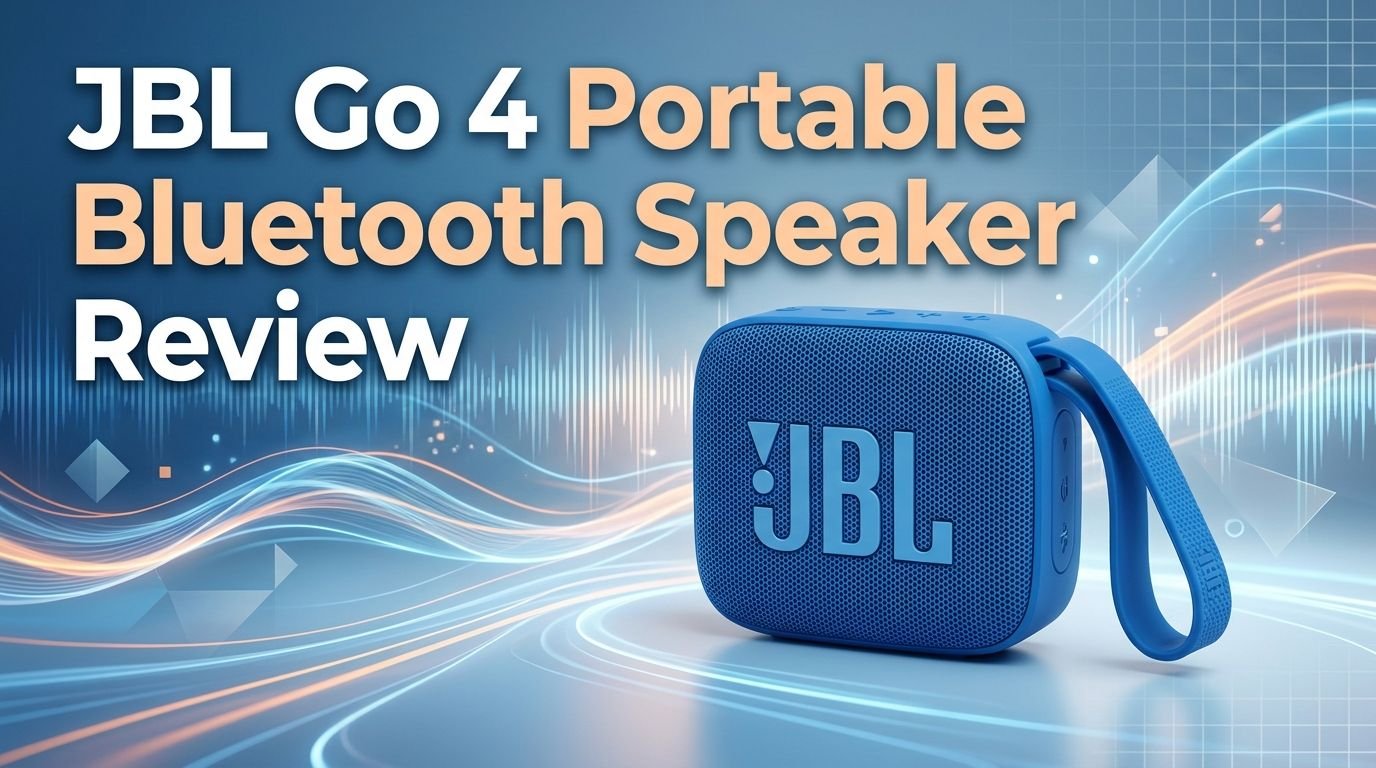
JBL Go 4 Portable Bluetooth Speaker Review 2026: Worth Buying?
You want big sound. You want a small speaker. You want something you can toss in your bag without a second thought. The JBL Go 4 promises all three.
This pocket-sized Bluetooth speaker has taken the portable audio market by storm since its release. It delivers JBL Pro Sound in a package smaller than your hand.
But does it actually live up to the hype? Can a speaker this tiny really impress your ears? In this full review, we break down every detail of the JBL Go 4.
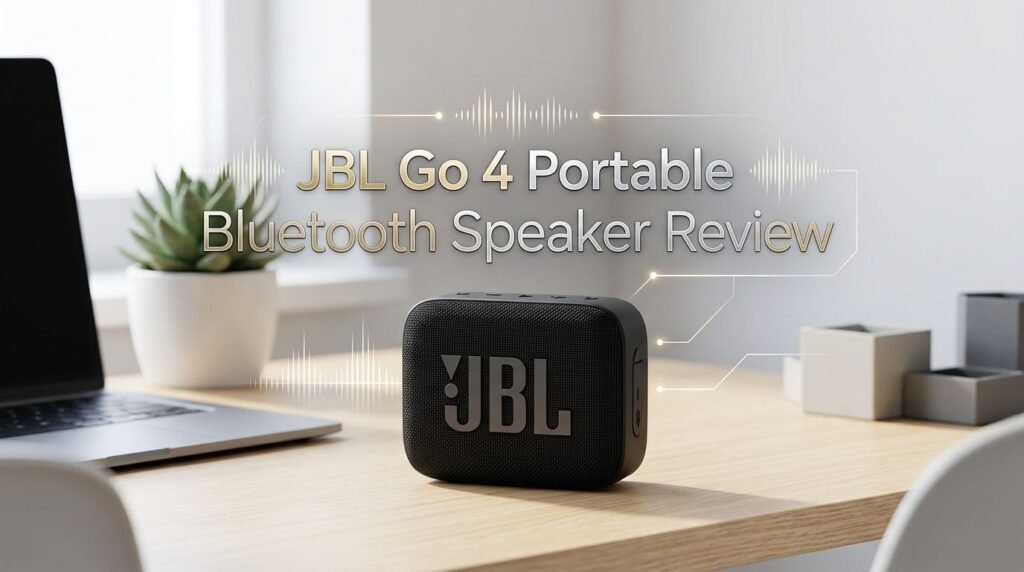
Key Takeaways:
- The JBL Go 4 delivers impressive sound for its size. It uses JBL Pro Sound technology with punchy bass output. You get clear audio from a speaker that weighs just 190 grams. This makes it one of the best ultra-portable speakers available right now.
- Battery life reaches up to 7 hours on a single charge. The Playtime Boost feature adds an extra 2 hours. However, this boost mode reduces sound quality by cutting low-end frequencies. Keep a portable charger handy for longer trips.
- IP67 waterproof and dustproof rating protects your investment. You can submerge this speaker in up to one meter of water for 30 minutes. It handles pool parties, beach trips, and shower sessions without any issues.
- The JBL Portable app adds real value. You get a 5-band customizable EQ for the first time on a Go series speaker. You can also use Auracast to connect multiple JBL speakers together for bigger sound.
- It lacks a microphone for phone calls. The JBL Go 4 does not support speakerphone or voice assistant features. If you need a speaker for calls, look elsewhere.
- Priced at around $49.95, it offers solid value. You get premium build quality, app support, and reliable JBL sound at a budget-friendly price point. It stands as one of the best speakers under $50 in 2026.


Last update on 2026-08-03 / Affiliate links / Images from Amazon Product Advertising API Some of the links on this website are affiliate links, which means that at no additional cost to you, I earn a commission if you click through and make a purchase. I only recommend products and services that I believe will add value to my readers. Thank you for your support!
JBL Go 4 Portable Bluetooth Speaker Overview
The JBL Go 4 is an ultra-portable Bluetooth speaker made for people who want music on the move. It sits as the smallest and most affordable speaker in JBL’s current portable lineup. The speaker measures just 94 x 78 x 42 mm and weighs only 190 grams. You can fit it in your back pocket, clip it to your bag, or hold it in one hand.
JBL designed the Go 4 as a direct upgrade to the popular Go 3. The company added Bluetooth 5.3 connectivity, app support through the JBL Portable app, and Auracast compatibility for multi-speaker setups. These features were missing from the Go 3.
The speaker comes in multiple bold colors to match your style. Each unit features a fabric grille made in part from recycled materials. The packaging uses FSC-certified paper printed with soy ink. JBL clearly made sustainability a priority here.
The Go 4 connects to your device using SBC codec only. It does not support higher bitrate codecs like aptX or AAC. This is standard for speakers in this price range and size category. Most users will not notice a difference during casual listening.
Sound Quality and Audio Performance
Sound quality is where the JBL Go 4 genuinely surprises people. This speaker packs a 4.2W output driver that pushes clear, loud audio. The mids come through strong and present. Vocals sound crisp. Acoustic instruments ring out with decent clarity.
The bass performance is respectable for such a small unit. JBL markets it as having “punchy bass,” and the speaker does try hard to deliver. The entire unit vibrates at higher volumes during bass-heavy tracks. It does not match larger speakers, but it punches above its weight class.
The stock sound signature leans mid-heavy. Snare drums, guitars, and voices dominate the mix. Some listeners may find the default tuning slightly flat for bass-forward genres like hip-hop or EDM.
Here is where the JBL Portable app saves the day. The 5-band customizable EQ lets you boost the 64Hz and 250Hz sliders for more low-end presence. You can also reduce the 1kHz slider to tame the mids. Within seconds, you can shape the Go 4’s sound to match your personal taste. This EQ access is a game-changing upgrade over the Go 3.
Keep in mind that this is a mono speaker. You will not get stereo separation from a single unit. Heavily layered instrumental tracks may lose some production detail.
Battery Life and Playtime Boost Feature
The JBL Go 4 offers up to 7 hours of playtime on a single charge. This is a solid improvement over the Go 3, which topped out at just 5 hours. Seven hours covers a full day at the beach, a long hike, or an evening cookout without any charging anxiety.
The speaker charges through a USB-C port located on the right side of the unit. JBL does not include fast charging on this model. A full charge takes roughly 3 hours from empty.
JBL also includes a Playtime Boost feature accessible through the JBL Portable app. This mode extends battery life by up to 2 additional hours. It does this by bypassing your custom EQ settings and cutting low-end frequencies.
The result of Playtime Boost is a treble-heavy, podcast-like sound. The quality drop is noticeable. Music sounds thin and harsh during this mode. Think of it as an emergency feature rather than a daily driver setting.
Your actual battery life will vary based on volume levels, EQ settings, and environmental conditions. Boosting the bass through the EQ will drain the battery faster. Keeping the volume at moderate levels helps maximize playtime.
Design and Build Quality
The JBL Go 4 looks and feels premium despite its budget price tag. JBL wrapped additional silicone protection around the edges of the speaker. This reduces the amount of exposed fabric that could wear or fray over time. The raised JBL logo on the front gives the speaker a more refined appearance than its predecessor.
The bottom features newly designed rubber feet for stable placement on flat surfaces. Two thick silicone strips on the backside keep the speaker steady if you lay it face-up as an upward-firing speaker. This dual orientation option adds practical flexibility.
The integrated loop attachment on the right side lets you hang the Go 4 from a carabiner, backpack strap, or hook. The USB-C charging port sits right next to this loop under a protective rubber flap.
Controls live on the left side in a recessed panel. You will find the power button, Bluetooth pairing button, and the new Auracast button here. Playback controls (play/pause, volume up, volume down) sit along the top edge of the speaker. None of these buttons are backlit, but they are raised and easy to find by touch.
The overall build feels solid and durable. It handles drops, bumps, and rough treatment without showing damage.
Top 3 Alternatives for JBL Go 4
If the JBL Go 4 does not check every box for you, these three alternatives deserve your attention. Each one offers something slightly different in the ultra-portable Bluetooth speaker category.
1. Anker Soundcore Select 4 Go

Last update on 2026-08-03 / Affiliate links / Images from Amazon Product Advertising API Some of the links on this website are affiliate links, which means that at no additional cost to you, I earn a commission if you click through and make a purchase. I only recommend products and services that I believe will add value to my readers. Thank you for your support!
The Soundcore Select 4 Go is a direct competitor to the JBL Go 4. It offers a massive 20-hour battery life that crushes the Go 4’s 7-hour rating. It carries the same IP67 waterproof and dustproof rating. The sound quality is solid for its price. If battery life matters most to you, this speaker wins easily.
2. Tribit StormBox Micro 2

Last update on 2026-08-04 / Affiliate links / Images from Amazon Product Advertising API Some of the links on this website are affiliate links, which means that at no additional cost to you, I earn a commission if you click through and make a purchase. I only recommend products and services that I believe will add value to my readers. Thank you for your support!
The Tribit StormBox Micro 2 delivers 10W of output power compared to the Go 4’s 4.2W. It features deeper bass thanks to its XBASS technology and a 48mm driver. Battery life reaches 12 hours. The built-in strap makes it easy to attach anywhere. It costs less than $60 and offers more volume and bass for the price.
3. Ultimate Ears Wonderboom 3

Last update on 2026-08-03 / Affiliate links / Images from Amazon Product Advertising API Some of the links on this website are affiliate links, which means that at no additional cost to you, I earn a commission if you click through and make a purchase. I only recommend products and services that I believe will add value to my readers. Thank you for your support!
The UE Wonderboom 3 provides 360-degree sound from a compact cylindrical design. It floats in water and carries the IP67 rating. Battery life hits 14 hours on a single charge. The sound profile delivers more balanced audio with stronger bass than the Go 4. It costs slightly more but gives you a significant upgrade in overall performance.
Waterproof and Dustproof Protection
The JBL Go 4 earns an IP67 rating from the International Protection standard. The “6” means complete protection against dust. The “7” means the speaker survives submersion in up to 1 meter of fresh water for 30 minutes.
This protection level makes the Go 4 a confident companion for wet environments. You can use it by the pool without worrying about splashes. You can take it into the shower. A sudden rainstorm during a picnic will not damage it.
The speaker also floats in water. If it falls into a pool or lake, it stays on the surface. You can grab it without diving. This floating design adds a practical safety net for poolside and waterfront use.
The rubberized silicone edges provide extra impact protection beyond just water and dust. The speaker handles accidental drops onto hard surfaces well. The reduced amount of exposed fabric means less material can absorb moisture or wear down.
One thing to remember: the IP67 rating applies to fresh water only. Saltwater, chlorinated pool water, and other liquids can still cause damage over time. Always rinse the speaker with fresh water after exposure to the ocean or pool chemicals.
Bluetooth Connectivity and Multipoint
The JBL Go 4 uses Bluetooth 5.3 for wireless connectivity. This is the latest Bluetooth standard available on most consumer devices. It provides a stable, reliable connection with low latency and improved power efficiency.
The wireless range reaches approximately 15 meters (about 50 feet) in open environments. Walls, furniture, and other obstacles will reduce this range. In most indoor settings, you can expect solid connectivity within a standard room.
Multipoint connection is a standout feature here. The Go 4 connects to two devices at the same time. You can pair it with your phone and your laptop. When a call or notification comes through your phone, the speaker switches over automatically. This saves you the hassle of constantly unpairing and repairing devices.
The speaker uses the SBC Bluetooth codec only. It does not support aptX, AAC, or LDAC. For casual music listening, podcasts, and YouTube videos, SBC works perfectly fine. Audiophiles seeking studio-quality wireless audio should look at higher-end options.
Pairing is fast and simple. Press the Bluetooth button on the left panel, find “JBL Go 4” in your device’s Bluetooth settings, and tap to connect. The process takes about 5 seconds from start to finish.
JBL Portable App and EQ Customization
The JBL Portable app support is one of the biggest upgrades on the Go 4. The Go 3 did not have app support. This addition transforms the user experience and adds serious value to the speaker.
Inside the app, you get a 5-band customizable equalizer. The five bands let you adjust frequencies at 64Hz, 250Hz, 1kHz, 4kHz, and 16kHz. You can boost the bass, cut the mids, brighten the highs, or create any combination that suits your listening style.
JBL also includes preset EQ profiles for quick adjustments. These presets offer tuning options for different music genres and listening situations. Switching between them takes just a single tap.
The app gives you access to the Auracast feature. You can connect multiple Auracast-compatible JBL speakers for a bigger sound setup. Want stereo sound? Pair two Go 4 speakers together through the app. The stereo pairing only works with identical Go 4 units.
One important note: connecting multiple speakers via Auracast locks the EQ to the default JBL signature setting. Your custom EQ adjustments will not carry over to multi-speaker mode. Keep this in mind if you plan to use the Party Together feature.
The app also shows your battery level, firmware version, and allows firmware updates. It is available for both iOS and Android devices.
Auracast Multi-Speaker Connection
Auracast is a new Bluetooth feature that JBL has built into the Go 4. It lets you wirelessly connect multiple JBL Auracast-compatible speakers. You can fill a room or outdoor space with bigger, more immersive sound.
The setup process happens through the JBL Portable app. Open the app, select the Auracast or Party Together option, and follow the on-screen instructions. The Go 4 also has a dedicated Auracast button on its left panel for quick access.
Here is an important detail. Connecting multiple Go 4 speakers via Auracast produces mono playback only. Every connected speaker plays the same mono signal. You will not get left-right channel separation across multiple units.
The only way to get true stereo playback is to pair exactly two identical Go 4 speakers. The app assigns one as the left channel and one as the right channel. This creates a proper stereo image with noticeable width and separation.
Auracast works with other JBL speakers that support the feature. You can mix different JBL models in a Party Together setup. The JBL Charge 6, Flip 7, and Clip 5 all support Auracast. This cross-compatibility is great if you already own other JBL speakers.
Sound quality in multi-speaker mode stays clean and synchronized. There is minimal delay between connected units. The experience feels seamless for casual listening and parties.
JBL Go 4 vs JBL Go 3: What Changed?
The JBL Go 4 brings several meaningful upgrades over the Go 3. The most impactful change is the addition of JBL Portable app support. The Go 3 had no app at all. With the Go 4, you get a full EQ, firmware updates, and Auracast control.
Battery life jumped from 5 hours to 7 hours. The Playtime Boost feature adds 2 more hours on top of that. This gives you up to 9 total hours of playback compared to the Go 3’s 5 hours. That is nearly double the listening time.
The Go 4 upgrades from Bluetooth 5.1 to Bluetooth 5.3. It also adds multipoint connection, which the Go 3 lacked. You can now connect to two devices at the same time without dropping either connection.
Durability improved significantly. The Go 4 adds more silicone protection around the edges. The redesigned rubber feet and backside silicone strips provide better stability. The build feels more rugged and premium.
Both speakers share the same 4.2W output power. The Go 4 does not increase wattage over the Go 3. The sound improvement comes from EQ customization rather than raw power.
The Go 4 also introduces Auracast multi-speaker connectivity. The Go 3 had the older PartyBoost feature. Auracast is the newer standard and works with more current JBL models. The price stays the same at $49.95, making the Go 4 a clear upgrade at no extra cost.
Who Should Buy the JBL Go 4?
The JBL Go 4 fits a specific type of listener perfectly. If you want a speaker you can carry everywhere without thinking about it, this is your match. It weighs less than a small apple. It fits in a jeans pocket. It clips to a bag with zero bulk.
Travelers and hikers will love the Go 4. Every ounce and inch counts in a backpack. This speaker adds music to your adventure without adding weight. The IP67 rating means rain, mud, and dust will not ruin it.
Shower listeners get a great option here. The waterproof rating handles full water exposure. The compact size fits on a shelf or hangs from a hook. The sound fills a bathroom easily.
Students living in dorms or small apartments benefit from the Go 4’s size and price. It costs under $50 and produces enough volume for a personal listening space. The JBL app lets you fine-tune the sound to your taste.
This speaker is not ideal for parties or large gatherings. The 4.2W output cannot fill a big room. If you need more volume and bass, consider the JBL Clip 5 or JBL Flip 7 instead.
It is also not ideal for phone calls. The Go 4 has no microphone. You cannot use it as a speakerphone or trigger voice assistants.
Pros and Cons of the JBL Go 4
The JBL Go 4 earns high marks in several areas. The ultra-portable design, improved battery life, and new app support make it a strong buy. The IP67 rating adds peace of mind for outdoor use. Bluetooth 5.3 with multipoint connection works smoothly. The build quality feels premium at a budget-friendly price.
The 5-band EQ through the JBL Portable app transforms the listening experience. You can shape the sound to your exact preference. This feature alone makes the Go 4 a worthy upgrade from the Go 3.
On the downside, the 4.2W output limits the Go 4’s volume potential. It cannot compete with larger portable speakers for sheer loudness. Bass lovers may find the stock tuning disappointing without EQ adjustments.
The Playtime Boost feature sounds poor. It cuts bass frequencies and creates a thin, harsh listening experience. It works in a pinch but should not be your go-to setting.
The speaker lacks a microphone. No speakerphone. No voice assistant support. This is a music-only device. If calls matter to you, look at the JBL Clip 5 or a competing product.
Finally, SBC-only codec support means no high-resolution audio streaming. This will not bother most casual listeners. But if you care about wireless audio quality, this is a limitation worth noting.
Final Verdict: Should You Buy the JBL Go 4 in 2026?
Last update on 2026-08-03 / Affiliate links / Images from Amazon Product Advertising API Some of the links on this website are affiliate links, which means that at no additional cost to you, I earn a commission if you click through and make a purchase. I only recommend products and services that I believe will add value to my readers. Thank you for your support!
The JBL Go 4 remains one of the best ultra-portable Bluetooth speakers you can buy in 2026. It delivers reliable sound, solid build quality, and useful features at a very fair price. The addition of the JBL Portable app with EQ customization sets it apart from the competition.
For under $50, you get a speaker that handles the pool, the shower, the trail, and the desk. It pairs quickly, sounds good after a little EQ tuning, and lasts long enough for a full day of casual use.
If you already own a Go 3, the upgrade is worth it for the app support and extended battery life alone. If you are buying your first ultra-portable speaker, the Go 4 is a smart, safe choice.
Just keep your expectations realistic. This is not a party speaker. It will not replace a Flip or a Charge. But for what it is meant to do, the JBL Go 4 does it exceptionally well.
Frequently Asked Questions
Is the JBL Go 4 waterproof?
Yes. The JBL Go 4 carries an IP67 waterproof and dustproof rating. It survives submersion in up to 1 meter of fresh water for 30 minutes. It also floats on the water surface if dropped into a pool or lake.
Can you take phone calls on the JBL Go 4?
No. The JBL Go 4 does not have a built-in microphone. It does not support speakerphone functionality or voice assistant features. It is a music and audio playback device only.
How long does the JBL Go 4 battery last?
The JBL Go 4 provides up to 7 hours of playtime on a single charge. The Playtime Boost feature in the JBL app can extend this by up to 2 additional hours. Actual battery life depends on volume level and EQ settings.
Can you pair two JBL Go 4 speakers for stereo sound?
Yes. You can pair two identical JBL Go 4 speakers through the JBL Portable app for stereo playback. One speaker handles the left channel. The other handles the right channel. This creates a true stereo listening experience.
Does the JBL Go 4 have an aux input?
No. The JBL Go 4 does not include an AUX or 3.5mm audio input. Bluetooth is the only connection option for audio playback. The USB-C port is for charging only.
Is the JBL Go 4 worth buying over the JBL Go 3?
Yes. The Go 4 adds app support with EQ customization, Bluetooth 5.3, multipoint connectivity, Auracast, and 2 extra hours of battery life. It costs the same price as the Go 3. The upgrade is clear and meaningful.
What colors does the JBL Go 4 come in?
The JBL Go 4 is available in multiple colors including Black, Blue, Red, Pink, Purple, and White. Color availability may vary depending on the retailer and region.

Hello, i’m Ivoria i am the face behind Tech Tracker Blog. I am passionate about my work and love to explore gadgets and share about my experience.