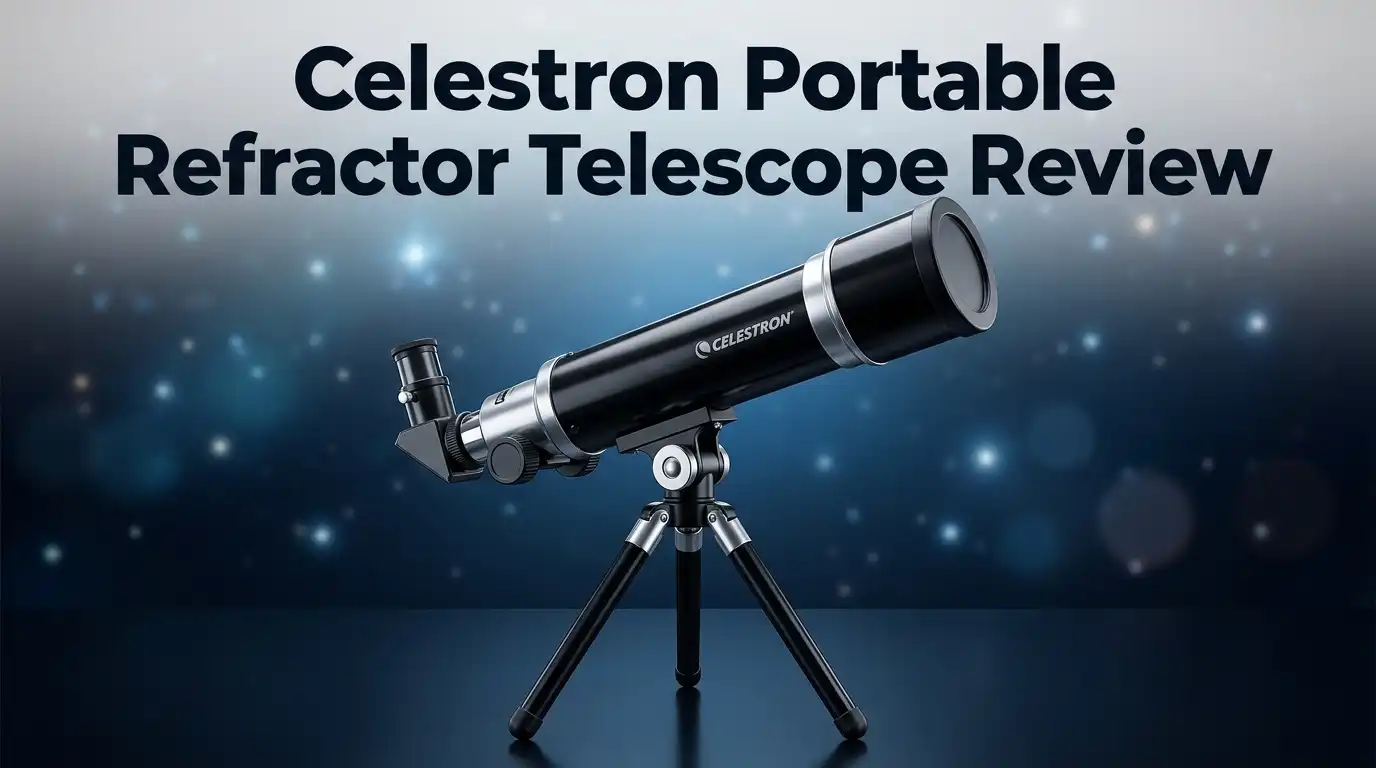
Celestron Portable Refractor Telescope Review 2026: Worth Packing?
You want a telescope you can actually carry. Not a giant tube that lives in a closet. That is the promise behind Celestron’s portable refractor line, and the Travel Scope 70 DX sits right at the center of it.
I spent several months with this telescope. I took it camping. I set it up on a picnic table. I dragged it into a dark field at 2 a.m. and froze my fingers focusing on Saturn.
This review covers what the scope does well, what it does badly, and who should skip it entirely. No marketing fluff. Just the real experience of using a 3.3 pound telescope under real skies.
In A Nutshell:
- The Travel Scope 70 DX is a travel first telescope. The entire kit weighs about 3.3 pounds and fits inside the included backpack. Portability is the single biggest reason to buy it, and it delivers on that promise better than almost any other scope at this price.
- The optics are honest, not amazing. A 70mm aperture with a 400mm focal length gives you sharp Moon views and small but clear planet views. Do not expect Hubble images. Expect a bright Moon, Saturn’s rings as a tiny oval, and four Jupiter moons as pinpricks.
- The tripod is the weakest part of the package. It shakes. Every touch of the focuser sends a wobble through the image that takes two or three seconds to settle. This is the number one complaint from real owners, and it is a fair one.
- Daytime performance surprises most buyers. The erect image diagonal makes this a genuinely useful spotting scope for birds, boats, and landscapes. Many people end up using it more in daylight than at night.
- Accessories add real value. You get two eyepieces, a 2x Barlow, a Moon filter, a smartphone adapter, and a Bluetooth shutter release. Buying those separately would cost a meaningful chunk of the telescope price.
- Beginners with backyard access may prefer a bigger scope. If you never plan to travel with it, spend the same money on a larger aperture instrument and get brighter views.
Why The Travel Scope 70 DX Deserves A Look In 2026


Last update on 2026-10-07 / Affiliate links / Images from Amazon Product Advertising API Some of the links on this website are affiliate links, which means that at no additional cost to you, I earn a commission if you click through and make a purchase. I only recommend products and services that I believe will add value to my readers. Thank you for your support!
Portable telescopes usually force a painful trade. You either get small and useless, or capable and heavy. The Travel Scope 70 DX lands in a narrow sweet spot where the compromise still feels worth it.
The optical tube measures roughly 17 inches long. It weighs under 2 pounds on its own. You can hold it in one hand while carrying coffee in the other.
Celestron has sold this design for years, and the DX version adds the pieces that the original kit lacked. The full height tripod, the smartphone adapter, and the Bluetooth remote all arrived with this upgrade.
The 2026 version ships with the same optics as previous years. Celestron did not redesign the glass. What changed over time is the accessory bundle and the backpack quality, both of which improved.
Here is the honest framing. This telescope competes with binoculars, not with big backyard reflectors. If your alternative purchase is a pair of 10×50 binoculars, the Travel Scope 70 DX gives you far more magnification and a real tripod mount.
If your alternative is a 6 inch Dobsonian sitting in your garage, the Travel Scope loses badly on image quality. It only wins when you need to fit a telescope into a suitcase or a bike pannier.
That is the whole pitch. Buy it because it travels, not because it outperforms.
Unboxing The Travel Scope 70 DX
The box arrives smaller than you expect. Mine measured about the size of a large shoebox stretched long. It felt light enough that I briefly wondered if something was missing.
Inside, everything sits in a molded cardboard tray. No foam. No plastic clamshell. Celestron keeps the packaging simple and recyclable.
The backpack comes folded flat at the bottom. Pull it out first. It has a padded main compartment for the tube, a long side sleeve for the tripod, and small mesh pockets for eyepieces.
The optical tube feels lighter than it looks. The tube body is aluminum with a plastic focuser assembly and a plastic dew shield end. That plastic focuser is your first clue about where Celestron saved money.
The tripod comes preassembled with the pan handle attached. You extend the legs, spread them, and lock three clamps. Total time from box to standing tripod ran about 90 seconds.
The accessory pouch holds a 20mm eyepiece, a 10mm eyepiece, a 45 degree erect image diagonal, a 2x Barlow lens, a Moon filter, and the smartphone adapter with its Bluetooth shutter.
The finderscope is permanently attached to the tube. You do not install it. That saves setup time but removes any option to upgrade it later.
First impression: the kit feels like good value and slightly cheap construction at the same time. Both things are true.
Specifications In Plain Language
Numbers on a spec sheet mean little until you translate them. Let me do that.
The aperture is 70mm, which is 2.8 inches. Aperture controls how much light the telescope collects. More light means brighter, more detailed images. 70mm is small, roughly double the light gathering of a good pair of binoculars.
The focal length is 400mm with a focal ratio of f/5.7. Short focal length means wide views and low magnification. This scope naturally shows big chunks of sky rather than tight closeups.
Magnification comes from dividing focal length by eyepiece focal length. The 20mm eyepiece gives you 20x. The 10mm gives you 40x. Adding the 2x Barlow doubles those to 40x and 80x.
Celestron lists a maximum useful magnification around 165x. Ignore that number. In real use, images fall apart above roughly 80x on this scope, and 40x to 60x is the sweet spot.
The optics are fully coated achromatic glass. Achromatic means two lens elements. It works well but produces some purple fringing around bright objects like the Moon and Venus.
Tripod height adjusts from about 22 inches to 52 inches. Total kit weight sits at 3.3 pounds. Tripod leg diameter is 1.25 inches, which explains the stability issues discussed later.
The focuser uses a rack and pinion design with a plastic housing. It moves smoothly enough but has noticeable play.
Setup And First Night Under The Sky
My first setup took four minutes including reading nothing. The second took under two.
You spread the tripod legs, tighten the clamps, then slide the optical tube onto the mount plate and turn the locking screw. Insert the diagonal, drop in the 20mm eyepiece, and you are observing.
The pan handle controls both axes. Loosen the clutch, swing the scope, retighten. It works, though the motion feels stiff at first and loosens up after a few sessions.
My first target was the Moon at 20x. The whole disc fit in the field of view with room around it. Craters along the terminator showed clear shadow detail. That single view justified the purchase for me.
Then I tried 40x with the 10mm eyepiece. Detail improved. So did the wobble. Every focus adjustment shook the image for two full seconds.
I found the workaround quickly. Focus, let go, wait, then look. Annoying but manageable.
Jupiter appeared as a small bright disc with two visible cloud bands at 40x. Four moons lined up beside it. Saturn showed an oval shape at 40x and a clear ring gap at 80x on a steady night.
The finderscope needs alignment before your first session. Do it in daylight on a distant tree or antenna. Skipping this step turns your first night into a frustrating hunt.
Top 3 Alternative for Celestron Travel Scope 70 DX

Last update on 2026-10-07 / Affiliate links / Images from Amazon Product Advertising API Some of the links on this website are affiliate links, which means that at no additional cost to you, I earn a commission if you click through and make a purchase. I only recommend products and services that I believe will add value to my readers. Thank you for your support!
Celestron Travel Scope 80mm Telescope Kit with Backpack

Last update on 2026-10-07 / Affiliate links / Images from Amazon Product Advertising API Some of the links on this website are affiliate links, which means that at no additional cost to you, I earn a commission if you click through and make a purchase. I only recommend products and services that I believe will add value to my readers. Thank you for your support!
Celestron AstroMaster 70AZ Refractor Telescope

Last update on 2026-10-07 / Affiliate links / Images from Amazon Product Advertising API Some of the links on this website are affiliate links, which means that at no additional cost to you, I earn a commission if you click through and make a purchase. I only recommend products and services that I believe will add value to my readers. Thank you for your support!
Celestron StarSense Explorer DX 102AZ Refractor Telescope
Moon And Planet Views Through The 70mm Lens
The Moon is where this telescope shines brightest. Literally.
At 20x, you see the full lunar disc with sharp edges. At 40x, individual craters resolve clearly. Copernicus, Tycho, and the Apennine mountain range all show real structure.
Add the Moon filter for anything past first quarter. A full Moon through 70mm of unfiltered aperture is genuinely uncomfortable and leaves an afterimage.
Purple fringing appears along the bright lunar limb. This is normal for a fast achromatic refractor. It does not ruin the view, but you will notice a violet halo on the sunlit edge.
Jupiter works well. You reliably see two equatorial cloud bands at 40x. The Galilean moons change position every night, which makes Jupiter a target worth revisiting.
Saturn is the crowd pleaser. At 80x with the Barlow, the rings separate from the planet body on a steady night. Titan shows as a faint dot nearby.
Mars disappoints. Even near opposition, it stays a small orange dot with almost no surface detail at these magnifications.
Venus shows phases clearly, which most people find surprising and delightful.
Bottom line on planets: you get real, recognizable views that beat any binocular. You do not get the detailed images shown in product listings, and no honest reviewer will tell you otherwise.
Deep Sky Views And Where They Fall Short
Deep sky observing is where 70mm of aperture hits its ceiling hard.
The good news first. The wide 400mm focal length makes this scope excellent for large, bright objects. The Pleiades cluster fits beautifully in the 20x view. The Double Cluster in Perseus looks genuinely impressive.
The Orion Nebula appears as a grey misty patch with the four Trapezium stars inside it. On a dark night, you can trace the wing shapes. It is a satisfying view.
The Andromeda Galaxy shows as an oval smudge. You see the bright core and a hint of the surrounding halo. No spiral arms. No dust lanes.
Globular clusters remain unresolved. M13 in Hercules looks like a fuzzy cotton ball rather than a ball of individual stars.
Faint galaxies, planetary nebulae, and most Messier objects beyond the top twenty simply do not appear. The light grasp is not there.
Light pollution makes this worse. From a suburban backyard, deep sky targets drop to maybe six or seven visible objects. From a dark rural site, that number jumps past thirty.
The honest summary: this telescope handles bright clusters and the two or three famous nebulae. Everything fainter requires more aperture. If deep sky observing is your main goal, this is the wrong purchase.
Daytime Spotting Scope Performance
This is the underrated half of the Travel Scope 70 DX, and it deserves attention.
The included 45 degree erect image diagonal corrects the view so images appear right side up and correctly oriented left to right. That makes daytime use natural instead of confusing.
At 20x, the view is bright, wide, and sharp across most of the field. Birds at 50 yards fill a satisfying portion of the view. Feather detail resolves well.
I used it to watch shorebirds from a beach parking lot. It outperformed my 8×42 binoculars on stationary subjects by a wide margin.
The 40x view works for distant landscapes and boats. Atmospheric heat shimmer usually limits you before the optics do, especially on warm afternoons.
Focus travel is quick, which helps when tracking moving subjects. The pan handle allows smooth horizontal sweeps if you keep the clutch slightly loose.
Limitations exist. The field of view is narrow compared with a dedicated spotting scope. Finding a small bird takes practice.
Eye relief on the 10mm eyepiece is tight. Glasses wearers will struggle at 40x and should observe without correction where possible.
For nature watching, camping trips, and general daytime observation, this scope earns its keep. Several owners report using it more in daylight than at night, and I understand why.
The Tripod Weakness You Should Know
Every honest review of this telescope must address the tripod. Here is mine.
The tripod legs measure 1.25 inches in diameter. That is thin. The material is lightweight aluminum with plastic clamps and a plastic head assembly.
Vibration is the result. Touch the focuser and the image jumps. Wait two seconds and it settles. Repeat this cycle for every single adjustment.
At 20x, the shake is mildly irritating. At 80x with the Barlow, it becomes the main obstacle between you and a good view.
Wind makes everything worse. Even a light breeze keeps the image in constant low level motion at higher magnifications.
I found three practical fixes. First, hang a weight from the tripod center. A water bottle in a bag works and cuts settling time roughly in half.
Second, shorten the legs. Running the tripod at 30 inches instead of 52 inches improves stability noticeably. Sit in a low chair instead.
Third, place the tripod on grass or soil rather than concrete or a wooden deck. Soft ground absorbs vibration.
The best fix costs money. A decent photo tripod with 1.5 inch legs transforms this telescope. The tube attaches with a standard mount plate, so any sturdy tripod works.
Celestron built this tripod for weight, not stability. That was a deliberate choice for a travel product, and you should factor a tripod upgrade into your budget.
Smartphone Photos Through The Eyepiece
The DX version includes a smartphone adapter and a Bluetooth shutter release. This combination works better than I expected.
The adapter clamps over the eyepiece with a rigid frame. Two tightening knobs hold the phone. Setup takes about a minute once you learn the alignment trick.
Note that thick or folio style phone cases must come off. Mine did not fit until I removed the case entirely.
The Bluetooth remote matters more than it sounds. Tapping your phone screen shakes the whole assembly. The remote lets you fire the shutter without touching anything.
Moon photos come out genuinely good. I captured shots with clear crater detail that people assumed came from a much larger telescope. The Moon is bright enough that your phone camera handles it easily.
Planets are much harder. Jupiter appears as a small overexposed dot in most phone shots. You need manual exposure control and a lot of patience.
Deep sky photography is not possible with this setup. The alt azimuth mount does not track, and exposures longer than a second produce star trails.
Daytime digiscoping works nicely. Bird photos through the eyepiece turn out sharp when the subject stays still.
Set your expectations at Moon photos and daytime shots. Within those limits, the smartphone kit delivers real results that are fun to share.
Pros And Cons Of The Celestron Travel Scope 70 DX
Here is the balanced view after months of use.
Pros
- Genuinely portable at 3.3 pounds total. The full kit fits in the included backpack and travels in carry on luggage without trouble.
- Setup takes under two minutes. No collimation, no cool down period, no complicated assembly. Point it and observe.
- Excellent Moon views. Crater detail at 40x satisfies both beginners and experienced observers who just want a quick look.
- Strong daytime performance. The erect image diagonal makes it a legitimate spotting scope for birds and landscapes.
- Complete accessory bundle. Two eyepieces, Barlow, Moon filter, diagonal, smartphone adapter, and Bluetooth shutter all included.
- Low maintenance. Sealed refractor optics need no alignment and rarely need cleaning.
- Good value for the price. The bundle costs less than buying comparable accessories separately.
Cons
- The tripod shakes badly. Vibration at higher magnifications is the single biggest flaw and affects every observing session.
- Small aperture limits deep sky views. Most galaxies and faint nebulae remain invisible.
- Purple fringing on bright objects. The achromatic design produces visible color halos on the Moon and Venus.
- Plastic focuser has play. Fine focusing requires patience and gentle hands.
- The finderscope is fixed and basic. You cannot upgrade it, and its small aperture makes locating faint targets difficult.
- Tight eye relief at 40x. Glasses wearers will find the 10mm eyepiece uncomfortable.
- Included eyepieces are entry level. Edge sharpness drops noticeably in the outer third of the field.
What This Telescope Does Not Do Well
Let me be direct about the failures, because product listings never are.
It does not deliver the images shown in advertising. Marketing photos of colorful nebulae come from long exposure astrophotography with expensive equipment. Your eye will see grey smudges.
It does not handle high magnification. Anything past 80x turns mushy. The 2x Barlow paired with the 10mm eyepiece pushes the optics past their comfortable limit.
It does not track objects. The alt azimuth mount is fully manual. At 80x, Jupiter drifts out of view in under 30 seconds and you must nudge it constantly.
This constant nudging combines with the tripod shake to create real frustration. You nudge, it wobbles, you wait, the object has drifted again.
It does not work well for astrophotography beyond the Moon. No tracking means no long exposures. No long exposures means no deep sky images.
It does not replace a proper beginner telescope for backyard use. If portability is not your priority, a 130mm reflector at a similar price shows far more.
The focuser does not feel precise. There is measurable slop between turning the knob and the drawtube moving. Fine focus becomes a small skill you develop.
The backpack does not protect against impact. Padding is thin. Treat it as a carry solution, not a hard case.
Knowing these limits before purchase turns disappointment into satisfaction. A telescope used within its abilities is a good telescope.
Celestron StarSense Explorer LT 80AZ As A Step Up

Last update on 2026-10-07 / Affiliate links / Images from Amazon Product Advertising API Some of the links on this website are affiliate links, which means that at no additional cost to you, I earn a commission if you click through and make a purchase. I only recommend products and services that I believe will add value to my readers. Thank you for your support!
If the Travel Scope feels too limited, the StarSense Explorer LT 80AZ is the logical next step for many buyers.
The core difference is the StarSense smartphone technology. You dock your phone in a cradle on the telescope. The app uses your phone camera to identify the star field and match it against a database.
Arrows appear on your screen. You move the telescope until the arrows turn into a bullseye. Your target sits in the eyepiece.
This solves the biggest beginner problem, which is finding things. Instead of hunting blindly for the Andromeda Galaxy, you follow arrows for 20 seconds.
The optics step up modestly. Aperture increases from 70mm to 80mm, and focal length grows to 900mm. That longer focal length gives higher magnification and better planetary views.
The tradeoff is portability. The LT 80AZ tube measures roughly 36 inches long and the whole setup weighs several times more than the Travel Scope. It does not fit in a backpack.
The tripod is sturdier but still not excellent. Some wobble remains, though the settling time is shorter.
Choose the LT 80AZ if you observe from home and struggle to find objects. Choose the Travel Scope 70 DX if your telescope needs to fit in a suitcase.
Who Should Buy The Travel Scope 70 DX
This telescope fits specific people very well and disappoints everyone else.
Buy it if you travel often. Campers, road trippers, and people who fly with luggage restrictions get real value here. No other telescope this capable packs this small.
Buy it if you want a dual purpose optic. The daytime spotting scope function makes this useful year round, not just on clear nights.
Buy it as a second telescope. Owners of large backyard scopes often keep a grab and go instrument for quick sessions and vacations. This fills that role cheaply.
Buy it for an older child or teenager. It is durable, simple, and light enough for them to set up alone. The smartphone photography angle keeps interest alive.
Skip it if you have backyard space and no travel plans. A 130mm tabletop reflector costs similar money and shows three times as much.
Skip it if deep sky observing excites you most. Galaxies and faint nebulae need aperture that this scope does not have.
Skip it if you want astrophotography. The manual mount rules out anything beyond Moon snapshots.
Skip it if high magnification planetary detail is your goal. A longer focal length scope serves that purpose far better.
Match the tool to the job. This tool is built for portability above all else, and it does that job honestly.
Final Verdict On The Celestron Portable Refractor In 2026
After months of use, my view is settled. The Travel Scope 70 DX is a good product with clearly defined limits.
It earns roughly four stars out of five for travelers and about two and a half stars for backyard only observers. Your use case determines the score.
The optics perform as expected for 70mm achromatic glass. Moon views are genuinely enjoyable. Planets are recognizable. Bright clusters look lovely.
The tripod remains the weak link and always will be. Budget for a better one if you plan serious use, or accept the workarounds described earlier.
The accessory bundle is the quiet strength of this package. Getting a Barlow, Moon filter, two eyepieces, a smartphone adapter, and a Bluetooth remote in one box is genuinely good value.
Celestron has not changed the core design in years, which tells you the formula works. The 2026 package is the same proven scope with a refined bundle.
Would I recommend it? Yes, with conditions clearly stated. Buy it as a portable, quick, low commitment window on the sky.
Do not buy it expecting a serious astronomy instrument. Buy it expecting a light, friendly telescope that makes stargazing convenient enough that you actually do it.
Convenience beats capability when capability sits unused in a closet. That is the real argument for this telescope, and it is a strong one.
Frequently Asked Questions
Is the Celestron Travel Scope 70 DX good for beginners?
Yes, with realistic expectations. Setup is simple, nothing needs alignment, and the included accessories cover everything a new observer needs. The learning curve is gentle. Beginners who expect detailed galaxy views will feel let down, so understanding the aperture limits before purchase matters more than anything else.
Can you see Saturn’s rings with a 70mm telescope?
Yes. At 40x you see an oval shape. At 80x with the included Barlow lens, the rings separate visibly from the planet body on steady nights. The view is small but unmistakable, and most people find it genuinely thrilling the first time.
How far can the Travel Scope 70 DX see?
Distance is the wrong measure for telescopes. Light gathering matters instead. This scope shows objects millions of light years away, such as the Andromeda Galaxy, but only as faint smudges. Brightness, not distance, sets the limit on what you can observe.
Does the Travel Scope 70 DX need collimation?
No. Refractor telescopes have sealed lens assemblies that stay aligned permanently. Unlike reflector telescopes, you never adjust mirrors. This is one of the genuine advantages of a refractor design for travel and for beginners.
Can I use my phone to take photos through this telescope?
Yes. The DX version includes a smartphone adapter and Bluetooth shutter release. Moon photography produces good results. Planetary and deep sky photography do not work well because the mount does not track objects across the sky.
What is the maximum useful magnification?
Celestron lists around 165x, but real world performance tops out near 80x. Beyond that, images become dim and soft. The most enjoyable range sits between 20x and 60x for both astronomy and daytime viewing.
Should I upgrade the tripod?
If you observe regularly, yes. Any sturdy photo tripod with legs thicker than 1.5 inches transforms the experience by removing most vibration. The optical tube uses a standard mount plate, so compatibility is rarely an issue.
Is the Travel Scope 80 worth the extra money over the 70?
The 80mm version gathers roughly 30 percent more light and shows slightly brighter images. It also weighs more and costs more. For most travelers, the 70 DX offers the better balance, while home observers benefit more from the 80mm.

Hello, i’m Ivoria i am the face behind Tech Tracker Blog. I am passionate about my work and love to explore gadgets and share about my experience.