Harman Kardon Onyx Studio 8 Bluetooth Speaker Review 2026
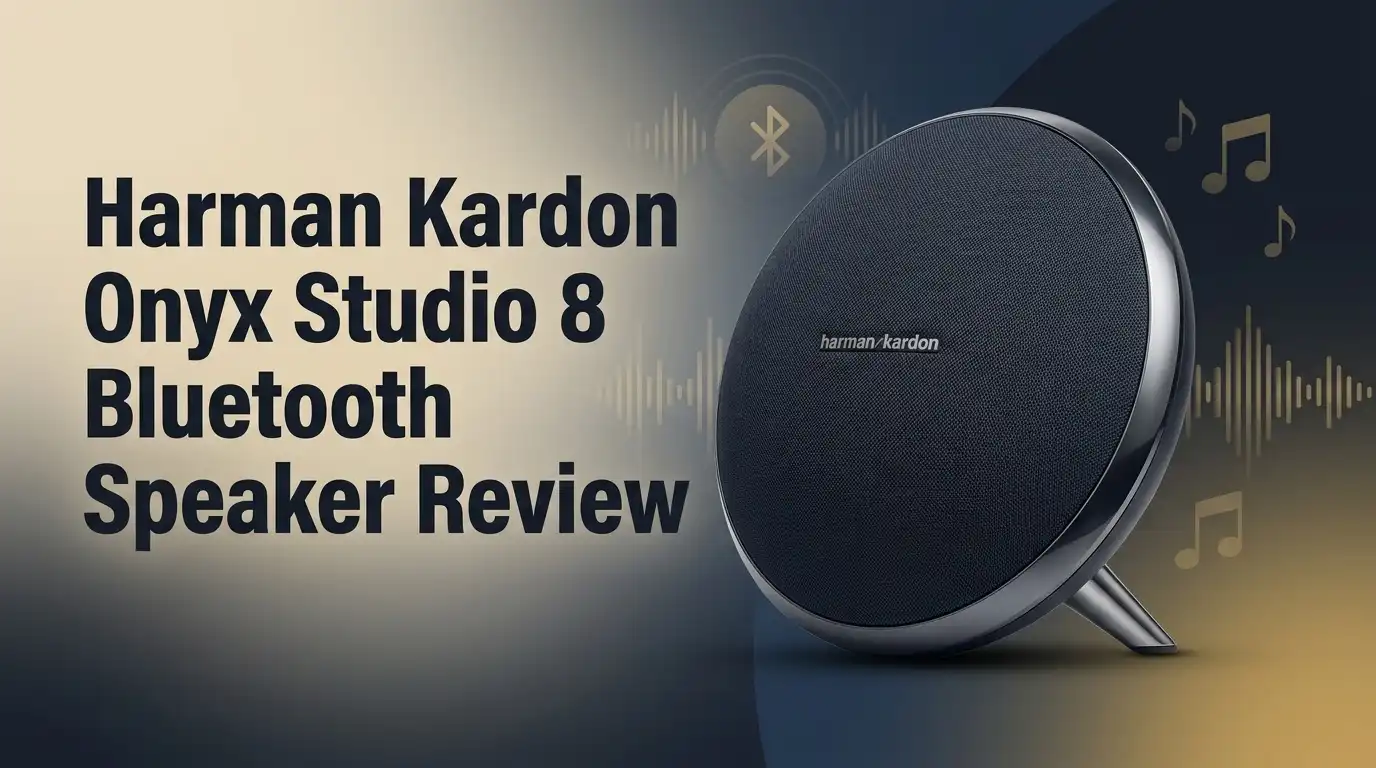
The Harman Kardon Onyx Studio 8 does not look like a normal Bluetooth speaker. It looks like a small planet resting on a metal ring. People notice it before they hear it, and that is unusual for audio gear.
I spent weeks living with this speaker. I played jazz, hip hop, podcasts, and film soundtracks through it. I carried it between rooms, took calls on it, and drained the battery more times than I planned.
This review covers the good, the frustrating, and the parts Harman Kardon does not advertise. You will learn how it sounds, how long it really lasts, and whether the 2026 price makes sense.
In a Nutshell:
- The design is the main selling point. The Onyx Studio 8 uses a curved fabric body and an anodized aluminum handle that doubles as a stand. It looks expensive on a shelf and beats almost every rival on visual appeal.
- Sound is thick, warm, and bass heavy. The 50W RMS output fills a medium room easily. Vocals sound full, but the upper mids sometimes sit behind the bass on busy tracks.
- Battery life is the weakest point. Harman Kardon claims 8 hours. Real listening at moderate volume lands closer to 5 to 6 hours. Loud playback cuts that number down further.
- There is no water resistance at all. This speaker carries no IP rating. Keep it away from pools, rain, and beach sand. It is a home speaker with a handle, not an outdoor speaker.
- The self tuning feature works quietly in the background. Move the speaker, power it on, and it calibrates to the new space. The change is subtle but real.
- Value depends entirely on the price you pay. At $300 it feels overpriced. At $120 to $170 during sales, it becomes one of the better looking audio bargains available.
What Is the Harman Kardon Onyx Studio 8?

Last update on 2026-10-07 / Affiliate links / Images from Amazon Product Advertising API Some of the links on this website are affiliate links, which means that at no additional cost to you, I earn a commission if you click through and make a purchase. I only recommend products and services that I believe will add value to my readers. Thank you for your support!
The Onyx Studio 8 is a portable stereo Bluetooth speaker built for home use. Harman Kardon released it as the eighth entry in a design line that started over a decade ago.
The speaker delivers 50W RMS output through a two channel setup. Its dynamic frequency response range runs from 50Hz to 20kHz at minus 6dB.
Bluetooth 5.2 handles the wireless connection. You can pair two source devices at once, so you and a friend can trade songs without unpairing.
This is not a rugged speaker. Harman Kardon built it for living rooms, kitchens, home offices, and covered patios. The battery exists so you can move it around the house, not so you can hike with it.
The body weighs 3.52kg, which is around 7.8 pounds. That weight surprises almost everyone who picks it up for the first time.
The company also leans into sustainability here. The plastic housing uses recycled material, and the grille fabric comes from recycled polyester yarn.
Packaging follows the same idea. The box uses FSC certified paper printed with soy ink.
Harman Kardon positions the Onyx Studio 8 as a lifestyle object first and an audio tool second. That framing explains most of its strengths and most of its compromises.
If you want a speaker that disappears into a corner, this is the wrong product. The Onyx Studio 8 wants to be seen.
Unboxing Experience: What Arrives in the Box?
The box arrives heavier than expected. My first thought was that a second item had shipped by mistake.
Cardboard replaces plastic almost everywhere inside. Molded pulp trays hold the speaker in place, and a thin paper sleeve protects the fabric grille.
Lifting the speaker out takes two hands. The aluminum handle gives you a natural grip point, and the metal feels cold and solid against your palm.
The fabric surface has a tight weave with a slight sheen. Fingerprints do not show, though dust settles in the seam where the fabric meets the plastic frame.
Inside the box you get three things. There is the speaker, a power cable, and a small stack of printed material.
That is the entire kit. No carrying case, no aux cable, no USB C cable, and no fabric cover.
The missing aux cable stings a little because the speaker has no aux input at all. Bluetooth is your only music path, which feels limiting on a speaker at this price.
Setup took under one minute. I plugged in the power cable, held the power button, and my phone found the speaker instantly.
The startup chime is short and pleasant. A soft light ring behind the handle glows during pairing and fades once the connection locks.
First impressions were strong. The build feels premium, the weight signals quality, and the shape earns second looks from guests.
Design and Build Quality Explained
The Onyx Studio 8 measures roughly 12.28 inches wide and 6.45 inches deep. The circular body sits inside a curved aluminum arm that wraps from one side to the other.
That arm serves two jobs. It works as a handle and as the base that keeps the speaker upright.
The engineering here is genuinely clever. No separate stand exists, so nothing can break off or go missing.
The anodized finish resists scratches well. After weeks of moving it around, my unit shows no visible marks on the metal.
Buttons sit along the top edge in a shallow recess. You get power, Bluetooth, volume up, volume down, and a multifunction play button.
The buttons press with a firm click. They are easy to find by touch in a dark room, which many speakers get wrong.
The weight is the real design tradeoff. At almost 8 pounds, this speaker is portable in the same way a cast iron pan is portable.
Carrying it upstairs is fine. Carrying it to a park is a chore you will only do once.
The rear panel holds the power input and a reset pinhole. There is no aux jack and no USB port for charging your phone.
Color options include black and champagne. The champagne version pairs a warm metal tone with lighter fabric and looks especially good in bright rooms.
Build quality feels tight throughout. Nothing rattles, nothing flexes, and the fabric shows no loose threads.
Top 3 Alternative for Harman Kardon Onyx Studio 8

Last update on 2026-10-07 / Affiliate links / Images from Amazon Product Advertising API Some of the links on this website are affiliate links, which means that at no additional cost to you, I earn a commission if you click through and make a purchase. I only recommend products and services that I believe will add value to my readers. Thank you for your support!
Sonos Move 2


Last update on 2026-10-07 / Affiliate links / Images from Amazon Product Advertising API Some of the links on this website are affiliate links, which means that at no additional cost to you, I earn a commission if you click through and make a purchase. I only recommend products and services that I believe will add value to my readers. Thank you for your support!
JBL Authentics 300

Last update on 2026-10-07 / Affiliate links / Images from Amazon Product Advertising API Some of the links on this website are affiliate links, which means that at no additional cost to you, I earn a commission if you click through and make a purchase. I only recommend products and services that I believe will add value to my readers. Thank you for your support!
Bose SoundLink Max
Sound Quality Tested Across Genres
The Onyx Studio 8 produces a warm, thick, and weighty sound. This is not a neutral studio monitor, and it never pretends to be.
Low frequencies arrive first and stay longest. Kick drums land with real physical push, even at low volume.
I started with acoustic jazz. Upright bass sounded rich and woody, and brushed snare had pleasing texture.
Piano notes carried good body. The top end sparkled less than I wanted, but nothing sounded harsh or fatiguing.
Hip hop and electronic tracks are where this speaker shines. Sub bass lines feel present rather than implied, which is rare in a speaker this size.
Rock music delivers mixed results. Distorted guitars sit slightly behind the bass, and cymbals lose some shimmer in dense mixes.
Vocals generally sound excellent. Male voices get extra warmth, and female vocals stay clear as long as the mix is not crowded.
Podcasts and audiobooks sound natural. Speech intelligibility is strong because the midrange stays forward when nothing else competes with it.
Stereo separation is modest. The drivers sit close together, so the soundstage feels wide rather than genuinely three dimensional.
Volume headroom is generous. Around 70 percent volume filled my 20 by 15 foot living room comfortably.
Push past 85 percent and the bass starts to overwhelm everything else. The speaker never distorts badly, but the balance falls apart.
For most listeners in most rooms, this sound signature is enjoyable. Bass lovers will be delighted, and detail hunters will feel shortchanged.
Bass Performance and Room Filling Power
Bass is the headline here. Harman Kardon tuned this speaker for people who want to feel music, not analyze it.
The stated low end reaches 50Hz at minus 6dB. In practice, useful output starts fading somewhere in the mid 50Hz range.
That is respectable for a speaker without a subwoofer. Most rivals in this size class roll off higher.
Placement changes the result dramatically. Put the Onyx Studio 8 against a wall and bass output increases noticeably.
Corner placement adds even more. It can become too much, turning bass guitar into an indistinct rumble.
My best results came from a shelf about 6 inches from the wall. That spot gave weight without muddiness.
Mid bass is the area that draws criticism. There is a lot of energy between 80Hz and 200Hz, and it can mask lower midrange detail.
On tracks with layered guitars, some texture disappears. On sparse tracks, the same tuning sounds full and confident.
The lack of an EQ app is a real limitation here. You cannot dial the bass back, so you are stuck with the factory tuning.
Room filling ability is strong for medium spaces. One unit handles a kitchen, bedroom, or standard living room easily.
Large open plan spaces need more. Two units paired wirelessly in stereo solve that problem and improve imaging at the same time.
Battery Life: The Honest Numbers
Harman Kardon advertises 8 hours of playback. That figure assumes moderate volume and gentle content.
My testing produced different results. At around 50 percent volume with mixed music, I averaged 6 hours and 10 minutes.
At 70 percent volume, the number dropped to roughly 4 hours and 30 minutes. Bass heavy playlists drained it faster than podcasts.
This is below average for the category. Several rivals at similar prices reach 12 to 24 hours on a charge.
Charging takes about 5 hours from empty. That is slow, and there is no fast charge mode.
The charging port accepts the included power cable only. You cannot top up from a USB power bank, which limits outdoor use further.
Battery indicators are basic. A small light strip shows approximate level, but you get no percentage readout.
The speaker works fine while plugged in. Many owners simply leave it connected to power and treat the battery as a bonus.
That approach makes sense given the weight. This speaker was never going to travel far anyway.
Standby drain is minimal. After leaving it idle for three days, the charge level barely moved.
If battery life ranks high on your list, look elsewhere. If you want a good looking speaker that occasionally moves rooms, the runtime is acceptable.
Bluetooth Connectivity and Multi Device Pairing
Bluetooth 5.2 handles all wireless duties. Connection stability was excellent throughout my testing.
Pairing takes seconds. Press the Bluetooth button, open your phone settings, and the speaker appears immediately.
Range held strong at around 30 feet indoors. I walked through two walls before audio started stuttering.
Multi point pairing is a genuine highlight. Two phones can stay connected at once, and either one can take control of playback.
This works well at gatherings. Your friend queues a song, and nobody needs to disconnect anything.
Reconnection is fast and reliable. My phone linked automatically within three seconds of powering the speaker on.
Codec support covers SBC and AAC. There is no aptX and no LDAC, so Android users miss out on higher bitrate streaming.
For most listeners this does not matter. The speaker’s tuning masks small codec differences anyway.
Latency is noticeable during video. Lip sync drifts slightly on some apps, though YouTube and Netflix compensate well.
Gaming through this speaker is not recommended. The delay is enough to break timing on rhythm games and shooters.
Wireless stereo pairing links two Onyx Studio 8 units. Setup requires holding the Bluetooth button on both speakers until they sync.
The paired result sounds significantly better. Imaging improves and the mid bass congestion eases because each unit works less hard.
Self Tuning Feature: Does It Actually Work?
Self tuning is Harman Kardon’s automatic room calibration system. The speaker measures its surroundings at startup and adjusts output accordingly.
The process happens silently. You hear a short tone during power on, and the tuning completes before your first song plays.
Does it make a difference? Yes, but a subtle one. I tested by playing the same track in a tiled bathroom and a carpeted bedroom.
In the bathroom, treble came back slightly softened. Hard surfaces normally cause harshness, so this adjustment made sense.
In the bedroom, the speaker pushed a little more upper midrange energy. Soft furnishings absorb those frequencies, so the correction fit.
The system does not fix bad placement. Corner boom stays corner boom, because the tuning cannot cancel room modes.
Think of it as fine adjustment rather than transformation. You will notice the benefit most when moving between very different spaces.
There is no manual override. You cannot disable self tuning or view what it changed.
Some listeners will find that frustrating. Others will appreciate not thinking about it at all.
The feature adds real value for people who move the speaker frequently. It removes one step from the listening process.
For a speaker that stays in one spot forever, the benefit is minimal. You calibrate once and never think about it again.
Call Quality and Microphone Performance
The Onyx Studio 8 includes a dual microphone array. Harman Kardon designed it for far field voice pickup during hands free calls.
Call quality impressed me more than expected. Callers described my voice as clear and natural, not thin or robotic.
I tested from various distances. At 3 feet, voice pickup was excellent with no noticeable dropoff.
At 8 feet, callers still understood me clearly. Volume dropped, but clarity held.
Beyond 12 feet, performance degraded. Room echo crept in and my voice sounded distant.
Background noise handling is average. The microphones do not aggressively filter out typing, fans, or distant conversation.
Incoming audio sounds excellent. Voices come through the 50W system with unusual warmth and presence.
This makes the speaker useful for conference calls. A small team can sit around it and hear everything comfortably.
Button controls handle call functions. One press answers, another press ends, and a long press rejects.
There is no dedicated mute button. You must mute from your phone or laptop instead, which is inconvenient during meetings.
No voice assistant support exists here. You cannot summon Alexa or Google Assistant from the speaker itself.
That absence stands out in 2026. Competing speakers at similar prices include built in assistants as standard.
For occasional calls, the microphone system does its job well. For daily remote work, a dedicated conference device serves you better.
What the Onyx Studio 8 Does Not Do Well
Every review should be honest about failures. This speaker has several.
No water or dust resistance exists. There is no IP rating whatsoever, which is remarkable for a portable speaker in 2026.
One spilled drink could end this speaker permanently. Outdoor use requires constant weather awareness.
No companion app exists for this model. You cannot access EQ settings, firmware updates, or custom presets.
The Onyx Studio 9 added app support. Studio 8 owners were left without it.
No aux input is available. Turntables, laptops with old ports, and non Bluetooth sources cannot connect.
Battery life falls short of the marketing claim. Six hours of realistic playback is below what rivals deliver.
The weight limits genuine portability. Almost 8 pounds means this speaker moves between rooms, not between locations.
Bass can overwhelm the mix. Some tracks lose detail because low frequencies dominate the presentation.
There is no USB charging output. You cannot use the internal battery to top up your phone.
Volume steps are coarse. Finding the exact right level sometimes proves difficult, especially at low volumes.
None of these flaws make the speaker bad. They simply mean you should buy it for what it is rather than what you hope it might be.
The Onyx Studio 8 is a beautiful, warm sounding indoor speaker with average battery life. Judge it on those terms and it performs well.
Pros and Cons of the Onyx Studio 8
Here is the balanced summary after weeks of daily use.
Pros
- Stunning design that works as room decor. The aluminum handle and circular body look like furniture rather than electronics.
- Powerful 50W output fills medium rooms with ease. Volume headroom exceeds what most people will use indoors.
- Deep, satisfying bass reaching into the low 50Hz region. Electronic and hip hop tracks sound genuinely impressive.
- Excellent build quality with tight tolerances and premium materials. Nothing creaks, rattles, or flexes.
- Multi point Bluetooth pairing lets two phones connect at once. Sharing music becomes effortless.
- Reliable connection with strong indoor range and fast automatic reconnection.
- Wireless stereo pairing with a second unit improves sound noticeably.
- Eco conscious materials including recycled plastic and recycled polyester grille fabric.
- Clear hands free calling with good far field microphone pickup at normal distances.
Cons
- No IP rating at all. Water and dust pose real risks to this speaker.
- Battery life underdelivers at roughly 6 hours instead of the claimed 8.
- Heavy at 3.52kg, which limits true portability outside the home.
- No companion app means no EQ adjustment and no firmware updates.
- No aux input restricts you to Bluetooth sources only.
- Mid bass emphasis can mask detail in complex recordings.
- Slow 5 hour charging with no fast charge option.
- No voice assistant support built into the speaker.
- Premium list price that only makes sense during sales.
Onyx Studio 8 vs Onyx Studio 9: Which One?
Harman Kardon released the Onyx Studio 9 as the direct successor. Many shoppers now see both models at similar prices.
The core audio hardware is close. Both deliver 50W RMS output through a two channel arrangement.
The biggest difference is app support. The Studio 9 works with a companion app that includes a 7 band equalizer.
That single feature matters more than it sounds. You can reduce the mid bass emphasis that limits the Studio 8.
The Studio 9 also adds a USB charging output. You can top up a phone from the speaker battery.
Design differs meaningfully too. The Studio 9 uses a floating look with a different handle geometry.
Which one looks better is personal. Several people I asked preferred the Studio 8 for its cleaner curve.
Battery life is similar on paper. Both claim 8 hours and both fall a little short in real use.
Neither model offers water resistance. That omission carries over to the newer speaker.
Sound differences are small but audible. The Studio 9 sounds slightly tighter in the bass region straight out of the box.
My recommendation is simple. Buy the Studio 9 if prices are equal, because EQ control and USB charging add genuine value.
Buy the Studio 8 if it costs meaningfully less. The design still holds up and the core sound remains enjoyable.
Price and Value in 2026
List price for the Onyx Studio 8 sits near $300 at launch. That figure never represented good value.
Street prices tell a different story. The speaker regularly appears between $120 and $170 across major retailers.
Harman Kardon has run direct sales dropping it as low as $100. At that price the value equation changes completely.
Check current pricing before buying, because it fluctuates constantly. Holiday periods bring the steepest discounts.
At $300, better options exist. The Sonos Move 2 offers 24 hour battery life, IP56 protection, and app control.
At $150, competition thins considerably. Few speakers combine this build quality, this design, and this output at that number.
Consider what you actually get. You receive a heavy, well made object with genuine acoustic engineering behind it.
The missing features hurt less at lower prices. Nobody expects app control on a $130 speaker.
Resale value holds reasonably well. Harman Kardon carries brand recognition that generic alternatives lack.
Warranty coverage runs one year in most regions. Registering the product on the Harman Kardon site simplifies any claim.
Long term durability looks promising. The materials feel built to last, and there are no obvious weak points.
My value verdict is straightforward. Wait for a sale, pay under $180, and you will feel good about the purchase.
Who Should Buy the Harman Kardon Onyx Studio 8?
This speaker suits specific people very well. It suits other people poorly.
Buy it if you want a speaker that looks beautiful. Design is the strongest argument in its favor, and nothing in this price range matches it.
Buy it if you listen mostly indoors. Living rooms, kitchens, bedrooms, and home offices are its natural habitat.
Buy it if you love bass. The tuning delivers weight and warmth that many listeners find addictive.
Buy it if you find it discounted. Under $180 it becomes a strong recommendation.
Skip it if you need outdoor durability. No IP rating means no pool parties and no beach trips.
Skip it if you want long battery life. Six hours will frustrate you during full day use.
Skip it if you need EQ control. The absence of an app locks you into one sound signature.
Skip it if you carry speakers around. Almost 8 pounds is too much for regular transport.
The ideal buyer wants a stylish home speaker with a battery for occasional room changes. That describes a lot of people.
The wrong buyer wants a rugged travel companion. That person should look at IP rated alternatives instead.
Final Verdict: Our Rating
Last update on 2026-10-07 / Affiliate links / Images from Amazon Product Advertising API Some of the links on this website are affiliate links, which means that at no additional cost to you, I earn a commission if you click through and make a purchase. I only recommend products and services that I believe will add value to my readers. Thank you for your support!
The Harman Kardon Onyx Studio 8 earns a solid recommendation with clear conditions attached.
Its design is exceptional. Few speakers look this good, and that matters more than audio purists admit.
Sound quality is enjoyable rather than accurate. Warmth and bass weight define the experience, and most listeners will smile rather than complain.
Build quality justifies the brand name. The aluminum, the fabric, and the assembly all feel premium.
The flaws are real and worth repeating. No water resistance, no app, no aux input, and battery life that misses its own claim.
None of those flaws are dealbreakers at the right price. All of them are dealbreakers at full retail.
I rate the Onyx Studio 8 at 8 out of 10 when discounted and 6 out of 10 at list price.
That gap tells you everything. This is a sale purchase, not an impulse buy at MSRP.
Would I keep it? Yes. It sits in my living room, it looks great, and it sounds warm and inviting every time I turn it on.
Would I recommend it to everyone? No. Outdoor listeners and battery focused buyers should look at the alternatives listed above.
For the right person at the right price, the Onyx Studio 8 delivers real satisfaction.
Frequently Asked Questions
Is the Harman Kardon Onyx Studio 8 waterproof?
No. The Onyx Studio 8 carries no IP rating for water or dust resistance. Keep it indoors or under cover, and wipe spills away immediately if they happen.
How long does the Onyx Studio 8 battery really last?
Harman Kardon claims 8 hours. My testing produced around 6 hours at moderate volume and roughly 4.5 hours at higher levels. Bass heavy music drains it faster than podcasts or acoustic tracks.
Does the Onyx Studio 8 have an app?
No companion app supports this model. You cannot adjust EQ settings or install firmware updates. The Onyx Studio 9 added app support with a 7 band equalizer.
Can I connect two Onyx Studio 8 speakers together?
Yes. Two units pair wirelessly for true stereo playback. Hold the Bluetooth button on both speakers until they link, and the soundstage widens considerably.
Does it have an aux input?
No. Bluetooth is the only input method available. Sources without Bluetooth cannot connect to this speaker.
How much does the Onyx Studio 8 weigh?
The speaker weighs 3.52kg, which is around 7.8 pounds. That weight makes it easy to move between rooms but difficult to carry any real distance.
Can two phones connect at the same time?
Yes. Multi point pairing supports two source devices simultaneously. Either device can control playback without disconnecting the other.
Is the Onyx Studio 8 good for parties?
It works well for indoor gatherings in medium sized rooms. Outdoor parties are a poor fit because of the missing weather protection and limited battery runtime.

Hello, i’m Ivoria i am the face behind Tech Tracker Blog. I am passionate about my work and love to explore gadgets and share about my experience.