Marshall Acton III Bluetooth Speaker Review 2026: Still Worth It?
The Marshall Acton III looks like a guitar amp that shrank in the wash. That is the whole point. It sits on a shelf, plays music loudly, and makes people ask questions about it.
I have spent weeks living with this speaker. I played rock, hip hop, jazz, podcasts, and film scores through it. I turned the knobs, cursed the app, and pushed the volume past sensible levels.
This review covers the good parts and the annoying parts. Marshall fans will love some of what follows. Spec chasers will not. Keep reading, because the Acton III is one of the most misunderstood speakers on the market right now.
In a Nutshell:
- Sound quality punches above its size. The Acton III uses one 30 watt Class D amplifier for the woofer and two 15 watt Class D amplifiers for the tweeters. Total output reaches 60 watts. Frequency range runs from 45 Hz to 20,000 Hz. The soundstage feels wider than the cabinet suggests.
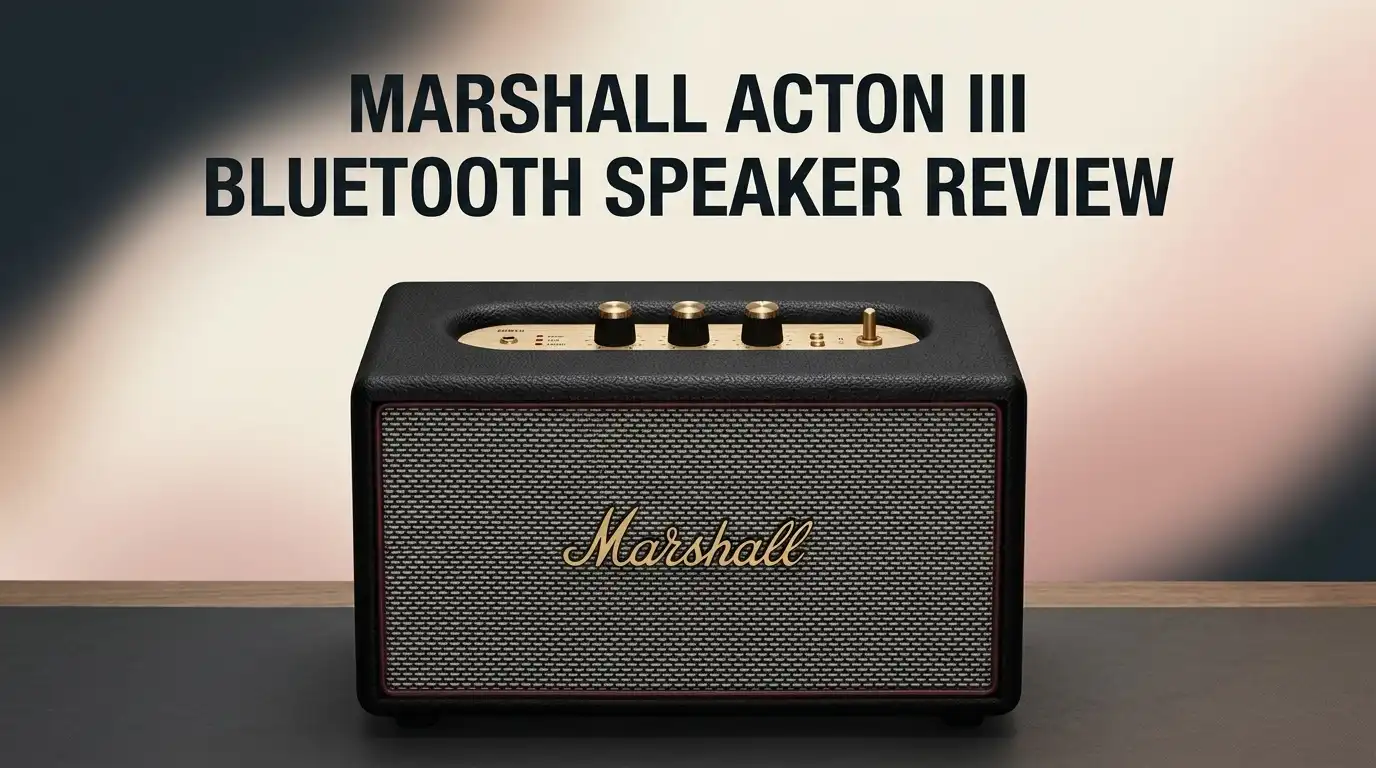
- The design is the main attraction. Brass knobs, textured vinyl, a script logo, and a fret cloth grille. It comes in black, cream, and brown. This speaker earns compliments in a way most black plastic boxes never will.
- Physical controls beat app controls. Real volume, bass, and treble knobs sit on the top plate. Red LEDs glow as you turn them. Tactile control feels great every single day.
- The feature list is thin for the price. No WiFi. No voice assistant. No microphone. No speakerphone. No stereo pairing. Bluetooth 5.2 with SBC codec only, which means no AAC and no aptX.
- Distortion appears at extreme settings. Push volume and bass to maximum together and bass heavy tracks turn muddy. Dial either one back and the problem disappears completely.
- Price swings widely. List price sits at $279.99 to $299. Sale prices have dropped near $179. At sale pricing this speaker becomes a genuinely easy recommendation.
Marshall Acton III Bluetooth Speaker Overview


Last update on 2026-10-04 / Affiliate links / Images from Amazon Product Advertising API Some of the links on this website are affiliate links, which means that at no additional cost to you, I earn a commission if you click through and make a purchase. I only recommend products and services that I believe will add value to my readers. Thank you for your support!
The Acton III is the smallest speaker in Marshall’s current home lineup. It sits below the Stanmore III and the much larger Woburn III. Marshall released it as a direct replacement for the Acton II.
The cabinet measures roughly 10.3 inches wide, 6.7 inches deep, and 5.9 inches tall. It weighs about 6.3 pounds. That weight tells you something. This is a dense, solid object, not a hollow shell.
Power comes from a wall outlet. There is no battery. The Acton III is a home speaker, not a picnic speaker. Marshall is very clear about that, and the included power cable runs long enough to reach awkward outlets.
Inside the cabinet you get a three driver setup. One woofer handles the low end. Two tweeters handle the highs and create the stereo image. Each driver gets its own dedicated amplifier, which is unusual at this price.
Connectivity covers Bluetooth 5.2 and a 3.5mm auxiliary input. The aux jack sits on the top left corner rather than the back. Turntable owners can feed a phono preamp straight into it.
Marshall also sells the speaker as record player compatible, and that claim holds up in practice. I ran a budget turntable through it with a built in preamp and the result sounded warm and full.
The core promise here is simple. You get loud, characterful sound in a package that looks like a piece of music history. Everything else is secondary.
Unboxing Experience: What Comes in the Box
The box arrives in Marshall’s usual matte black with the script logo printed large. It feels premium before you cut the tape. That matters more than reviewers usually admit.
Inside, the speaker sits wrapped in a soft cloth bag rather than a plastic sleeve. Molded pulp inserts hold everything in place. Marshall has moved most packaging to recycled cardboard, so there is almost no plastic waste.
Lift the speaker out and the weight surprises you. It feels like furniture. The vinyl wrap has a slight grain that catches light, and the fret cloth has real texture under your fingers.
Under the speaker you find a small accessory tray. It holds the power cable and a folded quick start guide. That is the entire contents list. No remote. No aux cable. No app card with a QR code.
The missing aux cable stings a little at this price. A three dollar cable would have cost Marshall almost nothing. Plan on buying one if you want to use the analog input.
Setup takes under two minutes. Plug in the cable, flip the brass power switch, and the speaker enters pairing mode automatically. Your phone finds it instantly under the name Acton III.
The first sound you hear is a short startup chime. It is subtle and pleasant. The whole unboxing feels like opening a well made instrument rather than a gadget. Marshall clearly spent money on this moment, and it works.
Design and Build Quality: The Real Selling Point
The Acton III copies the visual language of a 1960s Marshall stack. That is not an accident or a coincidence. Jim Marshall built his first amps in London in 1962, and this speaker borrows that look on purpose.
The front grille uses salt and pepper fret cloth. The script logo sits in the center in gold. Brass corner accents frame the cabinet edges. Every detail references the amps that shaped rock music.
Build quality holds up under inspection. Panel gaps are tight. The vinyl wrap has no bubbles or lifting corners. Four sturdy rubber feet keep the speaker planted and reduce vibration on wood surfaces.
The top plate deserves its own paragraph. It holds a source button, three brass knobs for volume, bass, and treble, a small joystick for playback, and a chunky power toggle. The knobs turn smoothly with light resistance.
Turning a real bass knob feels better than dragging a slider on a screen. Once you use physical controls daily, app only speakers start to feel cheap.
Now the flaw. The back panel is covered in printed legal text and certification logos. Most brands hide this on the bottom. Marshall prints it across the rear where anyone behind the speaker can read it.
If your Acton III sits on a shelf against a wall, nobody notices. If it sits on an island or a room divider, that text becomes a visual mess.
Marshall also places a bass port on the back. Keep the speaker at least nine inches from a wall for cleaner low end response.
Top 3 Alternative for Marshall Acton III

Last update on 2026-10-04 / Affiliate links / Images from Amazon Product Advertising API Some of the links on this website are affiliate links, which means that at no additional cost to you, I earn a commission if you click through and make a purchase. I only recommend products and services that I believe will add value to my readers. Thank you for your support!
Marshall Stanmore III Bluetooth Home Speaker

Last update on 2026-10-03 / Affiliate links / Images from Amazon Product Advertising API Some of the links on this website are affiliate links, which means that at no additional cost to you, I earn a commission if you click through and make a purchase. I only recommend products and services that I believe will add value to my readers. Thank you for your support!
Sonos Era 100 Wireless Smart Speaker
No products found.
JBL Authentics 200 Smart Home Speaker
Sound Quality Tested Across Genres
The Acton III sounds bigger than it looks. That is the headline. The dual tweeter arrangement creates real stereo separation from a cabinet barely ten inches wide.
I started with rock, because that feels obligatory. Electric guitars come through with bite and grit. Snare hits land with a sharp crack. Vocals sit forward in the mix and stay clear even at high volume.
Hip hop and electronic tracks show the woofer’s limits and strengths together. Kick drums hit with real punch and good attack. Deep sub bass rumble exists but never reaches subwoofer territory.
This speaker delivers punch rather than depth. You feel the beat in the room. You do not feel it in your chest.
Acoustic music sounds excellent. Fingerpicked guitar has texture and sparkle. Upright bass stays defined instead of turning into a blur. The midrange handles male and female vocals with equal skill.
Orchestral recordings surprised me most. Strings and brass separate cleanly. Quiet passages hold detail. The speaker never sounds congested during busy sections.
Jazz sits in the sweet spot. Brushed drums, piano, and horns all get room to breathe. The default tuning leans slightly bright, which helps detail but can fatigue your ears over long sessions.
Podcasts and spoken word come through with excellent intelligibility. I dropped the treble one notch for voice content and it sounded perfect.
Volume goes seriously loud. This speaker fills a large living room easily. Several owners report it handling rooms with twenty foot ceilings without strain.
At the top of the volume dial, digital signal processing steps in and reshapes the sound. Bass tightens up and dynamics compress slightly. Most listeners will never push it that far.
Bass, Treble, and the Knob Controls
The three knob layout defines the Acton III experience. Volume, bass, and treble each get a dedicated brass dial. Red LEDs light up around each knob as you turn it.
The knobs have no detents. They glide smoothly from zero to ten with a satisfying weight. Marks on the top plate show your position at a glance.
Default settings put bass and treble at the middle. That tuning sounds balanced and honest. Most people will want a little more bass than the middle setting provides.
I settled on bass at seven and treble at five for general listening. That combination adds warmth without turning the low end into mush. Try it as a starting point.
Push bass to ten and the character changes completely. Kick drums become thunderous. Bass guitar dominates the mix. Some listeners love this. Others find it overwhelming after twenty minutes.
Here is the important warning. Maximum bass plus maximum volume equals audible distortion on sub bass heavy tracks. Electronic music suffers most. Pull either dial back two notches and the distortion vanishes.
The treble knob is more forgiving. Even at nine the highs stay clean rather than harsh. Lowering it below four makes the speaker sound dull and closed in.
Physical EQ is genuinely useful, not a gimmick. Adjusting bass for a different album takes one second instead of five taps through a phone menu.
The knob positions sync with the app in both directions. Change bass on the speaker and the app updates. Change it in the app and the LEDs move.
Bluetooth Performance and Connectivity
The Acton III runs Bluetooth 5.2. Pairing takes seconds and reconnection happens automatically when you flip the power switch.
Range holds up well. I walked two rooms away with a phone in my pocket and the signal stayed stable. Thick brick walls caused occasional dropouts, which is normal.
The speaker supports multipoint connection for two devices at once. My laptop and phone both stayed paired. Playback switches when you press play on the other device.
Now the technical disappointment. The Acton III supports only the SBC codec. There is no AAC, no aptX, and no LDAC support at all.
SBC is the oldest and most basic Bluetooth codec available. At a price near $280, that omission raises eyebrows among audio enthusiasts.
Does it matter in practice? Honestly, less than the spec sheet suggests. Marshall tunes this speaker for character, not surgical accuracy. The codec limit is not the bottleneck here.
iPhone users take a small hit because iOS converts AAC streams to SBC. The difference is audible only on quiet, detailed recordings through careful listening.
The 3.5mm aux input solves the problem completely. Feed it a wired source and codec limits disappear. Turntables, CD players, and DACs all work.
There is no WiFi, no AirPlay, no Chromecast, and no Spotify Connect. There is also no stereo pairing with a second Acton III. Marshall keeps those features for its WiFi range and higher models.
The Marshall App and Placement Compensation
Marshall offers a free companion app for iOS and Android. Installation is optional. The speaker works fully without it.
The app’s best feature is the EQ page. Bass and treble sliders mirror the physical knobs. Changes apply instantly and the speaker’s LEDs follow along.
There are no saved presets and no multiband EQ. You get two controls, the same two on the top plate. The app essentially duplicates the hardware rather than extending it.
Placement compensation sounds clever until you use it. Real room correction uses a microphone to measure acoustics. This feature just asks you two questions.
It asks whether the speaker sits near a wall and whether it sits near an edge. Then it applies a preset adjustment. That is the entire process.
The result helps a little in tight corners. It reduces boomy bass buildup against walls. Manual bass adjustment achieves the same thing with more precision.
The rest of the app offers little. There is a device info page, a forget device button, a link to the manual, and a shopping section for other Marshall products.
Firmware updates arrive through the app, which is genuinely useful. Marshall has pushed several stability improvements since launch.
Skip the app after your first firmware check. The knobs do everything you actually need, and they do it faster.
What the Acton III Does Not Do Well
Every honest review needs this section. The Acton III has real weaknesses, and pretending otherwise helps nobody.
It has no microphone. That means no Alexa, no Google Assistant, no Siri, and no speakerphone function. A $280 speaker without voice control feels dated in 2026.
It has no WiFi. Multiroom audio is impossible. You cannot group it with other speakers or stream directly from a service. Bluetooth is your only wireless option.
Sub bass extension stops earlier than the spec sheet implies. The 45 Hz rating is honest, but output below 50 Hz is modest. Bass heads should look at the Stanmore III or add a subwoofer elsewhere.
Distortion at maximum volume with maximum bass is real. Marshall’s DSP tries to protect the drivers and the result gets messy on certain tracks.
There is no battery. You cannot take it to the beach or the garden without an extension cord. Marshall sells the Emberton and Willen lines for that purpose.
No remote control is included. The Stanmore III and Woburn III both ship with one. Reaching the speaker to change volume gets old if it sits across the room.
The back panel legal text remains an odd design choice. It undermines an otherwise beautiful object.
Finally, there is no stereo pairing. Two Acton III units cannot work as a left and right pair. For some buyers that alone rules the speaker out.
Marshall Acton III vs Stanmore III
These two speakers confuse buyers constantly. They look nearly identical in photos. The differences are size, power, and bass.
The Stanmore III is bigger and heavier. It weighs around 9.4 pounds against the Acton III’s 6.3 pounds. It also takes noticeably more shelf space.
Power output differs too. The Stanmore III pushes 50 watts through a different amplifier arrangement with larger drivers. Its low frequency extension reaches deeper.
Bass is the headline difference. The Stanmore III delivers more low end weight and more physical impact. Listeners consistently describe it as the bassier of the two.
Balance favors the Acton III. Several owners report that the Stanmore III’s bass can overshadow the midrange. The Acton III sounds flatter and more even across the frequency range.
The Stanmore III includes a remote control. The Acton III does not. That is a genuine convenience gap for larger rooms.
Price separates them by roughly $100 at list. Sale prices narrow or widen that gap unpredictably.
My take is simple. Choose the Acton III for bedrooms, offices, kitchens, and small living rooms. Choose the Stanmore III for large living rooms and parties.
If you mostly listen to rock, jazz, and acoustic music, the Acton III is the better sounding speaker. If you live on hip hop and electronic music, the extra bass earns its keep.
Marshall Acton III vs Sonos Era 100
This comparison pits style against technology. The two speakers appeal to different people for different reasons.
The Sonos Era 100 wins on features by a wide margin. It offers WiFi, AirPlay 2, Bluetooth, Trueplay tuning with a real microphone, voice control, and full multiroom support.
Stereo pairing works on the Era 100. Two units create a proper left and right pair. The Acton III offers nothing similar.
Sonos also runs a mature app ecosystem. Streaming services integrate directly. Software support continues for years.
Sound signature differs sharply. The Era 100 sounds neutral and controlled. It reproduces recordings accurately without adding much personality.
The Acton III sounds warmer, brighter, and more energetic. It adds character rather than removing it. Rock and guitar music particularly benefit from that tuning.
Design decides many purchases here. The Era 100 is a smooth white or black cylinder. It disappears into a room. The Acton III demands attention.
Physical controls favor Marshall again. The Era 100 has touch controls and a volume slider. The Acton III has knobs you can operate without looking.
Price sits close at list, though both go on sale often.
Buy the Sonos Era 100 if you want a smart, expandable system. Buy the Marshall Acton III if you want an object with soul that also plays music loudly.
Price and Value in 2026
Marshall lists the Acton III between $279.99 and $299. That is the sticker price, and very few people should pay it.
This speaker discounts frequently. Amazon has dropped it as low as $179, a cut of roughly forty percent. Holiday events reliably bring big reductions.
At $279 the value proposition is shaky. You pay a premium for design and brand heritage while giving up WiFi, voice control, and modern codecs.
At $199 the equation shifts. Sound quality and build quality both justify the money at that level.
At $179 it becomes an easy recommendation. Very few speakers at that price sound this good or look this distinctive.
Set a price alert and wait. Patience saves real money here.
Long term value looks solid. Marshall products hold resale value well because the design does not age. A used Acton II still sells for reasonable money years after release.
Durability supports the investment too. The cabinet is dense, the knobs feel built to last, and there is no battery to degrade over time.
A plug in speaker with no battery can realistically last a decade. That changes how you should think about the cost per year.
Owner satisfaction runs high. The speaker holds an average rating near 4.8 stars across thousands of reviews, which is unusually strong for this category.
Pros and Cons of the Marshall Acton III
Here is the honest summary after weeks of daily listening.
Pros
- Iconic amplifier styling that earns compliments in any room
- Excellent build quality with dense cabinet and premium vinyl wrap
- Real brass knobs for volume, bass, and treble with LED indicators
- Wide soundstage from dual tweeters and a dedicated woofer
- Loud enough to fill large rooms without strain
- Clear, forward vocals across music and podcasts
- 3.5mm aux input works with turntables and wired sources
- Bluetooth 5.2 with reliable range and multipoint pairing
- Three attractive color options including black, cream, and brown
- No battery to wear out, which supports long term reliability
- Frequent discounts bring the price down substantially
Cons
- No WiFi, AirPlay, or multiroom support of any kind
- No microphone, so no voice assistant and no speakerphone
- SBC codec only, with no AAC or aptX support
- Audible distortion at maximum volume with maximum bass
- Sub bass depth falls short of larger speakers
- No stereo pairing with a second unit
- No remote control included in the box
- No aux cable supplied despite the price
- Legal text printed across the rear panel looks untidy
- Companion app adds very little beyond the hardware controls
- Full list price feels high against feature rich rivals
Who Should Buy the Marshall Acton III

Last update on 2026-10-04 / Affiliate links / Images from Amazon Product Advertising API Some of the links on this website are affiliate links, which means that at no additional cost to you, I earn a commission if you click through and make a purchase. I only recommend products and services that I believe will add value to my readers. Thank you for your support!
This speaker suits specific people extremely well and disappoints others completely. Knowing which group you belong to prevents buyer regret.
Buy it if you care about how your gear looks. The Acton III works as decor and as a sound system at the same time. Few speakers manage both.
Buy it if you love physical controls. Turning a real knob beats tapping a screen every single time. This is the main reason owners keep recommending it.
Buy it if you play guitar or love rock music. The tuning flatters distorted guitars, live drums, and vocals. The brand connection feels earned rather than decorative.
Buy it for a bedroom, home office, kitchen, or medium living room. The size fits those spaces perfectly.
Buy it if you own a turntable with a preamp. The aux input turns it into a genuinely good all in one vinyl system.
Skip it if you want voice control or smart home integration. Sonos, JBL, and Amazon all serve you better.
Skip it if you need multiroom audio or stereo pairing. Those features simply do not exist here.
Skip it if you chase deep sub bass. Look at the Stanmore III, the Woburn III, or a proper subwoofer setup.
Skip it if you need portability. The Acton III never leaves a power outlet.
Final Verdict: Is the Acton III Worth It in 2026?
The Marshall Acton III is a character speaker in a market full of appliances. That is both its greatest strength and its biggest limitation.
Sound quality is genuinely good. The stereo image is wide, vocals are clear, and the speaker plays loud without falling apart. Physical EQ knobs let you shape the sound in seconds.
The feature list belongs to an earlier generation. No WiFi, no microphone, no voice assistant, no stereo pairing, and only the basic SBC codec.
Those omissions matter less than they should, because the Acton III sells an experience rather than a spec sheet. You buy it for the way it looks on your shelf and the way it feels under your hand.
My rating sits at 4.2 out of 5 at full price and 4.6 out of 5 on sale. Price changes the answer more than any other factor.
Wait for a discount below $220 if you can. The speaker drops that low regularly throughout the year.
Recommended for design lovers, guitar players, vinyl fans, and anyone tired of faceless plastic speakers. Not recommended for smart home builders or bass obsessives.
Marshall built something with personality. In 2026, that still counts for a lot.
Frequently Asked Questions
Does the Marshall Acton III have a battery?
No. The Acton III is a plug in home speaker with no internal battery. It requires a constant connection to a wall outlet. Marshall sells the Emberton and Middleton lines for portable use.
Can you pair two Marshall Acton III speakers together?
No. The Acton III does not support true stereo pairing or multi speaker grouping. Each unit works as a standalone stereo speaker with two tweeters. Marshall reserves multiroom features for its WiFi enabled models.
Does the Marshall Acton III support WiFi?
No. Connectivity is limited to Bluetooth 5.2 and a 3.5mm auxiliary input. There is no WiFi, no AirPlay, no Chromecast, and no Spotify Connect support on this model.
Is the Acton III loud enough for parties?
Yes for small and medium gatherings. Sixty watts of total power fills a large living room comfortably. For big outdoor parties or very large spaces, the Stanmore III or Woburn III makes more sense.
Can I connect a record player to the Acton III?
Yes. Use the 3.5mm aux input on the top left corner. Your turntable needs a built in phono preamp, or you need to add an external one. The pairing works well and sounds warm.
Does the Acton III have Alexa or Google Assistant?
No. The speaker has no microphone at all. Voice assistants, voice commands, and speakerphone calls are all impossible on this model.
What is the difference between the Acton II and Acton III?
The Acton III offers a wider soundstage, updated Bluetooth 5.2, refreshed styling, and a redesigned control panel. The driver layout also changed, with dedicated amplification for each driver.
How long does the Marshall Acton III last?
With no battery to degrade, the main wear points are the knobs and the power switch. Owners regularly report years of daily use with no issues. Build quality supports a long service life.
Does the Acton III support aptX or AAC?
No. Bluetooth playback uses the SBC codec only. Use the aux input if you want the highest possible audio quality from a wired source.
Is the Marshall app required?
No. The speaker works fully out of the box using the physical controls. The app only adds duplicate EQ sliders, a basic placement setting, and firmware updates.

Hello, i’m Ivoria i am the face behind Tech Tracker Blog. I am passionate about my work and love to explore gadgets and share about my experience.