Audioengine HD3 Wireless Computer Speakers Review
I spent years chasing better desktop sound. Most “computer speakers” gave me hollow vocals and fake, boomy bass that tired my ears out by lunch.
The Audioengine HD3 kept showing up on every shortlist I read. So I finally brought a pair home to my own desk.
This review covers the real experience. The unboxing, the sound, the flaws, and who should skip them.
In a Nutshell
- Sound signature: Clean, mids and highs focused audio. These speakers stay honest and never invent bass that the recording does not have.
- Best for: Music lovers, remote workers, and budget audiophiles who value clarity over thump on a desk or bookshelf.
- Build quality: Furniture grade wood veneer in walnut, cherry, or matte black, with aluminum trim and magnetic grilles.
- Connections: Bluetooth aptX-HD, USB, RCA, and a 3.5mm input. A built-in 24-bit DAC upgrades your laptop or phone audio.
- Main weakness: Light low-end. Bass fans will want the matching subwoofer. There is also some self-noise and no input switch.
- Price tier: Premium for the size, sitting around the $399 mark depending on finish and sales.
What Comes In The Box

Last update on 2026-10-04 / Affiliate links / Images from Amazon Product Advertising API Some of the links on this website are affiliate links, which means that at no additional cost to you, I earn a commission if you click through and make a purchase. I only recommend products and services that I believe will add value to my readers. Thank you for your support!
Opening the HD3 felt more like opening jewelry than electronics. Each piece sits in its own microfiber drawstring bag.
You get two speakers, four bags total, and a separate pouch for cables. Audioengine clearly wants you to feel the price you paid.
Inside you also find the power adapter, the speaker-to-speaker cable, a USB cable, and a 3.5mm audio cable. Nothing extra to buy on day one.
The presentation is genuinely nice. It makes the unboxing feel like a small event rather than a chore.
First Impressions And Build Quality
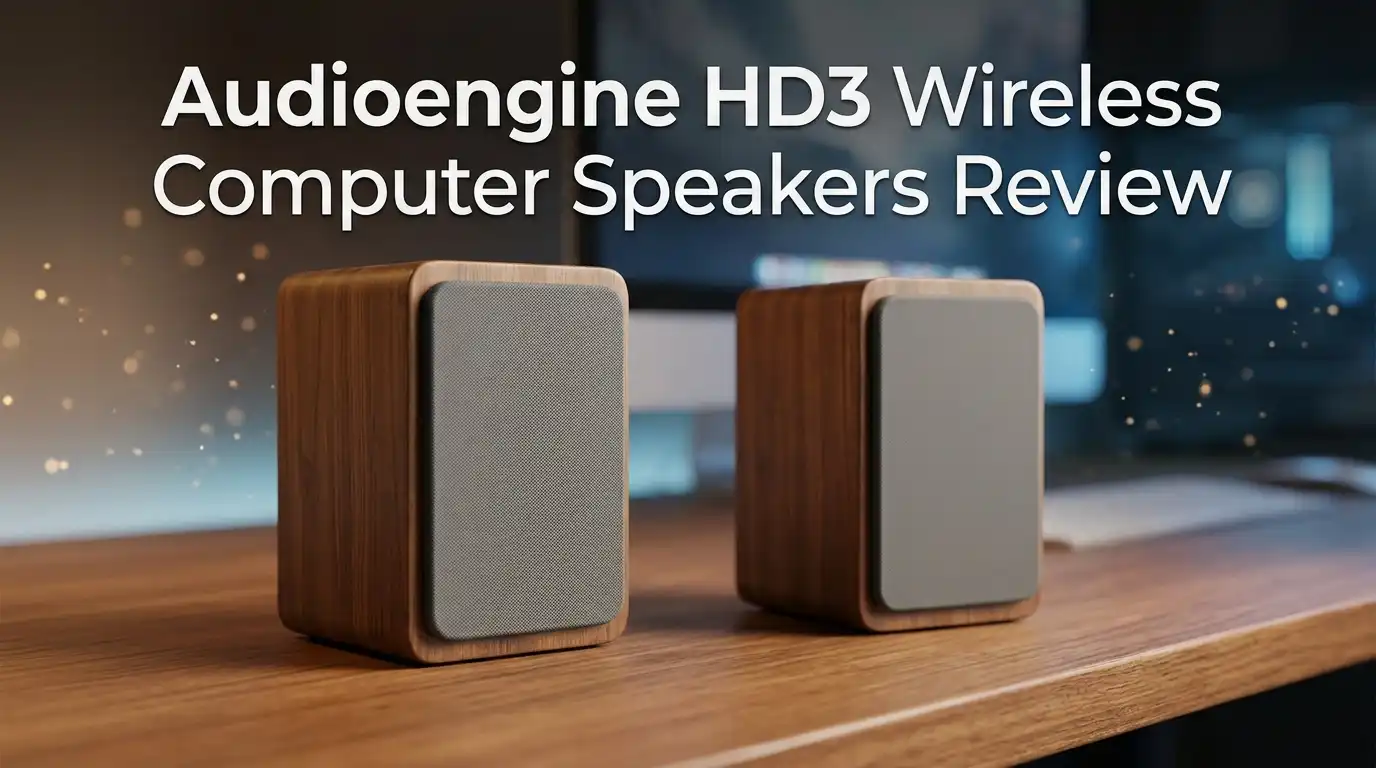
These speakers feel dense and serious the moment you lift them. Each one measures about 7 by 4.3 by 5.5 inches, so they fit a normal desk without crowding it.
The wood veneer is the star. My walnut pair looked warm and grown-up next to my monitor, not gamer-flashy.
The magnetic grilles snap on and off cleanly. I left mine off to show the woofers, but covering them up looks tidy too.
This is a product you can leave out in a living room without apologizing for it.
Top 3 Alternatives For Audioengine HD3
If the HD3 feels like too much money or too little bass, these three are the pairs I would actually consider.
Edifier MR3 Powered Studio Monitor Speakers

Last update on 2026-10-03 / Affiliate links / Images from Amazon Product Advertising API Some of the links on this website are affiliate links, which means that at no additional cost to you, I earn a commission if you click through and make a purchase. I only recommend products and services that I believe will add value to my readers. Thank you for your support!
Creative Pebble X Plus 2.1 Computer Speakers with Subwoofer

Last update on 2026-10-04 / Affiliate links / Images from Amazon Product Advertising API Some of the links on this website are affiliate links, which means that at no additional cost to you, I earn a commission if you click through and make a purchase. I only recommend products and services that I believe will add value to my readers. Thank you for your support!
Audioengine A2+ Wireless Computer Speakers

Last update on 2026-10-04 / Affiliate links / Images from Amazon Product Advertising API Some of the links on this website are affiliate links, which means that at no additional cost to you, I earn a commission if you click through and make a purchase. I only recommend products and services that I believe will add value to my readers. Thank you for your support!
Each one targets a different buyer. The MR3 leans studio-flat, the Pebble X Plus adds a subwoofer for thump on a budget, and the A2+ keeps the Audioengine house sound for less money.
Pick based on your bass appetite and your wallet. All three are easier on the budget than the HD3.
How The HD3 Actually Sounds
This is where the HD3 earns its reputation. The sound is accurate, clean, and detailed without feeling clinical.
Vocals come through with real richness. On a track with a baritone singer, the voice sat front and center with warmth, never buried.
The highs are crystal clear but never harsh or sibilant. Guitar strums and cymbals had bright presence without stabbing my ears.
This is a mids and highs focused speaker. It tells you what the recording really contains, which is a feature, not a flaw.
The Bass Question Everyone Asks
Let me be honest, since this is the number one complaint online. The HD3 does not deliver deep, rumbling sub-bass on its own.
The 2.75-inch Kevlar woofers are small. They simply cannot move enough air for that chest-thumping low end.
What you get instead is tight, articulate low-mids. Bass notes are present and clean, just not booming. Acoustic and vocal music shines here.
If you crave heavy bass, add the matching subwoofer or pick a 2.1 system. The HD3 alone is not built for that listener.
Connectivity And Everyday Use
The HD3 connects almost any way you want. There is Bluetooth with aptX-HD, USB, RCA, and a 3.5mm jack.
Pairing took seconds. The unit remembers up to six devices, though it only plays from one at a time.
The USB connection is my favorite. It uses the speaker’s own 24-bit DAC to bypass your laptop’s weaker audio chip, and the upgrade is audible.
A front headphone jack is a small but welcome touch for late-night listening without waking the house.
The Honest Downsides
No speaker is perfect, and the HD3 has real quirks worth knowing. The first is the open input design.
All inputs stay active at once. If your phone pings while connected over Bluetooth, that alert can blast through your USB music.
Several owners also mention self-noise, a faint hiss when the room is quiet. It is subtle, but sensitive ears will catch it.
And the price stings for the size. You are paying for sound quality and finish, not raw volume or bass.
Who Should Buy The HD3
These speakers are not for everyone, so let me be direct about the right buyer. They suit detail-focused listeners above all.
If you are a remote worker, a vinyl fan, or a budget audiophile who values clarity, you will love them. Vocals and acoustic music sound wonderful.
They also fit people who want one tidy pair that works on a desk now and a shelf later. The versatility is real.
Buy them for honesty and looks. Buy them for a refined, fatigue-free listening session at your desk.
Who Should Skip It
Last update on 2026-10-04 / Affiliate links / Images from Amazon Product Advertising API Some of the links on this website are affiliate links, which means that at no additional cost to you, I earn a commission if you click through and make a purchase. I only recommend products and services that I believe will add value to my readers. Thank you for your support!
Some buyers will feel let down, and I would rather save you the return shipping. Bass lovers should look away first.
If your music lives on kick drums and sub-bass, the HD3 will frustrate you. The low end is simply not their job.
Budget shoppers should also pause. Cheaper 2.1 systems deliver more obvious thump and louder volume for the money.
And if you hate any background hiss, the faint self-noise may bother you in a silent room. Test before you commit fully.
My Final Verdict
After living with the HD3 on my desk, I understand the love and the gripes. These are honest, beautiful speakers that respect the music.
I keep coming back to the clean vocals and clear highs. Long work sessions no longer leave my ears tired, which matters.
The missing deep bass is a fair trade for that accuracy. I knew the deal going in, and I made peace with it.
If you want truthful sound in a handsome, compact package, the HD3 is an easy recommendation.
Frequently Asked Questions
Do the Audioengine HD3 need a subwoofer?
Not required, but recommended if you want deep bass. The speakers handle mids and highs beautifully on their own. For thumping low end, the matching Audioengine subwoofer fills the gap nicely.
Are the HD3 good for gaming?
They work well for story and atmospheric games thanks to clear detail. Competitive players who rely on heavy explosions and rumble may want a 2.1 system instead. Positional clarity is strong; bass impact is light.
Is the Bluetooth sound quality good on the HD3?
Yes. With aptX-HD support, Bluetooth streaming sounds close to wired. For the very best fidelity, use the USB input and let the built-in 24-bit DAC handle the conversion.
Can I connect the HD3 to a TV?
You can, using the RCA or 3.5mm inputs. They make tidy stereo speakers for a small setup. For movie nights with big bass, pairing them with a subwoofer helps a lot.
Why do my HD3 speakers hiss slightly?
Some units have mild self-noise when no audio is playing. It is usually faint and disappears once music starts. If it is loud or constant, contact Audioengine support to check the unit.
Is the Audioengine HD3 worth the price?
For listeners who value clarity, accuracy, and premium build, yes. You pay for sound quality and finish, not volume or bass. Budget-focused buyers may find better value in cheaper 2.1 options.
Disclosure: This content is part of an Amazon Creator Connections campaign, meaning I earn a commission from qualifying purchases. Using these links costs you nothing extra but directly supports my blog and future content.

Hello, i’m Ivoria i am the face behind Tech Tracker Blog. I am passionate about my work and love to explore gadgets and share about my experience.