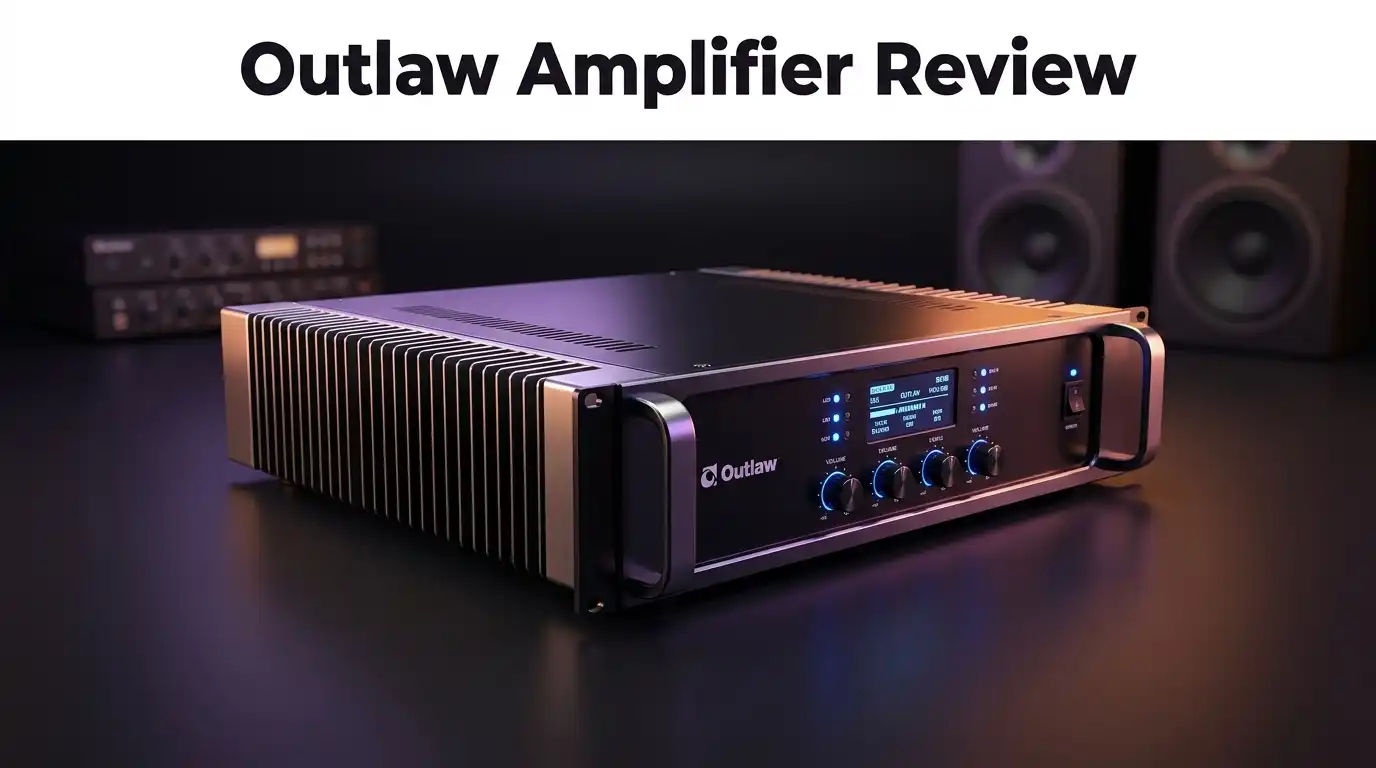
Outlaw Amplifier Review 2026: Worth Buying?
Home theater fans keep whispering the same name. Outlaw Audio. The brand sells direct, skips the showroom markup, and promises what it calls “honest power.”
That promise sounds great on paper. But does an Outlaw amplifier actually deliver in a real living room, with real speakers, at real volume levels?
I spent weeks with Outlaw gear. I hauled the boxes up stairs, wired the channels, pushed the volume, and listened for flaws. This review covers the good parts, the annoying parts, and the parts nobody mentions in the marketing copy.
In a Nutshell:
- Outlaw amplifiers deliver honest, verified power. The Model 5000x is rated at 5 x 120 watts into 8 ohms and 5 x 180 watts into 4 ohms with all channels driven. Independent bench testing confirmed the amp pushes over 800 watts total into four ohm loads without shutting down or complaining.
- The sound signature is neutral and clean. These amps do not add warmth or sparkle. They amplify the signal and get out of the way. Listeners who want a colored, tube style sound will feel bored.
- Build quality punches above the price. Heavy toroidal transformers, thick binding posts, and a slim 5.82 inch chassis make these amps feel like gear costing twice as much. The 5000x weighs close to 50 pounds.
- The value story is strong but no longer a steal. The Model 5000x sits around $849, the Model 2220 monoblock at $449, and the RR2160MkII receiver near $1,199. Prices climbed over the past few years.
- There are real weaknesses. Shipping costs hurt, the noise floor is not class leading, the styling is plain, and Outlaw sells direct with limited hands on demo options.
- Best for growing home theaters. If your receiver runs out of steam driving big towers, an Outlaw amp fixes that problem cheaply.
What Is Outlaw Audio and Why Do People Care?

Last update on 2026-10-07 / Affiliate links / Images from Amazon Product Advertising API Some of the links on this website are affiliate links, which means that at no additional cost to you, I earn a commission if you click through and make a purchase. I only recommend products and services that I believe will add value to my readers. Thank you for your support!
Outlaw Audio launched in 1999 as a direct to consumer audio brand. The founders wanted to cut out dealers and pass savings to buyers. That model still runs today.
The company sells power amplifiers, stereo receivers, and speakers straight from its own website and through Amazon. No showrooms. No sales staff. No markup layers.
This approach creates a specific kind of buyer. Outlaw customers research before they purchase. They read forums. They compare spec sheets. They care more about watts per dollar than brand prestige.
The name fits the attitude. Outlaw leans hard on Western imagery in its marketing, with talk of “taming” speakers and “posses” of owners. Some people find it charming. Others find it silly.
What matters more is the engineering philosophy. Outlaw rates its amplifiers conservatively. When the company says 120 watts per channel with all channels driven, bench tests confirm that number rather than exposing it as marketing fiction.
That honesty built a loyal following over 25 years. Forum threads regularly praise the customer service, including repairs offered well past the two year warranty window.
The tradeoff is simple. You buy without hearing the product first. You rely on the return policy and on reviews like this one.
Outlaw is not a boutique high end brand. It is a value brand that competes on measured performance. Knowing that distinction helps set the right expectations before you order.
Outlaw Model 5000x 5 Channel Amplifier
The Model 5000x sits at the center of the Outlaw lineup. It delivers 120 watts RMS per channel into 8 ohms and 180 watts per channel into 4 ohms, with every channel driven at once from 20 Hz to 20 kHz.
Those numbers come with low distortion figures. Outlaw quotes less than 0.02 percent total harmonic distortion at the 8 ohm rating.
The headline upgrade over the older Model 5000 is the balanced input stage. The 5000x adds XLR inputs alongside RCA, using THAT Corporation chips for common mode rejection.
That matters in real rooms. Long cable runs pick up hum from electrical interference. Balanced connections cancel that noise before it reaches your speakers.
For RCA users, Outlaw includes a differential sensing circuit that fights input hum. This is a thoughtful touch at this price point.
Other specs stay solid. Signal to noise measures 111 dB A weighted. Frequency response runs 20 Hz to 20 kHz within half a decibel. Input sensitivity sits at 1.2 volts.
The chassis measures 5.82 inches tall, 17 inches wide, and 16.75 inches deep. It fits a standard rack shelf but demands a deep cabinet.
Current pricing hovers around $849. Shipping adds meaningfully to that total because of the weight.
The 5000x targets a specific buyer. You already own a decent receiver or processor. You want more clean power for a 5.1 or 5.2 system. This amp answers that need without drama.
Unboxing the Outlaw Model 5000x
The box arrives heavy. Really heavy. The shipping carton alone signals that something serious lives inside.
Outlaw packs the amp in a double walled box with thick foam end caps. My unit arrived with zero cosmetic damage, which matters for direct shipped gear.
Plan for two people. The amplifier weighs close to 50 pounds, and the flat chassis offers no handles. Lifting it out of the carton solo is awkward and risky for your back.
Inside you find the amplifier wrapped in a soft cloth bag. That bag protects the black finish from scuffs during transit.
The accessory kit stays minimal. You get a detachable power cord, a printed manual, and rubber feet already installed. No cables. No remote. No trigger cable.
The lack of included interconnects surprised me at this price. Budget another $40 to $100 for decent RCA or XLR cables.
First impressions favor the amp. The faceplate feels thick. The single power button clicks with confidence. The blue standby indicator glows softly rather than lighting up the room.
Flipping the unit around reveals the real story. Five pairs of heavy binding posts sit spaced far apart, with left and right channels placed at opposite ends of the panel.
That layout helps thermally and keeps thick speaker cables from crowding each other. Small design decisions like this separate thoughtful products from rushed ones.
Build Quality and Design Details
Outlaw builds these amplifiers around a Class AB topology with a large toroidal transformer. That design choice explains both the weight and the sound.
Open the top cover and you see a clean layout. Separate amplifier modules handle each channel. Heatsinks run under the top panel rather than along the outside.
The internal heatsink placement is a mixed decision. It keeps the exterior smooth and easy to stack, but you cannot feel how hot the amp actually runs.
Binding posts deserve praise. They accept bare wire, spades, and banana plugs, and they tighten firmly without flexing.
The faceplate uses brushed metal with a simple Outlaw logo. Nothing else. No display. No meters. No lights beyond the power indicator.
Some buyers love this restraint. Others find it dull. If you want VU meters and glowing tubes, look elsewhere entirely.
The chassis finish resists fingerprints better than glossy competitors. Dust shows, but a microfiber cloth handles it in seconds.
One critique on capacitors surfaced in teardown discussions. Bench testers noted the filter capacitor voltage ratings sit closer to the operating margin than some engineers prefer.
That has not translated into widespread failure reports. Owners on forums regularly run these amps for five plus years without issue.
Outlaw backs the product with a two year warranty for home use. The company has a strong reputation for repairing units long after coverage expires, which counts for a lot with a direct sale brand.
Top 3 Alternative for Outlaw Model 5000x
If you want to compare before you commit, these three amplifiers show up most often in the same shopping carts.


Last update on 2026-10-07 / Affiliate links / Images from Amazon Product Advertising API Some of the links on this website are affiliate links, which means that at no additional cost to you, I earn a commission if you click through and make a purchase. I only recommend products and services that I believe will add value to my readers. Thank you for your support!
Monolith by Monoprice 5×200 Watt Multi Channel Home Theater Power Amplifier

Last update on 2026-10-07 / Affiliate links / Images from Amazon Product Advertising API Some of the links on this website are affiliate links, which means that at no additional cost to you, I earn a commission if you click through and make a purchase. I only recommend products and services that I believe will add value to my readers. Thank you for your support!
Monolith by Monoprice 7×200 Watt Multi Channel Home Theater Power Amplifier

Last update on 2026-10-07 / Affiliate links / Images from Amazon Product Advertising API Some of the links on this website are affiliate links, which means that at no additional cost to you, I earn a commission if you click through and make a purchase. I only recommend products and services that I believe will add value to my readers. Thank you for your support!
Crown XLS1002 2 Channel Class D DriveCore Professional Power Amplifier
Outlaw Model 2220 Monoblock Amplifier

Last update on 2026-10-07 / Affiliate links / Images from Amazon Product Advertising API Some of the links on this website are affiliate links, which means that at no additional cost to you, I earn a commission if you click through and make a purchase. I only recommend products and services that I believe will add value to my readers. Thank you for your support!
The Model 2220 takes a different path. It is a single channel amplifier delivering 200 watts into 8 ohms and 300 watts into 4 ohms.
Each unit stands only 1.75 rack units tall. That slim profile lets you stack several without building a tower.
Monoblocks solve a problem multichannel amps cannot. You buy exactly the channels you need, place them near the speakers, and add more later as your system grows.
Pricing sits at $449 per channel. That looks expensive next to the 5000x math until you consider the power difference and the flexibility.
Like the 5000x, the 2220 offers both XLR and RCA inputs. The balanced stage uses the same noise rejection approach found across the current Outlaw range.
Two of these driving front left and right speakers, paired with a receiver handling surrounds, makes a genuinely strong hybrid system.
Heat management works well thanks to the low profile and generous venting. My pair ran warm but never hot during long movie sessions.
The downsides mirror the larger amps. No display. No metering. Plain styling. Shipping costs stack up when you order multiple units.
Bench testing of the earlier Model 2200 showed performance that clearly beat typical receiver amplification while falling short of the very cleanest measuring amps available.
That summary applies to the whole Outlaw catalog. You get real power and real transparency, not laboratory perfection.
Sound Quality: How Does It Actually Sound?
Let me be direct. An Outlaw amplifier does not have a dramatic sound of its own.
Feed it a clean signal and it hands your speakers a bigger, stronger version of that same signal. That is the entire point.
Listening to acoustic recordings, the presentation stayed neutral. Vocals sat where the mix placed them. Cymbals had shimmer without harshness.
Bass control impressed me most. Driving a pair of large towers, the 5000x kept low frequencies tight rather than letting them turn into boom.
Movie performance is where these amps earn their keep. Explosive scenes that made my receiver strain sounded effortless with the Outlaw handling amplification.
Dialogue clarity improved noticeably. The center channel had headroom to spare, so voices stayed intelligible during loud action sequences.
Dynamic swings are the real upgrade. The jump from quiet to loud happens instantly and cleanly, which is exactly what a big power supply buys you.
Now the honest part. In casual A/B listening at moderate volume, the difference between an Outlaw amp and a good receiver amplifier is subtle.
The gap widens as you turn up. It widens further with hard to drive speakers. It nearly disappears with efficient bookshelf speakers in a small room.
Reviewers who described the Model 5000 as smooth and neutral, never cold or sterile, got it right. There is a hint of warmth without any obvious coloration.
Do not expect a night and day transformation. Expect headroom, control, and composure.
Power Output and Real Measurements
Marketing claims mean little without independent verification. Fortunately, the Outlaw platform has been measured carefully.
Bench testing of the Model 5000 confirmed the amp delivers its rated power with multiple channels driven simultaneously. Total output exceeded 800 watts into four ohm loads.
The toughest test involves sustained power across the full frequency range at low distortion. Many receivers quit during this test. The Outlaw passed with two channels and again with four.
At 40 Hz, where music peaks most often, testing showed 252 watts with two channels driven and 207 watts with four channels driven.
Gain measured 29 dB, which matches the THX recommendation. That number matters because it keeps volume levels predictable across your system.
Frequency response measured essentially flat across the audible band. Adding a simulated speaker load barely changed the curve, which indicates a stiff output stage.
Crosstalk performance was good, as expected from separate amplifier modules per channel.
Now the weak spot. Signal to noise ratio at low power fell short of the 96 dB threshold that fully covers CD dynamic range.
The linear power supply introduces some mains hum and power supply noise. Distortion is dominated by second harmonic content.
The resulting distortion plus noise figure lands mid pack rather than at the top of the charts.
Does that matter while watching a movie? Almost never. Does it matter to spec chasers? Absolutely.
The honest summary is that Outlaw trades last decibel measurement supremacy for power and price.
Setup, Inputs, and Connections
Setup takes about twenty minutes if you plan ahead.
Connect your receiver or processor preamp outputs to the amplifier inputs. Use XLR if your gear supports it. Use RCA if it does not.
Switch the input selector on the back to match your choice. Forgetting this step is the most common setup mistake.
Run speaker cables from the binding posts to your speakers. The posts accept thick gauge wire easily.
The 12 volt trigger connection deserves attention. Wiring the trigger to your receiver lets the amp power on and off automatically with the rest of your system.
Some owners report trigger reliability problems across various receiver and amplifier combinations. Check that your receiver supplies enough current on its trigger output before relying on it.
Without a trigger, you will press the front panel button manually every time. That gets old fast in a rack tucked behind cabinet doors.
Cooling requires planning. Leave several inches above the amp and keep the rear vents clear.
Do not stuff this amplifier into a sealed cabinet. Class AB designs generate real heat, and trapped heat shortens component life.
Depth catches people out. At 16.75 inches deep before you add cable clearance, this amp needs roughly 20 inches of usable shelf space.
Measure your rack before ordering. Returning a 50 pound amplifier is a genuinely miserable experience.
Heat, Fan Noise, and Living With It
Class AB amplifiers run warm by nature. The Outlaw is no exception.
During normal listening, the top panel gets noticeably warm to the touch. During long, loud movie marathons, it gets hot.
The amp never shut down on me. Protection circuits exist, but I could not trigger them in normal use.
Cooling combines passive heatsinks with active fans. The fans stay quiet in most conditions and only spin up under real load.
Some owners have described the fan as slightly audible in a silent room. It sits at a level comparable to a slow moving computer case fan.
In a dedicated theater with the volume up, you will never hear it. In a quiet listening room during soft passages, sensitive listeners might.
Idle power consumption is not trivial. A linear power supply draws current even when nothing is playing.
If your system sits idle for hours, the trigger connection or a manual power down saves electricity.
Physical placement matters more than with lighter gear. A flimsy glass shelf will not survive 50 pounds sitting on it for years.
Put the amplifier on the bottom shelf. That lowers your center of gravity and puts the heat source where rising air will not cook your other components.
Long term reliability reports look encouraging. Forum owners commonly report five to ten years of trouble free use, with Outlaw offering repairs even after warranty expiration.
What the Outlaw Amplifier Does Not Do Well
Every honest review needs this section. Here are the genuine shortcomings.
Shipping costs sting. Amazon listings show delivery charges near $70 for the 5000x. That is a real addition to the sticker price.
The noise floor is average. Measured signal to noise at low power falls short of what the best measuring amplifiers achieve. Hum from the linear supply contributes to this.
There is no display or metering. You get a power button and one indicator light. Buyers who enjoy watching meters dance will be disappointed.
The styling is forgettable. A plain black box with a logo. It disappears into a rack, which some people want and others do not.
No hands on audition. Direct sales mean you cannot walk into a store and listen. You buy based on reviews and rely on return policies.
The chassis is deep and heavy. Many furniture style AV cabinets simply cannot accommodate it.
No streaming, no room correction, no processing. This is a dumb power amplifier by design. It needs a receiver or processor upstream.
One more thing worth stating clearly. If your speakers are efficient and your room is small, you may hear almost no improvement over your existing receiver.
Buying more power than your system needs wastes money. The Outlaw earns its price only when your speakers actually demand current.
Pros and Cons of Outlaw Amplifiers
Here is the balanced summary in list form.
Pros
- Rated power figures hold up under independent bench testing, with all channels driven simultaneously.
- Balanced XLR and unbalanced RCA inputs both included, with genuine noise rejection circuitry on each.
- Heavy toroidal transformer and Class AB design deliver strong dynamic headroom for movies and music.
- Neutral tonal balance that adds no obvious coloration to the source signal.
- Excellent binding posts with generous spacing between channel pairs.
- Direct sales pricing undercuts most name brand separates offering similar output.
- Two year warranty plus a strong reputation for post warranty repair support.
- Slim 5.82 inch chassis stacks neatly in racks despite the internal mass.
Cons
- Signal to noise ratio at low listening levels trails the best measuring competitors.
- Shipping charges add significantly to the purchase price.
- No front panel display, metering, or status information beyond a single indicator.
- Chassis depth of 16.75 inches will not fit many consumer AV cabinets.
- Weight near 50 pounds makes solo installation genuinely difficult.
- No cables or trigger wire included in the box.
- Plain industrial styling that some buyers find uninspiring.
- Direct sale model prevents in store auditions before purchase.
Weigh these honestly against your own room, speakers, and budget.
Outlaw Model 7000x: The Bigger Option
Some systems need more than five channels. That is where the Model 7000x arrives.
This amplifier delivers 130 watts per channel into 8 ohms across all seven channels, and 200 watts per channel into 4 ohms.
Those numbers exceed the 5000x on every count. More channels, more power per channel, same clean design language.
The 7000x shares the balanced input stage built around THAT Corporation chips. Common mode rejection fights interference on long cable runs.
The differential sensing RCA circuit carries over too, so unbalanced users still get hum reduction.
Published specs include 111 dB signal to noise A weighted, voltage gain of 28 dB, and power bandwidth from 5 Hz to 54 kHz.
Physical dimensions match the 5000x exactly at 5.82 by 17 by 16.75 inches. Weight increases with the extra channels.
Who actually needs seven channels of external amplification? Anyone running a 7.1 layout, or a 5.1 system with two height channels for object based audio.
The 7000x also works well as the backbone of a larger setup. Use it for the main seven channels and add monoblocks for additional height speakers.
Cost sits above the 5000x, naturally. Whether the jump makes sense depends entirely on your channel count.
My advice is simple. Buy the channel count you need today plus whatever you will realistically add within two years. Do not overbuy for a theater you might build someday.
Price and Value in 2026
Let us talk money honestly.
The Model 5000x currently lists around $849. The Model 2220 monoblock sits at $449. The RR2160MkII stereo receiver runs about $1,199.
Those prices have climbed. The original Model 5000 launched at $649, and the RR2160 started near $799 before rising through several increases.
Outlaw is no longer the shocking bargain it once was. Inflation, tariffs, and component costs pushed prices up across the entire audio industry.
The value case still holds, though. Compare the 5000x against name brand five channel amplifiers with similar verified output and you will find prices climbing well past $1,500.
Competitors matter here. Monoprice sells Monolith amplifiers with higher power ratings at competitive prices. Emotiva plays in the same value space.
Professional amplifiers from brands like Crown offer enormous power per dollar, though with fan noise and utilitarian styling that many home users dislike.
Where does Outlaw win? It sits in the middle ground between pro audio harshness and audiophile pricing.
Factor in shipping when you compare. A $849 amplifier plus $70 shipping is a $919 amplifier.
Also factor in resale. Outlaw gear holds value reasonably well on the used market because the brand has a loyal following.
The verdict on value is positive but not overwhelming. You get honest performance at a fair price, not a giveaway.
Who Should Buy an Outlaw Amplifier?
This section saves you money if you read it carefully.
Buy an Outlaw amplifier if your receiver struggles with large or inefficient tower speakers. Adding external amplification transforms a strained system into a composed one.
Buy one if you own a separate processor with preamp outputs and need clean channels without paying boutique prices.
Buy one if you value measured performance over brand names and enjoy researching before purchasing.
Buy one if you plan to grow your system gradually. The monoblock approach lets you add channels one at a time.
Skip it if your speakers are efficient bookshelf models in a small room. Your receiver already does the job.
Skip it if you want an all in one solution with streaming, room correction, and video switching. This is a power amplifier only.
Skip it if your cabinet cannot fit a deep, heavy chassis. Measure first.
Skip it if you need last word measured performance for critical near field listening. Better measuring options exist at higher prices.
My overall take after extended listening is straightforward. Outlaw builds capable, honest amplifiers that solve a real problem for a fair price.
They are not exciting products. They do not look special. They simply make your existing speakers sound the way the designers intended.
For most home theater builders upgrading from receiver amplification, that is exactly the right purchase.
Frequently Asked Questions
Is the Outlaw Model 5000x worth the price in 2026?
Yes for the right buyer. At around $849 plus shipping, it delivers verified power that competitors charge considerably more to match. The value depends on whether your speakers actually need the extra current. Efficient speakers in small rooms will not benefit much.
Does the Outlaw amplifier get too hot?
It runs warm, which is normal for Class AB designs. Internal heatsinks and fans manage temperature effectively. Leave several inches of clearance above and behind the unit, and never install it in a sealed cabinet.
Can I use an Outlaw amplifier with any receiver?
You need a receiver or processor with preamp outputs. Most mid range and higher receivers include these. Connect via RCA or XLR, set the input selector correctly, and you are ready.
How loud is the cooling fan?
Very quiet in normal use. The fan only becomes audible under sustained heavy load, and even then it sits at roughly the level of a slow computer fan. Movie volume completely masks it.
What is the difference between the Model 5000 and 5000x?
The 5000x adds balanced XLR inputs with common mode rejection circuitry, which the original 5000 lacked. Power ratings stay similar. The balanced inputs matter most for long cable runs in electrically noisy environments.
How long does Outlaw Audio gear last?
Owners commonly report five to ten years of reliable service. The company offers a two year warranty and has a strong track record of repairing units well beyond that period, which is unusual for a direct sale brand.
Should I buy monoblocks or a multichannel amplifier?
Multichannel amplifiers cost less per channel and simplify wiring. Monoblocks like the Model 2220 offer more power per channel, easier placement, and the option to expand gradually. Choose based on your channel count and growth plans.

Hello, i’m Ivoria i am the face behind Tech Tracker Blog. I am passionate about my work and love to explore gadgets and share about my experience.