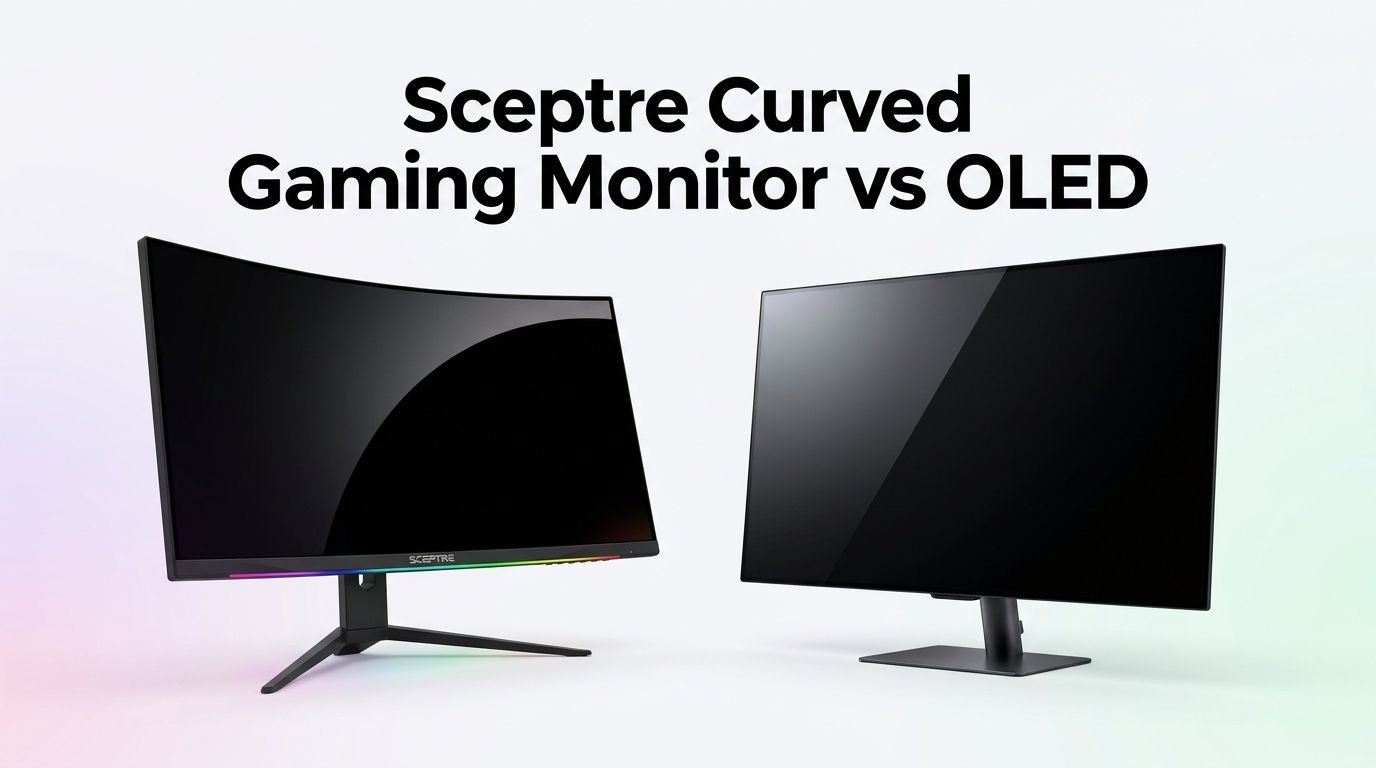
Sceptre Curved Gaming Monitor vs OLED in 2026
You want a new gaming monitor. You open a dozen tabs. You see Sceptre curved monitors at jaw dropping prices. Then you spot OLED gaming monitors with mind blowing contrast and color. The question hits you hard. Should you save money with a Sceptre curved display or invest in an OLED panel?
This comparison breaks down everything you need to know. We cover picture quality, refresh rates, response times, pricing, and real world gaming performance.
A Sceptre curved monitor can cost under $150. A quality OLED gaming monitor starts around $400 and climbs past $700. The price gap is huge. But does the OLED experience justify the extra cost?
Key Takeaways
- Sceptre curved gaming monitors offer incredible value. You can get a 24.5 inch or 32 inch curved display with up to 240Hz refresh rate for under $200. These monitors use VA panel technology with decent contrast ratios and solid color coverage. They suit casual gamers and budget conscious buyers who still want smooth gameplay.
- OLED gaming monitors deliver superior image quality. Models like the Samsung Odyssey OLED G6, ASUS ROG Swift PG27AQDP, and AOC Q27G4ZD produce true blacks, infinite contrast ratios, and 0.03ms response times. They provide the best visual experience available today.
- Refresh rates are competitive on both sides. Sceptre monitors reach 200Hz to 240Hz at 1080p resolution. OLED monitors hit 240Hz to 480Hz at 1440p or 4K resolution. OLED wins on both speed and resolution simultaneously.
- Burn in risk exists with OLED but has improved significantly. Modern OLED panels include pixel shift, logo dimming, and panel refresh features. Most gamers will not encounter burn in with normal use habits.
- Your GPU matters in this decision. A Sceptre 1080p monitor pairs well with mid range graphics cards. OLED monitors at 1440p 240Hz or higher demand powerful GPUs like the RTX 4070 or above to reach their full potential.
- Long term satisfaction favors OLED for serious gamers. If you play competitive titles, enjoy story driven games, or watch content on your monitor, OLED provides a noticeable upgrade in every visual category.
What Is a Sceptre Curved Gaming Monitor?
Sceptre is a California based monitor brand that focuses on affordable displays. The company produces curved gaming monitors in sizes from 24.5 inches to 34 inches. These monitors use VA (Vertical Alignment) LCD panels with LED backlighting.
The curve on Sceptre monitors typically measures 1500R or 1800R. This curvature wraps the screen edges slightly toward you. It creates a more immersive viewing experience compared to flat panels. Sceptre monitors also include built in speakers, multiple HDMI ports, and DisplayPort connections.
The brand targets budget and mid range buyers. A Sceptre curved gaming monitor rarely costs more than $250. Most popular models sit in the $120 to $180 range. This makes them attractive to first time builders and gamers who need a functional display without spending a fortune.
Sceptre Curved 24.5 Inch 240Hz Gaming Monitor


Last update on 2026-08-04 / Affiliate links / Images from Amazon Product Advertising API Some of the links on this website are affiliate links, which means that at no additional cost to you, I earn a commission if you click through and make a purchase. I only recommend products and services that I believe will add value to my readers. Thank you for your support!
This Sceptre C255B FWT240 is one of the most popular budget gaming monitors on Amazon. It packs a 24.5 inch curved display with a 1080p resolution and up to 240Hz refresh rate. The 1500R curvature gives you a slight wrap around effect during gameplay.
The monitor features a 1ms response time, two DisplayPort connections, and two HDMI ports. It covers 98% of the sRGB color space. Built in speakers handle basic audio needs. AMD FreeSync support eliminates screen tearing during fast paced games.
Pros:
- Ultra affordable price, often under $130
- 240Hz refresh rate for smooth competitive gaming
- 1ms response time reduces motion blur
- Dual DisplayPort and dual HDMI inputs
- Compact 24.5 inch size fits small desks
- Built in speakers save desktop space
Cons:
- 1080p resolution looks less sharp at close range
- VA panel has narrower viewing angles than IPS or OLED
- Color accuracy is average for creative work
- HDR support is limited
- Built in speakers sound tinny and lack bass
Sceptre Curved 32 Inch 240Hz Gaming Monitor

Last update on 2026-06-03 / Affiliate links / Images from Amazon Product Advertising API Some of the links on this website are affiliate links, which means that at no additional cost to you, I earn a commission if you click through and make a purchase. I only recommend products and services that I believe will add value to my readers. Thank you for your support!
The Sceptre C325B series delivers a bigger 32 inch curved screen with the same 240Hz performance. This 2025 model features 1080p resolution, 1ms response time, and 110% sRGB color coverage. The larger panel makes games feel more cinematic.
AMD FreeSync Premium keeps frames synchronized with your GPU. The monitor includes three HDMI ports and one DisplayPort. The 1800R curvature feels natural at 32 inches. This size hits a sweet spot for gamers who want a big display on a small budget.
Pros:
- Large 32 inch screen for immersive gaming
- 240Hz refresh rate with AMD FreeSync Premium
- 110% sRGB provides vibrant colors
- Multiple input options including 3 HDMI ports
- Budget friendly price under $200
- 1800R curve feels comfortable at this size
Cons:
- 1080p on 32 inches produces visible pixels
- No height adjustment on the stand
- Contrast can wash out in bright rooms
- Limited HDR capability
- Stand feels lightweight and less stable
What Is an OLED Gaming Monitor?
OLED stands for Organic Light Emitting Diode. Each pixel on an OLED screen produces its own light. This means individual pixels can turn completely off. The result is perfect black levels and infinite contrast ratio.
Two main types dominate the market. WOLED panels come from LG Display. QD OLED panels come from Samsung Display. Both deliver stunning color accuracy, wide viewing angles, and ultra fast response times. QD OLED panels tend to produce more vivid colors. WOLED panels often achieve higher brightness.
OLED gaming monitors became widely available in 2024 and 2025. Prices have dropped significantly. You can now find quality 27 inch 1440p OLED monitors starting around $400 to $500. Premium models with 480Hz refresh rates cost $700 or more. Brands like ASUS, Samsung, LG, and AOC lead this category.
Samsung 27 Inch Odyssey OLED G6 Gaming Monitor

Last update on 2026-08-04 / Affiliate links / Images from Amazon Product Advertising API Some of the links on this website are affiliate links, which means that at no additional cost to you, I earn a commission if you click through and make a purchase. I only recommend products and services that I believe will add value to my readers. Thank you for your support!
The Samsung Odyssey OLED G6 is a 27 inch QD OLED gaming monitor with a 2560×1440 resolution. It runs at 240Hz with a 0.03ms response time. The QD OLED panel produces rich colors with exceptional brightness and contrast.
This monitor supports AMD FreeSync Premium Pro and is G Sync compatible. It covers a wide color gamut and carries DisplayHDR True Black 400 certification. Samsung includes a 3 year warranty that covers burn in, which adds peace of mind for OLED buyers.
Pros:
- QD OLED panel delivers true blacks and vivid colors
- 240Hz refresh rate with 0.03ms response time
- QHD 1440p resolution is sharp and detailed
- FreeSync Premium Pro and G Sync compatible
- 3 year burn in warranty from Samsung
- Anti glare coating reduces reflections
Cons:
- Price is significantly higher than Sceptre monitors
- Flat panel design lacks curved immersion
- 27 inch screen may feel small for some users
- Potential burn in risk with static elements over time
- Requires a powerful GPU to push 1440p at 240Hz
ASUS ROG Swift OLED PG27AQDP 480Hz Monitor

Last update on 2026-08-04 / Affiliate links / Images from Amazon Product Advertising API Some of the links on this website are affiliate links, which means that at no additional cost to you, I earn a commission if you click through and make a purchase. I only recommend products and services that I believe will add value to my readers. Thank you for your support!
The ASUS ROG Swift PG27AQDP holds the title of the first 1440p 480Hz OLED gaming monitor. It uses a 26.5 inch WOLED panel with a 0.03ms response time. This monitor targets competitive gamers who demand the fastest possible visuals.
ASUS built a custom heatsink into the design. It keeps the OLED panel cool and extends its lifespan. The monitor supports G Sync compatibility and includes ASUS OLED Care+ features. These features include pixel refresh, logo detection dimming, and uniform brightness adjustments.
Pros:
- 480Hz refresh rate is the fastest OLED available at 1440p
- WOLED panel delivers flawless blacks and contrast
- Custom heatsink improves panel longevity
- OLED Care+ features reduce burn in risk
- Excellent color accuracy for gaming and content
- Premium build quality with ergonomic stand
Cons:
- High price point around $700 to $800
- 480Hz requires extremely powerful GPU hardware
- 26.5 inch actual viewable area is slightly smaller than advertised
- Glossy screen can show reflections in bright rooms
- Overkill for casual gamers
AOC Q27G4ZD QD OLED Budget Friendly Option

Last update on 2026-08-04 / Affiliate links / Images from Amazon Product Advertising API Some of the links on this website are affiliate links, which means that at no additional cost to you, I earn a commission if you click through and make a purchase. I only recommend products and services that I believe will add value to my readers. Thank you for your support!
The AOC Q27G4ZD brings QD OLED technology at a lower price point. This 27 inch monitor features a 2560×1440 resolution with a 240Hz refresh rate. It offers the same 0.03ms response time found in more expensive OLED models.
AOC includes a 3 year zero bright dot warranty. The monitor supports G Sync compatibility and features two HDMI 2.0 ports and two DisplayPort connections. DisplayHDR True Black 400 certification confirms its excellent HDR performance. This is one of the best entry points into OLED gaming.
Pros:
- Most affordable QD OLED gaming monitor available
- 240Hz and 0.03ms response time for competitive play
- QHD resolution is sharp for 27 inches
- 3 year zero bright dot warranty provides confidence
- True Black HDR delivers impressive dark scenes
- G Sync compatible for Nvidia GPU users
Cons:
- Stand lacks tilt and swivel adjustability on base model
- Speaker quality is minimal
- Still costs 3x more than budget Sceptre monitors
- Some users report minor color uniformity issues at edges
- HDMI ports limited to 2.0 standard
Picture Quality Comparison: Sceptre VA vs OLED
The gap in picture quality between these two technologies is massive. Sceptre curved monitors use VA panels with contrast ratios around 3000:1 to 4000:1. OLED monitors achieve infinite contrast because each pixel turns off independently.
Black levels show the biggest difference. Sceptre monitors display dark grays where OLED shows pure black. In games with dark environments like horror titles or space sims, OLED makes scenes look three dimensional. VA panels look flat by comparison.
Color accuracy also favors OLED. Sceptre monitors cover around 98% to 110% sRGB. OLED monitors cover 98% DCI P3 or higher, which is a much wider color gamut. Every color looks richer, more saturated, and more lifelike on an OLED display. HDR content benefits greatly from the combination of perfect blacks and bright highlights.
Refresh Rate and Response Time Breakdown
Both Sceptre and OLED monitors offer high refresh rates. Sceptre models reach 200Hz to 240Hz at 1080p. OLED monitors hit 240Hz to 480Hz at 1440p or higher resolutions. The numbers look similar, but context matters.
Response time is where OLED dominates completely. Sceptre monitors claim 1ms response times. Real world measurements often show 4ms to 8ms on VA panels. OLED monitors deliver a true 0.03ms response time. This eliminates ghosting and motion blur entirely.
Competitive gamers notice this difference immediately. Fast moving objects look sharper on OLED. Camera panning in FPS games feels smoother. If you play titles like Valorant, CS2, or Fortnite at high frame rates, OLED provides a genuine advantage. Sceptre monitors still perform well for casual play, but they cannot match OLED motion clarity.
Price and Value: Where Sceptre Shines
The price difference between Sceptre curved monitors and OLED displays is the main reason this comparison exists. A Sceptre 24.5 inch 240Hz monitor costs around $120 to $140. A Sceptre 32 inch 240Hz model costs about $170 to $200.
Compare that to OLED pricing. The AOC Q27G4ZD starts around $430 to $470. The Samsung Odyssey OLED G6 costs approximately $500 to $550. The ASUS ROG Swift PG27AQDP runs $700 to $800. You could buy three or four Sceptre monitors for the price of one mid range OLED.
Sceptre delivers strong value for the money. You get a high refresh rate, decent colors, and a curved panel. For gamers on a tight budget, students building their first setup, or anyone who needs a secondary display, Sceptre makes perfect financial sense. The monitors work. They perform. They just do not match the visual quality of OLED.
Build Quality and Ergonomics
Sceptre monitors use plastic construction throughout. The stands provide basic tilt adjustment. Most models lack height adjustment, swivel, or pivot. The bezels are thicker than premium brands. Cable management is minimal. The overall build feels functional but not premium.
OLED gaming monitors feature better construction across the board. The Samsung Odyssey G6 includes a sleek metal design. The ASUS ROG Swift PG27AQDP offers a fully adjustable ergonomic stand with height, tilt, swivel, and pivot. Build materials feel solid and durable.
This difference matters for daily comfort. A height adjustable stand lets you position the screen at eye level. This reduces neck and back strain during long sessions. If ergonomics matter to you, OLED monitors from ASUS, LG, and Samsung provide better options. Sceptre users can solve this with a third party VESA monitor arm, which adds $20 to $40 to the total cost.
Who Should Buy a Sceptre Curved Gaming Monitor?
A Sceptre curved gaming monitor fits budget gamers, students, and first time builders. If you need a reliable display under $200 with a high refresh rate, Sceptre delivers. The curved design adds a touch of immersion without the OLED price tag.
These monitors also work well as secondary or triple monitor setups. The low cost makes it easy to buy two or three. Ultrawide Sceptre models like the 30 inch C305B series provide extra screen space for productivity and gaming.
Sceptre is also ideal for console gamers. The PS5 and Xbox Series X output at 1080p 120Hz. A Sceptre 240Hz monitor handles this easily. You do not need a 1440p OLED panel to enjoy console gaming. The Sceptre gets the job done at a fraction of the cost.
Who Should Buy an OLED Gaming Monitor?
An OLED gaming monitor fits serious gamers, content creators, and visual enthusiasts. If you value picture quality above everything else, OLED is the clear winner. The perfect blacks, wide color gamut, and instant response times transform how games look and feel.
Competitive esports players benefit from the 0.03ms response time and high refresh rates. Story driven gamers enjoy the cinematic HDR visuals. Content creators appreciate the color accuracy for editing photos and videos.
If you already have a mid range to high end GPU, an OLED monitor lets your hardware shine. A 1440p OLED paired with an RTX 4070 or RX 7800 XT delivers a stunning gaming experience. The investment pays off in daily enjoyment. Prices continue to drop in 2026, making OLED more accessible than ever before.
Final Verdict: Sceptre Curved vs OLED
This comparison comes down to budget versus visual quality. Sceptre curved gaming monitors offer remarkable value. They provide high refresh rates, curved immersion, and functional features at prices under $200. They are the smart choice for budget conscious gamers.
OLED gaming monitors offer a generational leap in display technology. Perfect blacks, instant response times, wide color gamuts, and stunning HDR make every game look better. Prices now start around $430 for entry level models like the AOC Q27G4ZD.
Our recommendation? If you can stretch your budget to $430 or more, go OLED. The visual difference is dramatic. You will notice it every time you turn on your monitor. If your budget stays under $200, Sceptre curved monitors remain excellent choices. Either way, you get a capable gaming display that performs well in 2026.
FAQs
Is Sceptre a good brand for gaming monitors?
Yes, Sceptre produces solid budget gaming monitors. The brand has been making displays for over 30 years. Their curved gaming monitors offer high refresh rates and decent image quality at very low prices. They suit casual gamers and budget builds well. They lack the premium features of higher end brands but deliver strong performance for the money.
Do OLED monitors get burn in during gaming?
Modern OLED gaming monitors include burn in prevention technology. Features like pixel shift, logo dimming, and automatic panel refresh reduce the risk significantly. Samsung, ASUS, and LG all offer burn in warranties on their OLED monitors. Normal gaming use with varied content rarely causes burn in issues in 2026.
Can I use a Sceptre monitor for competitive gaming?
Absolutely. Sceptre monitors with 240Hz refresh rates and 1ms response times handle competitive games well. You get smooth frame delivery and minimal input lag. The 1080p resolution is easy to drive at high frame rates even with mid range GPUs. Many competitive players prioritize frame rate over resolution, and Sceptre delivers on that front.
Is the price difference between Sceptre and OLED worth it?
It depends on your priorities. OLED monitors cost 3x to 5x more than Sceptre models. The visual upgrade is significant. You get perfect blacks, better colors, and faster response times. If picture quality matters to you and your budget allows it, the OLED upgrade is absolutely worth the premium. If budget is your primary concern, Sceptre monitors provide a great gaming experience at a fraction of the cost.
What GPU do I need for an OLED gaming monitor?
For a 1440p 240Hz OLED monitor, you need at least an RTX 4060 Ti or RX 7700 XT for most games at high settings. The ASUS PG27AQDP at 480Hz demands an RTX 4080 or higher. A Sceptre 1080p 240Hz monitor works well with an RTX 4060 or RX 7600. Match your GPU power to your monitor resolution for the best experience.

Hello, i’m Ivoria i am the face behind Tech Tracker Blog. I am passionate about my work and love to explore gadgets and share about my experience.