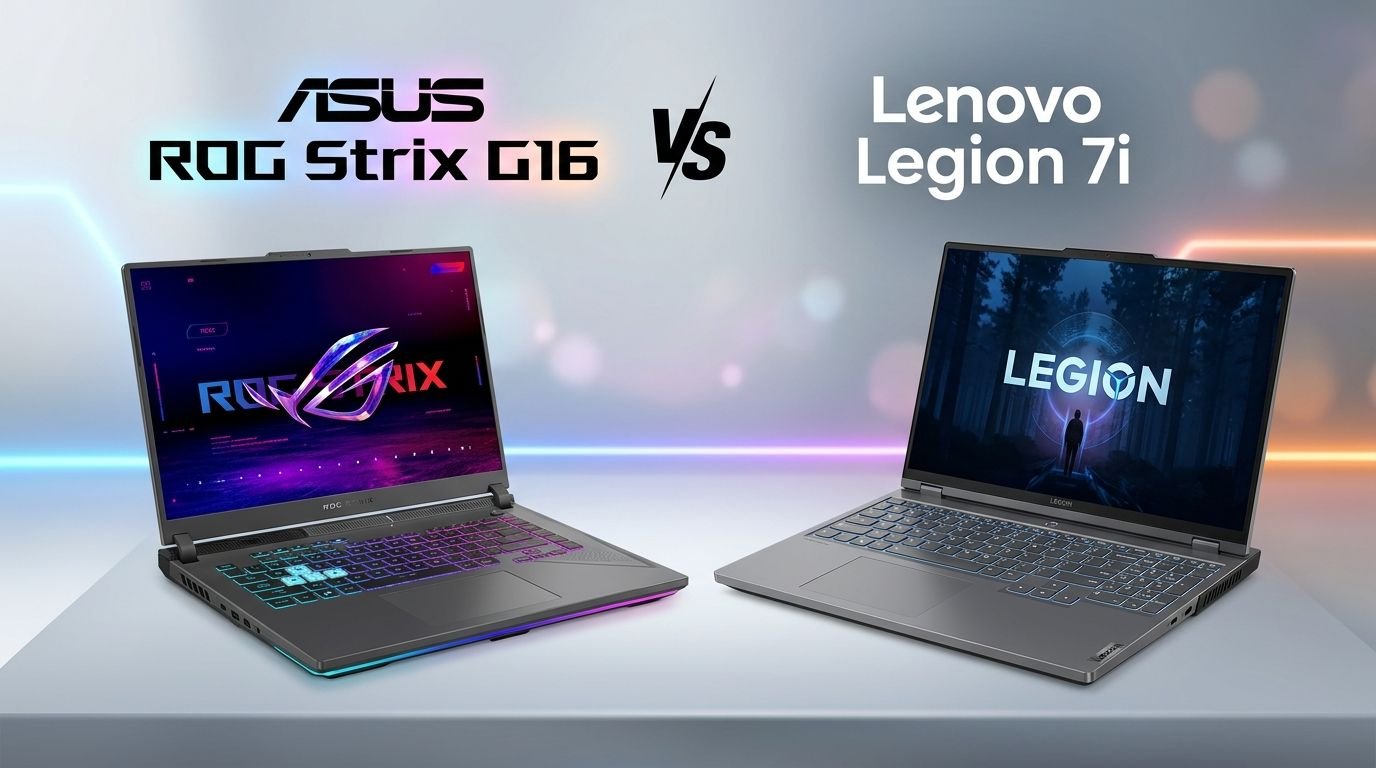
ASUS ROG Strix G16 vs Lenovo Legion 7i: Who Wins?
Are you stuck between the ASUS ROG Strix G16 and the Lenovo Legion 7i? You are not alone. These two gaming laptops sit at the top of most recommendation lists right now.
Both pack powerful Intel processors, RTX 50 series GPUs, and stunning 16 inch displays. But they differ in build quality, thermal design, display technology, and price.
Choosing between them can feel like a real challenge. This detailed comparison breaks down every major category so you can pick the laptop that fits your gaming style, work needs, and budget. Keep reading to find out which one deserves your money.
Key Takeaways
- The ASUS ROG Strix G16 offers excellent value for gamers who want strong performance without spending top dollar. It features up to an Intel Core Ultra 9 275HX processor and NVIDIA RTX 5080 GPU. Its 90Wh battery delivers around 5 to 8 hours of light use. The 165Hz FHD+ display is sharp and smooth for fast paced games. It also supports easy RAM and SSD upgrades with two slots each.
- The Lenovo Legion 7i targets premium buyers who want a gorgeous OLED display and a refined build. It comes with up to an Intel Core Ultra 9 275HX and RTX 5070 GPU. The 2.5K 240Hz OLED panel delivers vivid colors and deep blacks. Battery life sits around 7 to 8 hours for light tasks. The overall chassis feels more premium with a sleeker design.
- For raw GPU power at a lower price, the ROG Strix G16 wins. It offers RTX 5080 options at competitive pricing. The Legion 7i charges more for similar configurations but compensates with a better display and build.
- Display quality goes to the Legion 7i hands down. The OLED panel with 240Hz refresh rate and 2.5K resolution beats the ROG Strix G16’s IPS options in color accuracy and contrast.
- Both laptops support Wi-Fi 7, DDR5 RAM, and PCIe Gen 4/5 storage. They are future proof machines that handle AAA games, content creation, and everyday tasks with ease.
- Thermal performance is strong on both, but the ROG Strix G16 has a slight edge thanks to ASUS’s advanced cooling system with liquid metal thermal compound.
ASUS ROG Strix G16 Overview


Last update on 2026-10-17 / Affiliate links / Images from Amazon Product Advertising API Some of the links on this website are affiliate links, which means that at no additional cost to you, I earn a commission if you click through and make a purchase. I only recommend products and services that I believe will add value to my readers. Thank you for your support!
The ASUS ROG Strix G16 (2025) is a gaming powerhouse built for serious players. It features a 16 inch FHD+ display with a 165Hz refresh rate and 3ms response time. The screen uses a 16:10 aspect ratio that gives you extra vertical space for games and productivity.
Under the hood, you get up to an Intel Core Ultra 9 275HX processor paired with up to an NVIDIA GeForce RTX 5080 GPU. This combo handles AAA titles at high settings without breaking a sweat. The laptop comes with 16GB or 32GB DDR5 RAM and a 1TB PCIe SSD for fast load times.
ASUS uses liquid metal thermal compound on the CPU. This keeps temperatures lower during long gaming sessions. The keyboard features per key RGB lighting and a comfortable layout for extended use.
Pros:
- Strong GPU options up to RTX 5080 at competitive prices
- Liquid metal cooling keeps thermals in check
- 90Wh battery lasts 5 to 8 hours for light use
- Easy upgradability with dual RAM and M.2 slots
- Per key RGB keyboard with good travel distance
Cons:
- Display is IPS, not OLED, so contrast is average
- Webcam quality is basic
- Fan noise gets loud under heavy load
- Build uses more plastic than metal
- No Thunderbolt 4 on all configurations
Lenovo Legion 7i Overview

Last update on 2026-10-17 / Affiliate links / Images from Amazon Product Advertising API Some of the links on this website are affiliate links, which means that at no additional cost to you, I earn a commission if you click through and make a purchase. I only recommend products and services that I believe will add value to my readers. Thank you for your support!
The Lenovo Legion 7i (2025) is a premium gaming laptop with a focus on display excellence and build quality. It features a stunning 16 inch 2.5K OLED display with a 240Hz refresh rate and 1ms response time. Colors look vivid and blacks appear truly deep on this panel.
It runs on an Intel Core Ultra 9 275HX processor and offers GPU options up to the NVIDIA GeForce RTX 5070. You get 32GB DDR5 5600MT/s RAM and a 1TB SSD in the standard configuration. The machine handles both gaming and creative work beautifully.
Lenovo’s ColdFront thermal system keeps heat under control with large dual fans and multiple heat pipes. The laptop weighs around 5.3 pounds and feels solid in hand. The aluminum chassis gives it a premium look that stands out from most gaming laptops.
Pros:
- Gorgeous 2.5K OLED display with 240Hz and deep blacks
- Premium aluminum build quality
- Wi-Fi 7 support for fast online gaming
- Excellent keyboard with good feedback
- Clean, professional design that works for office and gaming
Cons:
- GPU tops out at RTX 5070 compared to RTX 5080 on the Strix
- Higher price for similar processing power
- 84Wh battery is smaller than the ROG’s 90Wh
- Heavier than some competitors in this class
- Limited availability of certain configurations
Display Quality Comparison
The display is one of the biggest differences between these two laptops. The Lenovo Legion 7i uses a 2.5K OLED panel with 240Hz refresh rate. This means you get perfect blacks, infinite contrast ratio, and 100% DCI-P3 color coverage. Games and movies look absolutely stunning on this screen.
The ASUS ROG Strix G16 uses an IPS panel with a 165Hz refresh rate at FHD+ resolution. It is a solid display with good brightness and decent color accuracy. But it cannot match the OLED’s contrast or color depth.
If you care about visual quality above all else, the Legion 7i wins this round easily. The OLED panel makes a visible difference in dark scenes, HDR content, and color rich games. The ROG Strix G16 is still good for competitive gaming where speed matters more than visual fidelity.
Processor and CPU Performance
Both laptops can be configured with the Intel Core Ultra 9 275HX processor. This chip features 24 cores and can boost up to 5.4GHz. It excels at multitasking, content creation, and heavy gaming workloads.
The ROG Strix G16 also offers an Intel Core i7 14650HX option for budget configurations. The Legion 7i pairs with an Intel Core Ultra 7 255HX at its lower tier. Both lower options still deliver strong performance for most games.
In CPU benchmarks, these laptops perform very close to each other. The difference comes down to thermal management and power delivery. ASUS allows slightly higher sustained power limits in Performance mode. Lenovo keeps things a bit more conservative to reduce noise. Real world gaming performance is nearly identical between the two.
GPU and Graphics Performance

Last update on 2026-10-18 / Affiliate links / Images from Amazon Product Advertising API Some of the links on this website are affiliate links, which means that at no additional cost to you, I earn a commission if you click through and make a purchase. I only recommend products and services that I believe will add value to my readers. Thank you for your support!
This is where the ASUS ROG Strix G16 takes a clear lead. It offers configurations with the NVIDIA GeForce RTX 5080, which is a significant step up from the Legion 7i’s RTX 5070. The RTX 5080 provides more VRAM, higher CUDA core count, and better ray tracing performance.
In AAA games like Cyberpunk 2077 and Alan Wake 2, the RTX 5080 in the Strix G16 delivers 15 to 25% higher frame rates compared to the RTX 5070 in the Legion 7i. This gap grows wider at higher resolutions and with ray tracing enabled.
The Legion 7i’s RTX 5070 is still a very capable GPU. It handles most games at high settings above 60fps. But if you want the highest possible frame rates and future proof GPU power, the Strix G16 with RTX 5080 is the better choice.
Thermal Management and Cooling
The ASUS ROG Strix G16 uses a cooling system with liquid metal thermal compound on the CPU. This reduces temperatures by several degrees compared to traditional thermal paste. The laptop also features large heat pipes and dual fans that push air through four exhaust vents.
The Lenovo Legion 7i relies on Lenovo’s ColdFront cooling technology. It uses dual fans with 71 thin blades each and a vapor chamber design. The rear exhaust layout helps keep the keyboard area cool during gaming sessions.
In stress tests, the ROG Strix G16 runs slightly cooler on the CPU. The Legion 7i stays quieter at similar performance levels. Fan noise on the Strix can reach 50dB under full load, while the Legion 7i stays closer to 45dB. If quiet operation matters to you, the Legion 7i has an advantage here.
Build Quality and Design

Last update on 2026-10-17 / Affiliate links / Images from Amazon Product Advertising API Some of the links on this website are affiliate links, which means that at no additional cost to you, I earn a commission if you click through and make a purchase. I only recommend products and services that I believe will add value to my readers. Thank you for your support!
The Lenovo Legion 7i wins the build quality contest. Its aluminum chassis feels solid and premium. The Glacier White color option looks clean and modern. The hinge is sturdy and the lid resists flex well.
The ASUS ROG Strix G16 uses a mix of plastic and metal in its construction. It has a more aggressive gamer aesthetic with angular lines and RGB accents. The build is good but feels less premium than the Legion 7i in direct comparison.
Both laptops have full size keyboards with numeric keypads. The Legion 7i’s keyboard has slightly better key feedback. The ROG Strix G16 offers more customizable RGB zones through ASUS Aura Sync software. Both trackpads are large and responsive.
Battery Life Comparison
Battery life on gaming laptops is always a compromise. The ASUS ROG Strix G16 packs a 90Wh battery. It lasts around 5 to 8 hours for light tasks like web browsing and document editing. Gaming on battery drops this to about 1 hour.
The Lenovo Legion 7i has an 84Wh battery. It delivers about 7 to 8 hours of light productivity use. The OLED display helps with battery life in dark themed apps since OLED pixels turn off completely for black content.
For unplugged productivity, both laptops perform well. The ROG Strix G16 has a larger battery capacity. The Legion 7i is slightly more efficient with power management. Neither laptop is meant for extended gaming without a charger. Keep the power adapter handy for serious play sessions.
Keyboard and Trackpad Experience
The ASUS ROG Strix G16 features a chiclet style keyboard with per key RGB backlighting. Key travel is about 1.7mm, which feels satisfying for both typing and gaming. The keyboard layout includes a full numeric keypad and dedicated volume keys.
The Lenovo Legion 7i has a slightly different approach. Its keyboard uses a softer key press with good tactile feedback. The RGB backlighting covers 4 zones by default. Lenovo’s TrueStrike keyboard design spaces keys well to reduce mistyping.
Both trackpads are glass surface and support Windows Precision drivers. The Legion 7i’s trackpad is slightly larger. The ROG Strix G16’s trackpad responds just as accurately. For gaming, most users will connect an external mouse. For daily tasks, both trackpads work great.
Ports and Connectivity
The ASUS ROG Strix G16 offers a solid port selection. You get USB C with DisplayPort support, multiple USB A ports, HDMI 2.1, and an Ethernet jack. Some configurations include Thunderbolt 4 support. Wi-Fi 7 comes standard for fast wireless connections.
The Lenovo Legion 7i provides a similar port layout. It features USB C with Thunderbolt 4, USB A ports, HDMI 2.1, and a combo audio jack. The rear mounted ports keep cables tidy behind the display. Wi-Fi 7 and Bluetooth 5.4 are included.
The Legion 7i places most ports on the rear of the laptop. This creates a cleaner desk setup. The ROG Strix G16 spreads ports along both sides and the rear. Both laptops include an SD card reader for photographers and content creators.
Pricing and Value for Money

Last update on 2026-10-17 / Affiliate links / Images from Amazon Product Advertising API Some of the links on this website are affiliate links, which means that at no additional cost to you, I earn a commission if you click through and make a purchase. I only recommend products and services that I believe will add value to my readers. Thank you for your support!
The ASUS ROG Strix G16 starts around $1,299 for the base RTX 5060 configuration. Mid range models with RTX 5070 Ti cost about $1,699 to $1,899. The RTX 5080 model pushes past $2,000. These prices make it a strong value for the hardware you receive.
The Lenovo Legion 7i starts around $1,869 for the RTX 5060 configuration. The RTX 5070 model costs approximately $2,249. This is a significant premium over the ROG Strix G16 for similar processing power.
You pay more for the Legion 7i’s OLED display, aluminum build, and premium features. The ROG Strix G16 gives you more GPU power per dollar. Budget conscious gamers should lean toward the Strix. Those who value display quality and build should consider the Legion 7i.
Who Should Buy Which Laptop?
The ASUS ROG Strix G16 is the right pick for gamers who want the best performance per dollar. If you prioritize frame rates, GPU power, and upgradeability, this laptop delivers. It is also great for gamers who like RGB customization and a bold design.
The Lenovo Legion 7i suits buyers who want a premium experience beyond just raw specs. If you care about display quality, quiet operation, and build materials, this laptop is worth the extra cost. It also works well as a professional workstation that doubles as a gaming machine.
Students and budget gamers should pick the ROG Strix G16. Content creators and premium buyers should look at the Legion 7i. Both laptops will serve you well for years to come.
Final Verdict
Both the ASUS ROG Strix G16 and Lenovo Legion 7i are excellent gaming laptops. They represent the best of what ASUS and Lenovo offer in this price range. The ROG Strix G16 wins on raw GPU power, value, and upgradeability. The Legion 7i wins on display quality, build materials, and noise levels.
There is no wrong choice here. Your decision should depend on what matters most to you. Pick the Strix G16 for performance. Pick the Legion 7i for the experience. Either way, you get a 16 inch gaming laptop that will handle every game you throw at it.
Frequently Asked Questions
Is the ASUS ROG Strix G16 better than the Lenovo Legion 7i for gaming?
The ROG Strix G16 offers a higher GPU ceiling with RTX 5080 options. This makes it better for pure gaming performance. The Legion 7i tops out at RTX 5070 but provides a better visual experience through its OLED display. For competitive gaming, the Strix G16 has the edge.
Which laptop has a better display?
The Lenovo Legion 7i wins the display comparison with its 2.5K OLED panel. It offers 240Hz refresh rate, perfect blacks, and wide color coverage. The ROG Strix G16 uses an IPS panel that is good but cannot match OLED quality.
Can I upgrade RAM and storage on both laptops?
Yes. Both laptops support RAM and SSD upgrades. The ROG Strix G16 offers two SO-DIMM RAM slots and two M.2 SSD slots. The Legion 7i also provides dual M.2 slots and accessible RAM modules.
How long does the battery last on each laptop?
The ROG Strix G16 lasts about 5 to 8 hours for light use with its 90Wh battery. The Legion 7i delivers about 7 to 8 hours with its 84Wh battery. Both last about 1 to 1.5 hours during gaming on battery power.
Which laptop runs cooler and quieter?
The ROG Strix G16 runs slightly cooler thanks to liquid metal thermal compound. The Legion 7i runs quieter during gaming sessions. Your preference between lower temps and lower noise will guide your choice here.
Are these laptops good for content creation?
Absolutely. Both laptops handle video editing, 3D rendering, and graphic design well. The Legion 7i’s OLED display gives it an advantage for color accurate work. The ROG Strix G16’s stronger GPU makes it faster for rendering tasks.

Hello, i’m Ivoria i am the face behind Tech Tracker Blog. I am passionate about my work and love to explore gadgets and share about my experience.