
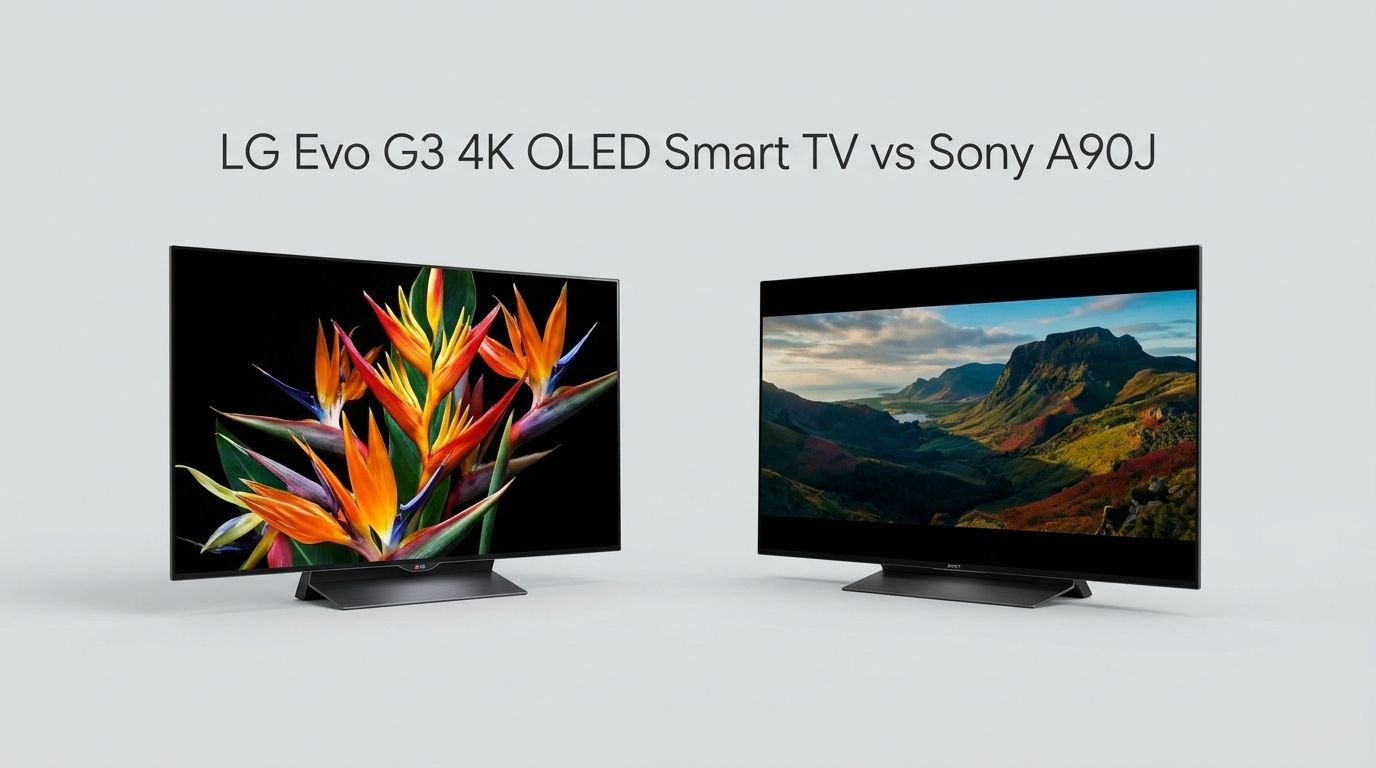
LG Evo G3 4K OLED Smart TV vs Sony A90J In 2026
Are you stuck choosing between the LG Evo G3 4K OLED Smart TV and the Sony A90J OLED? Both TVs deliver stunning picture quality, deep blacks, and premium features. But they differ in brightness, processing power, gaming performance, and smart TV platforms.
This comparison will break down every important detail so you can make a confident buying decision. Whether you love movies, gaming, or sports, one of these TVs will fit your living room perfectly. Read on to find out which OLED champion deserves your money.
Key Takeaways
- The LG Evo G3 uses Micro Lens Array (MLA) technology that boosts peak brightness up to 70% higher than standard OLED panels. This gives it a major edge in bright rooms and HDR content. The Sony A90J, while bright for its generation, cannot match the G3’s raw luminance output.
- Sony A90J excels in image processing with its Cognitive Processor XR. This chip analyzes content the way humans see and hear. It produces natural skin tones, smoother gradients, and fewer processing artifacts. Many reviewers praise Sony’s motion handling as the best in the OLED market.
- LG G3 is the better choice for gamers. It offers four HDMI 2.1 ports, 120Hz VRR support on all inputs, NVIDIA G Sync, AMD FreeSync Premium, and very low input lag around 9ms. The Sony A90J has only two HDMI 2.1 ports and slightly higher input lag around 17ms.
- The LG G3 runs webOS while the Sony A90J runs Google TV. Both platforms provide access to major streaming apps. Google TV offers a more unified content discovery experience. WebOS feels snappier and more responsive on the LG G3 hardware.
- Sony A90J uses its screen as a speaker with Acoustic Surface Audio+ technology. The panel vibrates to create sound that comes directly from the screen. The LG G3 has a standard 60W speaker system that sounds good but cannot match Sony’s immersive audio trick.
- The LG G3 features a slim gallery design built for wall mounting. It sits nearly flat against the wall. The Sony A90J has a thicker profile and includes a traditional stand with multiple positioning options.
LG Evo G3 4K OLED Smart TV Overview


Last update on 2026-08-04 / Affiliate links / Images from Amazon Product Advertising API Some of the links on this website are affiliate links, which means that at no additional cost to you, I earn a commission if you click through and make a purchase. I only recommend products and services that I believe will add value to my readers. Thank you for your support!
The LG Evo G3 is a 2023 flagship OLED TV from LG. It uses the latest OLED evo panel with Micro Lens Array (MLA) technology. This technology places tiny lenses over each OLED pixel to direct more light toward the viewer. The result is a peak brightness of around 1,500 nits in HDR highlights on the 55 inch and 65 inch models.
The TV runs on the a9 AI Processor Gen6, which handles upscaling, noise reduction, and AI picture adjustments. It supports Dolby Vision, Dolby Atmos, HDR10, and HLG. The ultra slim design makes it ideal for wall mounting with a flush fit bracket included in the box.
LG built the G3 for premium home theater setups. It handles movies, sports, and gaming with ease. The 120Hz panel combined with four full bandwidth HDMI 2.1 ports makes it a top pick for next gen console owners.
Pros:
- Exceptional peak brightness with MLA technology
- Four HDMI 2.1 ports with full 48Gbps bandwidth
- Ultra slim gallery design with included wall mount bracket
- Outstanding gaming features including G Sync and FreeSync Premium
- AI powered upscaling with a9 Gen6 processor
Cons:
- Premium price point higher than most OLEDs
- No traditional stand included in the box
- WebOS may feel limited compared to Google TV for some users
- Built in speakers lack bass depth
Sony A90J 4K OLED Smart TV Overview

Last update on 2026-08-04 / Affiliate links / Images from Amazon Product Advertising API Some of the links on this website are affiliate links, which means that at no additional cost to you, I earn a commission if you click through and make a purchase. I only recommend products and services that I believe will add value to my readers. Thank you for your support!
The Sony A90J launched in 2021 as part of the Master Series lineup. It was Sony’s flagship OLED for that year. The TV uses a standard WOLED panel from LG Display but pairs it with Sony’s Cognitive Processor XR. This processor made headlines as the first chip designed to process content the way the human brain does.
The A90J delivers peak brightness around 650 to 800 nits depending on the content window size. It supports Dolby Vision, Dolby Atmos, HDR10, HLG, and IMAX Enhanced. The Google TV platform gives users a content first interface with deep integration of streaming services.
Sony designed the A90J for movie lovers and audiophiles. The Acoustic Surface Audio+ system turns the entire screen into a speaker. The sound follows the action on screen. This creates an immersive experience few other TVs can replicate.
Pros:
- Cognitive Processor XR delivers outstanding image processing
- Acoustic Surface Audio+ creates immersive screen based sound
- Excellent color accuracy and gradient handling out of the box
- Google TV platform with strong content discovery
- IMAX Enhanced support for compatible content
Cons:
- Only two HDMI 2.1 ports instead of four
- Lower peak brightness compared to newer OLEDs
- VRR support required a firmware update at launch
- Higher input lag compared to LG G3 for gaming
- Heavier and thicker design
Picture Quality Comparison
Picture quality is the biggest factor for most TV buyers. The LG G3 wins in raw brightness. Its MLA technology pushes HDR highlights to roughly 1,500 nits. The Sony A90J reaches around 650 to 800 nits in similar test conditions. This means HDR content looks more impactful and vivid on the G3.
However, Sony’s image processing is outstanding. The Cognitive Processor XR handles skin tones, color gradients, and shadow detail with remarkable accuracy. Many professional reviewers note that Sony OLEDs produce the most natural and film like image out of the box. The A90J has fewer banding artifacts in dark scenes.
Both TVs deliver infinite contrast thanks to OLED’s per pixel dimming. Black levels are identical. The LG G3 has a slight edge in bright room performance because of its higher brightness and effective anti reflection coating. The Sony A90J works best in controlled or dim lighting.
Brightness and HDR Performance
Brightness matters for HDR content. Specular highlights in movies, sunlight reflections, and bright sky details all benefit from higher brightness. The LG G3 with its Brightness Booster Max feature produces up to 70% more brightness than standard OLED panels.
In real world tests, the G3 reaches about 1,500 nits on a 3% HDR window. The Sony A90J peaks around 800 nits in similar measurements. This is a significant gap. Movies with high contrast scenes look more dynamic on the G3. Colors pop more and bright elements feel more realistic.
The Sony A90J still performs well for HDR. It was among the brightest OLEDs of its generation. Its tone mapping is excellent and avoids harsh clipping of bright details. Sony’s processing ensures a smooth and natural HDR experience even at lower peak brightness levels. If you watch in a darker room, this brightness gap becomes less noticeable.
Gaming Features and Input Lag
Gamers should pay close attention to this section. The LG G3 is one of the best gaming TVs available. It provides four HDMI 2.1 ports that support 4K at 120fps, VRR (Variable Refresh Rate), ALLM (Auto Low Latency Mode), NVIDIA G Sync, and AMD FreeSync Premium.
Input lag on the LG G3 measures around 9ms at 4K/120Hz in Game Mode. This is extremely responsive. The Game Optimizer menu gives quick access to gaming settings and shows real time frame rate and HDR status.
The Sony A90J offers two HDMI 2.1 ports (ports 3 and 4). Input lag sits around 17ms at 4K/120Hz. VRR support arrived through a firmware update. The A90J lacks native G Sync compatibility. It supports basic VRR through the HDMI forum standard.
For serious gamers with a PS5, Xbox Series X, or a high end PC, the LG G3 is the clear winner in this category. The extra HDMI 2.1 ports and lower input lag provide a noticeable advantage.
Sound Quality
The Sony A90J has a unique audio advantage. Its Acoustic Surface Audio+ technology uses actuators behind the panel to vibrate the screen itself. This creates sound that appears to come directly from the characters and objects on screen. The effect is impressive for dialogue and action scenes.
The A90J also supports Dolby Atmos decoding and has a built in subwoofer for added bass. Total audio output feels balanced and full for a flat panel TV. Many reviewers rank the A90J as one of the best sounding TVs ever made.
The LG G3 uses a 60W speaker system with a 4.2 channel configuration. Sound quality is good for an OLED TV. It supports Dolby Atmos passthrough and decoding. However, it cannot match the immersive positional audio effect of Sony’s vibrating screen technology.
Both TVs benefit from a dedicated soundbar. But if you prefer using built in speakers, the Sony A90J delivers a better audio experience straight out of the box.
Smart TV Platform
The LG G3 runs webOS 23. This platform offers a clean home screen with quick access to streaming apps like Netflix, Disney+, Apple TV+, Amazon Prime Video, and more. The interface is smooth and loads apps quickly. LG’s Magic Remote supports point and click navigation and voice commands.
The Sony A90J runs Google TV (based on Android TV). Google TV presents a content first experience. It recommends shows and movies across multiple apps on the home screen. The platform supports Google Assistant, Chromecast built in, and Apple AirPlay 2. The app selection is broader thanks to the Google Play Store.
Both platforms work well. Google TV has more apps and deeper content integration. WebOS feels faster and more responsive on the LG G3 hardware. Your preference may depend on which ecosystem you already use. If you own Google Home devices, the Sony A90J fits better. If you prefer a snappy and straightforward interface, the LG G3 delivers that.
Design and Build Quality
The LG G3 features a gallery style design. It measures just a few millimeters thick across the entire panel. LG includes a flush wall mount bracket in the box. Once mounted, the TV sits nearly flat against the wall like a framed piece of art. There is no traditional stand included.
The Sony A90J has a more conventional design. It is thicker due to the Acoustic Surface Audio+ actuators behind the panel. Sony includes a stand with two positioning options. You can place the TV higher for soundbar clearance or lower for a standard look. The build quality feels solid and premium.
If wall mounting is your plan, the LG G3 looks sleeker. If you plan to use a TV stand or media console, the Sony A90J is more practical since it includes a stand in the box. Both TVs use high quality materials and have a premium look.
Viewing Angles and Reflection Handling
OLED TVs generally offer wide viewing angles. Both the LG G3 and Sony A90J maintain accurate colors when viewed from the side. The LG G3 has a slight edge here thanks to its MLA technology, which helps direct light more evenly across wider angles.
Reflection handling differs between these two. The LG G3 has a strong anti reflection filter that reduces glare from windows and lamps. This makes it a solid choice for living rooms with lots of natural light. The Sony A90J handles reflections well but is not as effective in very bright environments.
If your viewing area has multiple light sources or large windows, the LG G3 will manage reflections better. In a dim or dark room, both TVs perform equally well. The infinite contrast of OLED makes both models ideal for nighttime movie watching.
Connectivity and Ports
The LG G3 provides four HDMI 2.1 ports with full 48Gbps bandwidth. This means every port supports 4K at 120Hz, eARC, VRR, and ALLM. You also get three USB ports, an optical digital audio output, an Ethernet port, and built in Wi Fi 6E with Bluetooth 5.0.
The Sony A90J has four HDMI ports total, but only two are HDMI 2.1. The other two are HDMI 2.0. It includes two USB ports, an optical audio output, an Ethernet port, and built in Wi Fi 5 with Bluetooth 4.2.
The LG G3 offers more future proof connectivity. Wi Fi 6E is faster and more reliable than Wi Fi 5. Having all four ports at HDMI 2.1 means you will not run out of high bandwidth connections if you use multiple gaming consoles, a Blu ray player, and a streaming device. The Sony A90J may feel limited for users with many HDMI 2.1 devices.
Value for Money
The LG G3 launched at a higher price than the Sony A90J. The G3 debuted around $2,500 for the 65 inch model. The Sony A90J originally launched near $2,800 for the 65 inch size but has dropped significantly since 2021.
Today, the Sony A90J can often be found at heavily discounted prices since it is a 2021 model. If you find a good deal, it offers excellent picture quality for less money. The LG G3 holds its value better as a 2023 release but also costs more.
Your decision depends on priorities. The LG G3 delivers newer technology, higher brightness, and better gaming features. The Sony A90J offers outstanding image processing and sound quality at a potentially lower price. Both represent excellent value in the premium OLED segment.
Which TV Should You Buy?
Choosing between these two depends on your main use case. Pick the LG Evo G3 if you want the brightest OLED picture, the best gaming experience, and a sleek wall mounted design. Its MLA technology, four HDMI 2.1 ports, and low input lag make it the better all around TV for most buyers in 2024.
Pick the Sony A90J if you prioritize cinematic image processing, best in class built in audio, and a lower price point. Sony’s Cognitive Processor XR still produces one of the most accurate and film like images on any OLED. The Acoustic Surface Audio+ is a genuine differentiator.
For gamers, the LG G3 wins without question. For movie enthusiasts who watch in darker rooms and care about accurate color and sound, the Sony A90J remains a fantastic choice. Both TVs are premium products that will deliver years of enjoyment.
Frequently Asked Questions
Is the LG G3 brighter than the Sony A90J?
Yes. The LG G3 uses MLA technology to achieve peak brightness around 1,500 nits. The Sony A90J reaches about 650 to 800 nits. The G3 is significantly brighter in both SDR and HDR content. This makes the LG G3 a better option for bright rooms and high impact HDR viewing.
Which TV is better for PS5 gaming?
The LG G3 is the better choice for PS5 gaming. It has four HDMI 2.1 ports, lower input lag at around 9ms, and full support for VRR, G Sync, and FreeSync Premium. The Sony A90J has only two HDMI 2.1 ports and higher input lag around 17ms.
Does the Sony A90J support Dolby Vision?
Yes. The Sony A90J supports Dolby Vision, Dolby Atmos, HDR10, HLG, and IMAX Enhanced. It provides a wide range of HDR format compatibility for movies, TV shows, and streaming content.
Can I wall mount the Sony A90J?
Yes. The Sony A90J supports VESA wall mounting. However, it does not sit as flush against the wall as the LG G3. The G3 includes a slim wall mount bracket in the box and was specifically built for a gallery style wall mounted installation.
Which TV has better built in speakers?
The Sony A90J has better built in sound. It uses Acoustic Surface Audio+ technology that vibrates the screen to produce sound. This creates an immersive audio experience where sound appears to come from the on screen action. The LG G3 has a solid 60W speaker system but cannot match Sony’s unique audio approach.
Is the Sony A90J still worth buying?
The Sony A90J remains a strong buy if you find it at a discounted price. Its image processing, color accuracy, and audio quality are still excellent. It lacks the brightness and gaming features of newer models like the LG G3. But for movie watching in a dim room, it delivers a premium experience that holds up well.

Hello, i’m Ivoria i am the face behind Tech Tracker Blog. I am passionate about my work and love to explore gadgets and share about my experience.