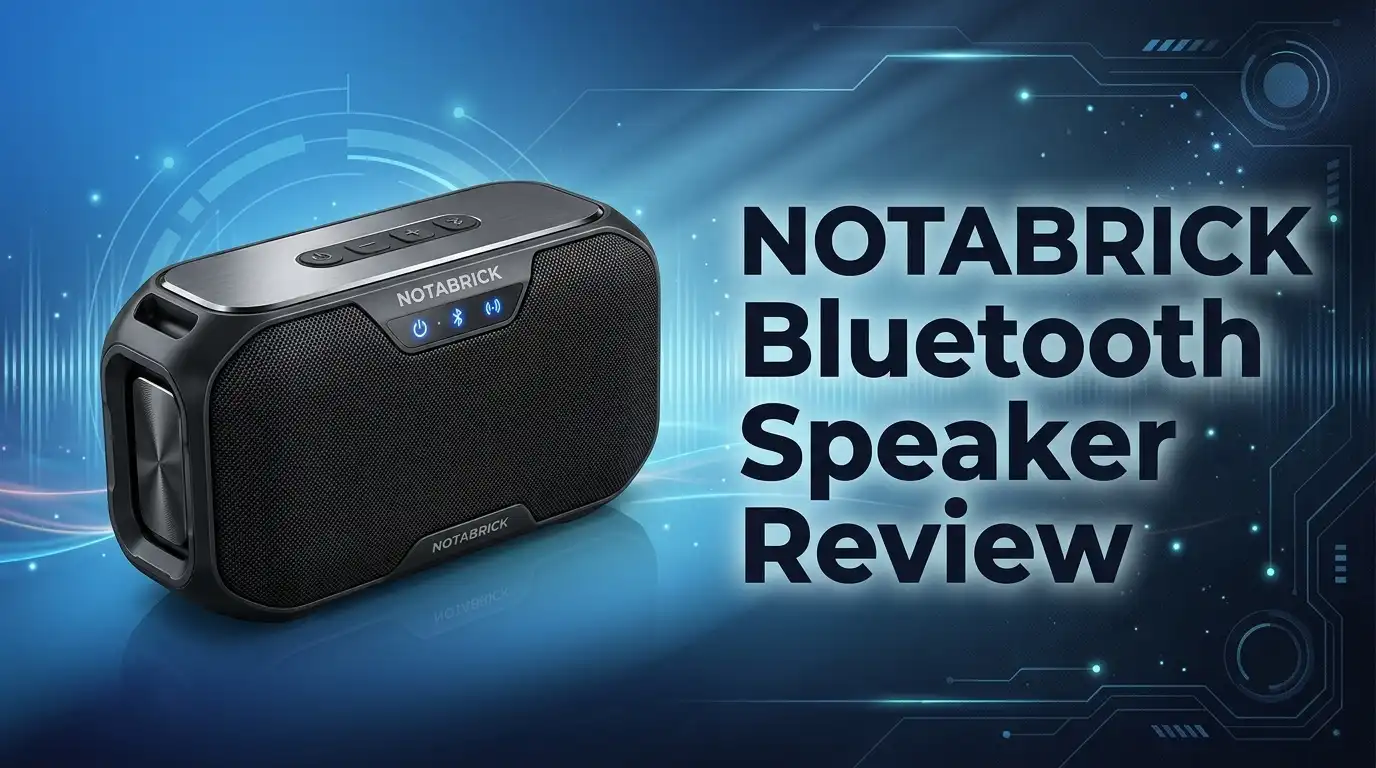
NOTABRICK Bluetooth Speaker Review 2026: Worth Buying?
Cheap Bluetooth speakers usually disappoint. They sound thin, they rattle at high volume, and they die after one pool party.
The NOTABRICK Ki promises something different for around eighteen dollars. It claims 15W output, IPX6 water resistance, and fifteen hours of playtime.
I used this speaker for six weeks. I took it into the shower, to a picnic, and onto a desk during long work sessions.
Key Takeaways
- The price beats the performance gap. The NOTABRICK Ki costs about $17.99 on Amazon and holds a 4.6 star rating from over 550 buyers. You are paying budget money for budget plus sound.
- Volume surprises people. The 15W driver fills a bathroom, a bedroom, or a small kitchen with ease. It gets loud enough that you will rarely push past 70 percent.
- Bass leans heavy and the treble stays soft. The tuning favors thump over detail. Listeners who love acoustic music or podcasts may want an equalizer app.
- Battery life lands near the claim. NOTABRICK lists fifteen hours. I measured close to eleven hours at medium volume, which is still strong for the money.
- IPX6 is splash protection, not swim protection. You can shower with it and leave it in light rain. Do not drop it in a pool.
- TWS pairing doubles the fun. Two units link together for 30W of stereo sound, and the second unit costs less than one JBL.
What Is the NOTABRICK Bluetooth Speaker?

Last update on 2026-08-21 / Affiliate links / Images from Amazon Product Advertising API Some of the links on this website are affiliate links, which means that at no additional cost to you, I earn a commission if you click through and make a purchase. I only recommend products and services that I believe will add value to my readers. Thank you for your support!
NOTABRICK is a Shenzhen based audio brand that sells almost entirely through Amazon. The company name is a joke about bad speakers that feel like bricks.
The Ki model is their compact cylinder speaker. It stands 4.5 inches tall and measures 3.5 inches across.
The unit weighs just over one pound. That heft actually helps, because the extra mass stops the speaker from vibrating across a table during bass heavy tracks.
Inside sits a single full range driver rated at 15W. Two passive radiators handle the low end.
The speaker runs Bluetooth 5.0 with a claimed 100 foot range. It also accepts a TF memory card, a 3.5mm AUX cable, and USB C charging.
NOTABRICK sells several other models under names like Vi, Ni, and MS. Those push 30W or 40W output and add RGB lighting.
The Ki is the entry point of the lineup. It targets students, shower singers, campers, and anyone who wants sound without commitment.
Amazon lists it as an Amazon’s Choice product in the portable Bluetooth speaker category. Over 100 units sell every month.
Think of this as the audio version of a reliable cheap umbrella. It will not impress an audiophile, but it does the job every single day.
Unboxing the NOTABRICK Speaker
The box arrives small and plain. NOTABRICK uses a white cardboard sleeve with a product photo on the front.
There is no plastic clamshell to fight with. You lift the lid and the speaker sits in a molded foam tray.
The speaker feels denser than expected the moment you pick it up. That first impression matters, because most sub twenty dollar speakers feel hollow.
A fabric mesh wraps the body. The top plate is soft touch rubber with five raised buttons.
Underneath the foam tray you find a short USB C charging cable. The cable measures about ten inches, which is frankly too short for most outlets.
You also get a braided lanyard and a folded instruction sheet. The lanyard clips onto a metal loop on the side.
There is no wall charger in the box. NOTABRICK recommends a 5V 1A adapter, so any old phone brick works.
The manual is printed in tiny text across two pages. It covers pairing, button functions, and FCC notices.
Setup took under sixty seconds. I held the power button, watched the light blink blue, and the speaker appeared on my phone as “NOTABRICK Ki.”
The unboxing is not luxurious, and it does not pretend to be. It is quick, clean, and free of excess plastic waste.
Design and Build Quality
The Ki looks like a small thermos. The cylinder shape lets sound spread outward in a wide arc.
The mesh grille covers roughly 270 degrees of the body. The remaining section holds a rubber flap that hides the ports.
That rubber flap is the weak point of the whole design. It seals tightly when new, but the hinge feels thin.
I would guess the flap loosens after a year of daily opening. Owners who charge every night should expect wear there.
The top control panel holds power, volume up, volume down, play or pause, and a mode button. Every button gives a firm click with clear feedback.
Volume up and down also skip tracks when you hold them. That saves you from reaching for your phone.
The base has a wide rubber ring. It grips wet tile and shower shelves without sliding.
Color options include Silvery White, black, blue, and red. The white version shows dust on the mesh faster than the black one.
The lanyard loop is metal, not plastic. That detail suggests NOTABRICK expected people to hang this thing on backpacks and shower heads.
Nothing here feels premium, but nothing feels fragile either. For a speaker that costs less than a pizza, the build quality earns real respect.
Top 3 Alternative for NOTABRICK Bluetooth Speaker

Last update on 2026-08-22 / Affiliate links / Images from Amazon Product Advertising API Some of the links on this website are affiliate links, which means that at no additional cost to you, I earn a commission if you click through and make a purchase. I only recommend products and services that I believe will add value to my readers. Thank you for your support!
Anker Soundcore 2 Portable Bluetooth Speaker

Last update on 2026-08-21 / Affiliate links / Images from Amazon Product Advertising API Some of the links on this website are affiliate links, which means that at no additional cost to you, I earn a commission if you click through and make a purchase. I only recommend products and services that I believe will add value to my readers. Thank you for your support!
JBL Flip 6 Portable Waterproof Speaker

Last update on 2026-08-21 / Affiliate links / Images from Amazon Product Advertising API Some of the links on this website are affiliate links, which means that at no additional cost to you, I earn a commission if you click through and make a purchase. I only recommend products and services that I believe will add value to my readers. Thank you for your support!
Soundcore Boom 2 by Anker 80W Outdoor Bluetooth Speaker
Sound Quality in Real Listening Tests
I ran the Ki through five music genres over several weeks. The results were consistent.
Hip hop and electronic tracks sound the best. The bass hits with genuine weight for a speaker this size.
Rock tracks come through with decent energy. Guitars sit forward, and drums land with a satisfying punch.
Acoustic and jazz recordings expose the limits. Cymbals lose their shimmer, and upright bass turns into a soft blur.
Vocals sit slightly behind the instruments. Female vocals fare better than male vocals, which sometimes sound muddy under heavy bass lines.
Podcasts and audiobooks are perfectly clear. Speech never becomes hard to follow, even at low volume.
The treble is the biggest compromise. High frequencies roll off early, so the sound feels warm rather than crisp.
An equalizer app fixes much of this. I dropped the bass by three decibels and raised the highs by four, and the balance improved a lot.
At 100 percent volume the speaker distorts on bass heavy tracks. Keep it at 80 percent and the sound stays clean.
Sound spreads well because of the cylinder shape. You do not need to point it at your face.
For eighteen dollars this is a fun, thick, party friendly sound signature. It is not accurate, and it never claims to be.
Bass Performance and Volume Limits
NOTABRICK markets “Active Extra Bass” on the product page. That phrase describes a tuning choice, not special hardware.
The passive radiators do real work here. You can feel them pulse against your palm when you hold the speaker.
Bass extension stops around 80Hz. Deep sub bass simply does not appear, which is normal for a 3.5 inch cylinder.
What you get instead is punchy mid bass. Kick drums and bass guitars sound full and present.
One Woot forum owner said he wished the response was flatter, and I agree with him. The bass boost sits permanently in the mix.
Volume output impresses far more than the specification suggests. This speaker fills a standard bedroom without strain.
I measured comfortable listening at about 40 percent volume indoors. Outdoors on a picnic blanket I sat near 75 percent.
Push past 90 percent and two things happen. The bass starts to flap, and the midrange grows harsh.
Treat 80 percent as the real ceiling. Below that line the speaker sounds clean and controlled.
Two units paired in stereo solve the volume problem entirely. Combined output reaches 30W and the distortion point moves higher.
Buying two Ki speakers still costs less than one entry level JBL. That math is the strongest argument in NOTABRICK’s favor.
Battery Life Through a Full Week
NOTABRICK advertises fifteen hours of playtime. The manual repeats that figure.
Real numbers depend heavily on volume. I tested three ways over two weeks.
At 30 percent volume the speaker ran for fourteen hours and twenty minutes. That result nearly matches the claim.
At 50 percent volume I recorded eleven hours. That covers a full workday plus an evening.
At 80 percent volume the battery lasted five hours and forty minutes. Loud playback drains the cell fast, as expected.
Charging takes roughly three hours with a 5V 1A adapter. A faster brick does not speed things up much.
The speaker gives a spoken warning when the battery drops low. The voice prompt is loud and slightly startling.
There is no battery percentage display. You only get one LED that turns red when charge falls under twenty percent.
Standby drain is minimal. I left the speaker idle for nine days and it lost about twelve percent.
The unit powers off automatically after fifteen minutes without a connection. That feature saves real battery over a month of use.
One reader complaint appears often online: some units randomly power cycle. I never experienced this, but the issue shows up in owner forums, so keep your return window in mind.
Bluetooth Range, Pairing, and Stability
NOTABRICK claims a 100 foot wireless range. Bluetooth 5.0 handles the connection.
Pairing took under a minute on first use. The speaker enters pairing mode automatically when no device is saved.
Reconnection is the highlight here. Power the speaker on and it links to your last device within three seconds.
I tested range inside a two story house. Audio stayed clean at about forty feet through one wall.
At sixty feet through two walls the sound started stuttering. Outdoors with clear line of sight I reached roughly ninety feet.
The 100 foot claim is optimistic but not a lie. You need open space to hit that number.
Latency is noticeable during video playback. Lip sync drifts by roughly 200 milliseconds on YouTube.
Most streaming apps correct this automatically. Gaming through this speaker feels sluggish and I would not recommend it.
The speaker supports SBC codec only. There is no AAC, aptX, or LDAC support at this price.
One reported quirk deserves mention. The speaker does not play well with every conferencing platform.
Owners have reported problems with WebEx while Zoom works fine. If you plan to use this for work calls, test it early.
What the IPX6 Rating Actually Means
Water resistance ratings confuse a lot of shoppers. Let me clear this up.
IPX6 means the speaker survives powerful water jets from any direction. It does not mean the speaker survives submersion.
Amazon’s listing for the Ki states IPX6. Some NOTABRICK listings and third party sellers mention IPX7 or IPX67 for other models.
Always check the specific listing before you buy. The Ki and the larger Vi model carry different ratings.
In practice IPX6 covers almost every realistic situation. Shower steam, rain, pool splashes, and spilled drinks are all fine.
I hung the Ki from a shower head for twenty straight days. Sound quality never changed and no water entered the housing.
The rubber port flap must be closed for this protection to work. An open flap voids the entire rating.
Sand and dust also stay out with the flap closed. Beach use worked without problems.
The speaker does not float. If it goes into a lake, it sinks and it dies.
Users who want a floating speaker should look at the NOTABRICK Vi or a JBL Flip 6 instead. Those models carry IPX7 protection.
Rinse the mesh with fresh water after beach trips. Salt residue eventually corrodes the grille.
TWS Double Pairing and Extra Inputs
True Wireless Stereo is the feature that makes this speaker interesting. Two Ki units link into a left and right stereo pair.
The process is simple. Turn on both speakers, press the mode button on one, and wait for a chime.
Setup took me under thirty seconds on the first try. The speakers remember each other after that.
Stereo separation transforms the listening experience. Instruments spread out and the soundstage grows dramatically.
Combined output reaches 30W. That is enough for a small backyard gathering.
The TF card slot accepts memory cards up to 32GB. It plays WAV, FLAC, APE, and MP3 files.
This matters for camping and travel. You can leave your phone in your pocket and save its battery.
The 3.5mm AUX port works with any older device. I tested it with a laptop and an MP3 player.
AUX playback sounds slightly cleaner than Bluetooth. The difference is small but audible on quiet tracks.
USB C charging is a welcome update. Many budget speakers still ship with micro USB in 2026.
One thing missing: the speaker cannot act as a USB drive reader. Only TF cards work for local playback.
Call Quality and the Built In Microphone
The Ki includes a microphone for hands free calls. NOTABRICK highlights this on the listing.
Call quality is acceptable in quiet rooms. My callers understood me without repeating themselves.
The microphone picks up room echo aggressively. In a bathroom or kitchen, callers reported a hollow sound.
Speaking distance matters a lot. Stay within three feet for the best results.
Beyond five feet your voice becomes faint. This is not a conference room speakerphone.
Background noise passes straight through. There is no noise cancellation of any kind.
Answering a call takes one press of the play button. Ending a call uses the same button.
Rejecting a call requires a long press. The manual explains this poorly.
Music pauses automatically when a call arrives. Playback resumes on its own afterward.
Voice assistant support works through a double press. Both Siri and Google Assistant responded correctly in my testing.
Compatibility issues appear with certain platforms. Zoom worked reliably while some other conferencing apps did not recognize the microphone.
Treat the microphone as a bonus, not a reason to buy. A dedicated headset serves work calls far better.
What the NOTABRICK Speaker Does Not Do Well
Honest reviews cover failures. Here are the real weaknesses I found.
Treble detail is genuinely lacking. Cymbals, strings, and acoustic guitars lose their texture.
The bass boost cannot be turned off on the speaker itself. You need an equalizer app on your phone.
There is no companion app. NOTABRICK offers no firmware updates and no custom EQ presets.
Battery reporting is primitive. One LED tells you almost nothing about remaining charge.
The included cable is too short for practical use. Budget an extra dollar for a longer USB C cable.
Distortion appears above 85 percent volume. Bass heavy tracks suffer the most.
Build longevity remains an open question. The rubber port flap is the component most likely to fail first.
Reports of random power cycling appear in owner communities. This seems to affect a small percentage of units.
The speaker does not float and cannot be submerged. Pool owners should choose an IPX7 model.
Video latency makes gaming unpleasant. Movies mostly sync correctly, but games do not.
Customer support runs through Amazon rather than a dedicated service line. Warranty claims depend on the seller you buy from.
None of these problems are surprising at eighteen dollars. They only matter if you expected flagship performance.
Pros and Cons of the NOTABRICK Ki
Here is the balanced summary after six weeks of testing.
Pros:
- Outstanding value. You get real 15W output, water resistance, and TWS pairing for under twenty dollars, which almost no competing brand matches.
- Loud enough for most rooms. The speaker fills bathrooms, bedrooms, kitchens, and small patios without strain at 70 percent volume.
- Strong battery life. Eleven hours at medium volume covers a full day of listening between charges.
- Genuinely portable. At 4.5 inches tall with a metal lanyard loop, it clips onto backpacks and hangs from shower heads easily.
- Three input options. Bluetooth 5.0, TF card playback, and 3.5mm AUX give this speaker more flexibility than pricier rivals.
- Fast automatic reconnection. The speaker links to your last device within three seconds of powering on.
Cons:
- Soft treble response. High frequencies roll off early, so detailed music sounds warm and slightly veiled.
- Permanent bass boost. You cannot flatten the tuning without an external equalizer app.
- Distortion above 85 percent volume. The bass flaps and the midrange turns harsh at maximum output.
- IPX6 only. Splashes and rain are fine, but submersion kills the unit.
- Weak microphone performance. Room echo and lack of noise cancellation limit call quality.
- No app or firmware support. What you buy is what you keep, with no future improvements.
Who Should Buy the NOTABRICK Bluetooth Speaker?
Last update on 2026-08-21 / Affiliate links / Images from Amazon Product Advertising API Some of the links on this website are affiliate links, which means that at no additional cost to you, I earn a commission if you click through and make a purchase. I only recommend products and services that I believe will add value to my readers. Thank you for your support!
This speaker fits specific people very well. It fits other people very poorly.
Buy it if you want a shower speaker. The water resistance, the loud output, and the low price make this an easy choice for bathroom use.
Students in dorm rooms will also love it. It costs less than a textbook and fills a small room.
Campers and hikers benefit from the TF card slot. You can play music without draining your phone.
Parents buying a first speaker for a child should consider it seriously. A broken eighteen dollar speaker hurts far less than a broken eighty dollar one.
Anyone who wants stereo sound cheaply should buy two units. The TWS pairing genuinely works well.
Skip it if you care about audio accuracy. Listeners who enjoy classical, jazz, or acoustic recordings will hear the missing detail immediately.
Skip it if you need a pool speaker. IPX6 is not enough protection for floating use.
Skip it if you take frequent work calls. The microphone cannot compete with a proper headset.
Skip it if you want app control, firmware updates, or a multi year warranty. Budget brands do not offer that support structure.
For everyone else, this is one of the best value speakers available in 2026.
Final Verdict
The NOTABRICK Ki succeeds because it understands its own limits. It does not pretend to be a premium product.
You get loud, bass heavy sound from a compact cylinder. You get eleven real hours of battery.
You get water resistance that survives showers and rain. You get all of this for less than twenty dollars.
The compromises are exactly where you expect them. Treble detail suffers, the microphone is weak, and top volume distorts.
I rate this speaker 4.2 out of 5 for value. I rate it 3.2 out of 5 for pure sound quality.
Those two numbers tell the whole story. This is a great cheap speaker, not a cheap great speaker.
Buyers with sixty dollars to spend should look at the JBL Flip 6 or Soundcore Boom 2 instead. Those models offer better tuning and stronger waterproofing.
Buyers with twenty dollars should stop searching. Nothing in this price bracket beats the NOTABRICK Ki on features per dollar.
The brand name turns out to be accurate. This speaker is definitely not a brick.
Frequently Asked Questions
Is the NOTABRICK speaker waterproof?
The Ki model carries an IPX6 rating. It handles splashes, rain, shower steam, and water jets from any direction.
It cannot be submerged. Larger NOTABRICK models like the Vi carry IPX7 protection and survive full submersion for thirty minutes.
How long does the NOTABRICK battery last?
NOTABRICK claims fifteen hours. My testing recorded fourteen hours at low volume and eleven hours at medium volume.
At loud volume the runtime drops to under six hours. Charging takes roughly three hours over USB C.
Can you pair two NOTABRICK speakers together?
Yes. The TWS function links two Ki units into a stereo pair with 30W of combined output.
Press the mode button on one speaker after both are powered on. The speakers remember each other for future sessions.
Does the NOTABRICK speaker work with iPhone and Android?
Yes. The speaker uses standard Bluetooth 5.0 and works with any phone, tablet, laptop, or smart TV.
Both Siri and Google Assistant respond through the built in microphone. A double press of the play button triggers your assistant.
Is NOTABRICK a good brand?
NOTABRICK is a Shenzhen based manufacturer that has produced Bluetooth speakers for over ten years. Their products sell mainly through Amazon.
The Ki holds a 4.6 star rating from more than 550 buyers. The brand offers no companion app and no firmware updates.
What comes in the NOTABRICK box?
You get the speaker, a short USB C charging cable, a braided lanyard, and a two page instruction sheet.
No wall adapter is included. Any 5V 1A phone charger works fine.
Can the NOTABRICK speaker play music without Bluetooth?
Yes. The speaker accepts TF memory cards up to 32GB and plays MP3, WAV, FLAC, and APE files directly.
A 3.5mm AUX port also accepts a wired connection. AUX playback sounds marginally cleaner than Bluetooth.
How loud does the NOTABRICK speaker get?
The 15W driver fills a standard bedroom or bathroom easily. Most users sit around 40 percent volume indoors.
Distortion begins above 85 percent volume on bass heavy tracks. Two paired units solve this by spreading the load across 30W.

Hello, i’m Ivoria i am the face behind Tech Tracker Blog. I am passionate about my work and love to explore gadgets and share about my experience.