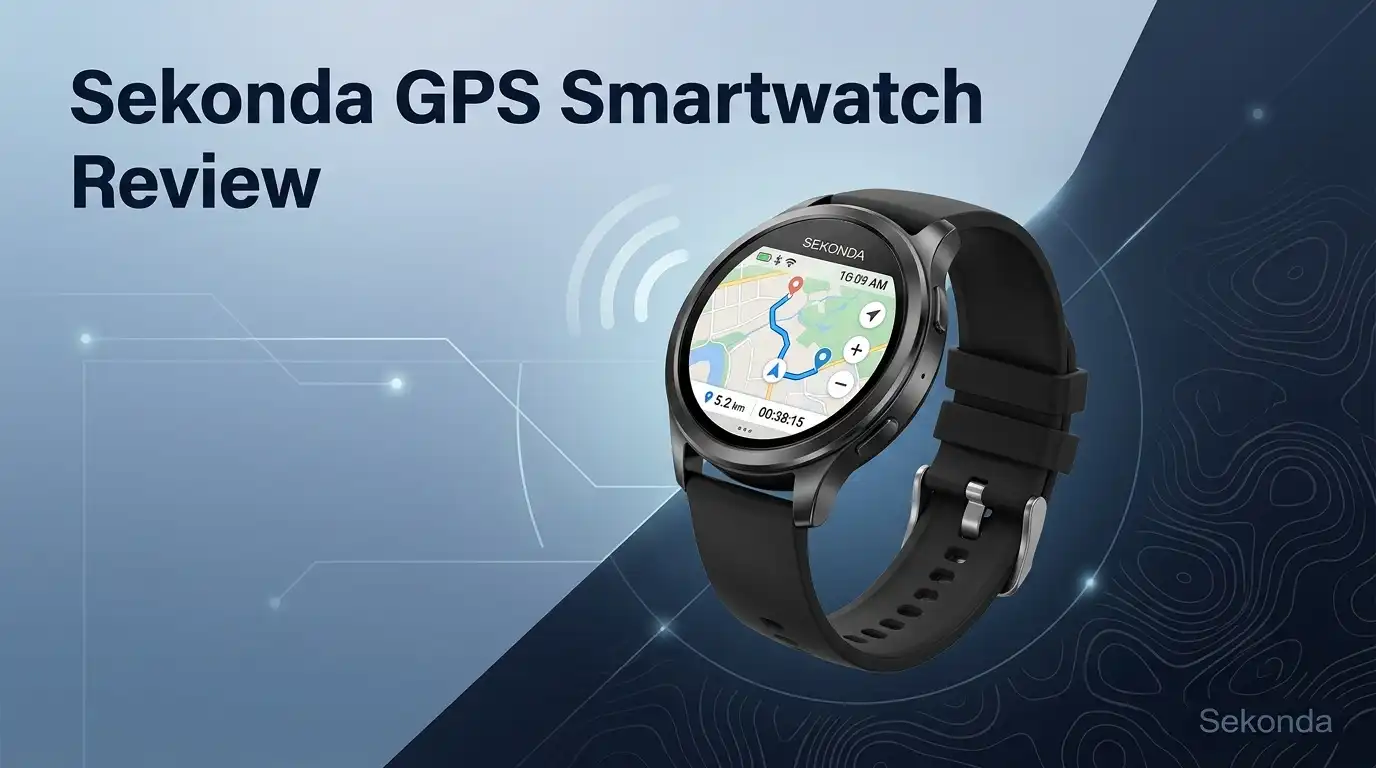
Sekonda GPS Smartwatch Review 2026: Worth Buying?
Smartwatches keep getting more expensive, yet most people just want three things. They want accurate step counts, honest heart rate data, and a battery that survives the week. The Sekonda GPS smartwatch range promises all three for a price that sits far below Garmin and Apple.
Sekonda is a British watch brand with roots going back to 1966. The company built its name on affordable quartz watches sold through high street jewellers. In 2026 the brand sells a full smartwatch line, and the GPS models sit at the top of it.
I wore the Sekonda Active Pro GPS daily for several weeks. I ran with it, slept with it, swam with it, and charged it far less often than expected.
Key Takeaways:
- Battery life is the headline feature. Sekonda quotes up to 20 days on the Active Pro and up to 10 days on some variants. In mixed real use with the always on display switched off, I saw roughly seven to ten days per charge. That beats almost every mainstream smartwatch at this price.
- The AMOLED screen looks far better than the price suggests. The 1.4 inch 466 x 466 panel is bright, sharp, and readable in direct sunlight. Colours pop, and the always on clock mode works well indoors.
- Built in GPS removes the phone from your run. Route mapping worked reliably on open roads and parks. Accuracy drops under tree cover and between tall buildings, which is normal for budget GPS chips.
- Health tracking is broad but not clinical. You get continuous heart rate, SpO2, sleep stages, stress scores, and guided breathing. Treat the numbers as trends, not medical readings.
- The Sekonda Smart app is the weak link. It handles the basics fine. It does not export to Strava as smoothly as rivals, and the interface feels dated next to Zepp or Garmin Connect.
- Value is the real selling point. With IP68 protection, Bluetooth calling, swim mode, and a two year guarantee, the package makes sense for casual users rather than serious athletes.
What Is the Sekonda GPS Smartwatch?
No products found.
The Sekonda GPS smartwatch is a family of fitness focused watches rather than a single model. The current lineup includes the Active Go, the Active Plus, and the flagship Active Pro.
Only some models carry true satellite positioning. The Active Pro is the one with built in GPS, so it records your route without your phone in your pocket. Cheaper Sekonda models borrow GPS from a connected phone instead.
The Active Pro uses a 47mm round case in ion plated alloy. It pairs that with a 22mm quick release silicone strap and a rotating crown for scrolling menus.
Sekonda positions this watch as an everyday tracker for walkers, runners, cyclists, and gym users. It is not aimed at ultra runners or triathletes chasing training load metrics.
The brand sells mainly in the UK through jewellers, its own website, and Amazon. That distribution matters, because you can walk into a store and try one on before buying.
Pricing usually sits well under £150, and frequent discounts push it lower. That price bracket is crowded, with Amazfit, Xiaomi, and Honor all fighting for the same buyer.
What sets Sekonda apart is the retail presence and the two year guarantee. Many rivals offer one year and an email address in another country.
So the honest framing is simple. This is a budget GPS smartwatch from a familiar watch brand, not a technical training computer.
Sekonda Active Pro GPS Smart Watch
The Active Pro is the model most people mean when they search for a Sekonda GPS smartwatch. It launched as the brand’s most feature complete wearable and it remains the flagship in 2026.
The specification sheet reads well. You get a 1.4 inch AMOLED touchscreen at 466 x 466 resolution, an always on display option, and a rotating crown.
Inside sits a lithium polymer battery rated up to 20 days depending on settings. Sekonda quotes 10 days for heavier use, which felt closer to reality for me.
Health sensors cover the usual list. Continuous heart rate monitoring, blood oxygen readings, sleep staging, stress scoring, and guided breathing all appear in the menu.
Sports tracking includes 14 modes on the standard firmware, covering walking, running, cycling, rowing, football, and yoga. Some marketing materials mention far higher mode counts across the wider range.
The case measures 47mm across, which is genuinely large. On my 17cm wrist it looked bold rather than absurd, but smaller wrists will feel it.
Water resistance is rated IP68 with a dedicated water lock and swim mode. That covers pool swimming and rain, though not diving or hot showers.
Smart features round it out with Bluetooth calling, message notifications, music control, weather, compass, alarms, and a stopwatch.
Charging uses a magnetic two pin cable. It is proprietary, so losing it means ordering a replacement rather than grabbing a spare USB cable.
Unboxing Experience: What Comes in the Box
The box arrives smaller than expected. Sekonda ships the Active Pro in a compact rectangular carton measuring roughly 19 x 7.5 x 3 centimetres and weighing around 130 grams.
Lift the lid and the watch sits face up in a moulded tray. There is no fancy magnetic flap or soft velvet lining, which suits the price point.
The watch ships with a screen protector film already applied. Peel it off, because it dulls the AMOLED panel badly and attracts fingerprints.
Underneath the tray you find the magnetic charging cable, a folded quick start leaflet, and the guarantee card. No power adapter is included, so use an existing phone plug or a laptop USB port.
The strap comes fitted and feels softer than most budget silicone. Quick release spring bars sit underneath, so swapping to a 22mm leather or metal band takes about twenty seconds.
First power on took a long press of the crown. The watch woke with maybe 40 percent charge, enough to start setup immediately.
A QR code on the packaging sends you straight to the Sekonda Smart app download page. That saved hunting through the app store for the right listing.
Total setup time from opening the box to a paired, updated watch was about twelve minutes. Most of that was the firmware update, which ran slowly over Bluetooth.
The overall impression is tidy and practical. Nothing feels luxurious, but nothing feels cheap either.
Top 3 Alternative for Sekonda GPS Smartwatch


Last update on 2026-10-07 / Affiliate links / Images from Amazon Product Advertising API Some of the links on this website are affiliate links, which means that at no additional cost to you, I earn a commission if you click through and make a purchase. I only recommend products and services that I believe will add value to my readers. Thank you for your support!
Amazfit Bip 6 Smart Watch

Last update on 2026-10-07 / Affiliate links / Images from Amazon Product Advertising API Some of the links on this website are affiliate links, which means that at no additional cost to you, I earn a commission if you click through and make a purchase. I only recommend products and services that I believe will add value to my readers. Thank you for your support!
Garmin Forerunner 165 Running Smartwatch

Last update on 2026-10-06 / Affiliate links / Images from Amazon Product Advertising API Some of the links on this website are affiliate links, which means that at no additional cost to you, I earn a commission if you click through and make a purchase. I only recommend products and services that I believe will add value to my readers. Thank you for your support!
Google Fitbit Charge 6 Fitness Tracker
Design and Build Quality
The Active Pro looks like a sports watch rather than a tech gadget. The round ion plated alloy case has a brushed finish with polished chamfers around the bezel.
At 47mm wide it wears large. Sekonda does not currently offer a smaller GPS version, which is a genuine gap in the range.
Weight sits at a comfortable level thanks to the alloy case and silicone strap. I forgot I was wearing it during sleep tracking, which is the real test.
The rotating crown is the standout physical detail. It clicks satisfyingly, scrolls menus smoothly, and doubles as a press button for the app grid.
A second flat pusher sits below it for shortcuts. Both buttons feel firm with no wobble, which is rare at this price.
The bezel markings look sharp from a distance, though close inspection shows printed rather than engraved detail. That is a fair compromise.
The glass sits slightly proud of the bezel, so it can catch on door frames. Mine picked up one faint scuff after three weeks of ordinary use.
The strap deserves praise. It is soft, breathable enough for gym sessions, and the keeper loop actually holds instead of flapping loose.
Build quality feels solid for the money. There are no creaks and no gaps in the case seams. Compared with generic Amazon smartwatches at similar prices, the finishing is a clear step up.
Display and Always On Screen
The 1.4 inch AMOLED panel is the best part of this watch. Blacks look truly black, and the 466 x 466 resolution keeps text crisp at small sizes.
Brightness climbs high enough for a sunny run. I kept it on automatic and only twice needed to shade the screen with my hand.
The always on display works well but costs battery. Turning it on roughly halved my runtime, from about nine days to four or five.
Raise to wake responded quickly in most positions. It occasionally missed when my arm came up slowly from a desk, which is a common complaint across budget watches.
Watch faces number in the dozens, with more available through the app. Quality varies wildly, and some look like clip art from a decade ago.
The good ones look genuinely smart. I settled on a simple analogue face with a step ring and heart rate complication.
Touch response is quick with no noticeable lag when swiping between panels. The crown makes long menus far easier than swiping alone.
One small annoyance stands out. The screen timeout is short by default and cannot be extended very far, so reading a long message means tapping to keep it alive.
Colour accuracy is good enough that photos in notifications look natural. For a watch in this bracket, the display punches well above its weight.
GPS Accuracy in Real Use
Built in GPS is the main reason to pick the Active Pro over cheaper Sekonda models. It means you can leave your phone at home and still record a route.
Satellite lock took between 20 and 45 seconds outdoors on most attempts. Standing still while it searched produced faster results than walking out the door immediately.
On a familiar five kilometre park loop, the watch recorded distances within about two percent of my reference device. That is acceptable accuracy for casual training.
Road running produced the cleanest traces. The plotted line followed pavements closely with only minor corner cutting at sharp turns.
Performance dropped under dense tree cover. One woodland route showed visible zigzagging and added around 150 metres to the true distance.
City centre running between tall buildings produced similar drift. This is standard behaviour for single band GPS chips, and Sekonda does not claim dual band on every model.
Cycling tracking held up better than running, likely because higher speeds smooth out the signal. My commute route matched the map almost perfectly.
Pace readings updated with a noticeable lag. Instant pace jumped around during intervals, so I relied on lap averages instead.
Elevation data is the weakest metric. Without a barometric altimeter, climb figures came from GPS alone and varied between repeat runs of the same hill.
For walkers, casual runners, and cyclists, the GPS does its job. Serious runners chasing precise splits will want a dedicated running watch.
Heart Rate, SpO2 and Sleep Tracking
The optical sensor on the back tracks heart rate continuously through the day. Resting readings matched my chest strap within two or three beats per minute.
Steady state exercise also tracked well. During an easy 30 minute run, the average sat within five beats of my reference strap.
High intensity intervals exposed the limits. The watch lagged behind during sharp efforts and sometimes undercounted peak heart rate by 10 beats or more.
Wearing the watch snugly one finger width above the wrist bone improved results noticeably. Loose wear produced obvious dropouts.
SpO2 readings ranged from 95 to 99 percent overnight, which is plausible for a healthy adult. Treat these numbers as a general trend rather than a medical measurement.
Sleep tracking splits the night into deep, light, and awake periods. Total sleep duration was usually accurate within about 15 minutes.
Sleep stage breakdowns felt less trustworthy. The watch credited me with deep sleep during a night I remember as restless.
Stress scoring uses heart rate variability. The scores moved in sensible directions across busy and calm days, but the underlying logic is not explained anywhere.
Guided breathing is simple and pleasant. A pulsing circle sets the rhythm for one to five minute sessions.
None of this data is clinical grade. Used as a nudge toward better habits, it works well. Used as a diagnostic tool, it does not.
Battery Life Tested
Battery life is where the Sekonda GPS smartwatch genuinely competes with far pricier rivals. Sekonda quotes up to 20 days for the Active Pro under light use.
My results landed lower but still strong. With notifications on, continuous heart rate active, and the always on display off, I averaged eight to nine days per charge.
Adding the always on display cut that to roughly four days. Adding daily GPS runs of 40 minutes cut it further to about three days.
A one hour GPS session consumed around eight to ten percent of the battery. That works out to roughly ten hours of continuous tracking, which is fine for marathons but not ultras.
Charging is reasonably quick. A full charge from ten percent took a little under two hours on a standard phone plug.
The magnetic puck attaches firmly and lines up without fiddling. It has never fallen off overnight, unlike some cheaper docks.
Standby drain is very low. I left the watch unworn for four days and it lost about six percent.
One frustration deserves mention. The battery percentage on some Sekonda models is less granular than it should be, dropping in visible chunks rather than steady increments.
Trustpilot reviews mention a minority of units where battery life collapsed after a year or so. The two year guarantee covers this, and Sekonda’s replacement process is generally well rated.
The Sekonda Smart App Experience
The watch pairs with the free Sekonda Smart app on Android 9.0 or newer and iOS 12.0 or newer. Setup requires creating an account with an email address.
The home screen shows steps, heart rate, sleep, and recent workouts in stacked cards. It is clear and easy to read at a glance.
Daily and weekly charts load quickly. Tapping a workout opens a map, a pace graph, and a heart rate zone breakdown.
Watch face management sits in its own tab. Downloads take about thirty seconds each over Bluetooth.
Notification settings let you pick individual apps. This worked reliably for messages, email, and social apps in my testing.
The app is functional but plain. The layout looks several years behind Zepp, Garmin Connect, and Fitbit, and animations feel sluggish on older phones.
Data export is the biggest limitation. There is no smooth native sync to Strava or Apple Health equivalents that most runners expect.
Long term trend analysis is thin. You can scroll back through weeks of data, but there is no training load, no recovery advice, and no fitness age style summary.
Occasional sync failures happened maybe once a week. Closing and reopening the app fixed it every time.
App store ratings sit around average, with users praising simplicity and criticising bugs after firmware updates. That matches my experience.
Bluetooth Calling and Notifications
Bluetooth calling works better than I expected on a budget watch. The Active Pro connects as a hands free audio device alongside the app connection.
Call quality on my side was clear in a quiet room. Callers reported that my voice sounded distant but understandable, which is typical of wrist microphones.
Outdoors with traffic noise, the microphone struggled. I ended up moving calls to my phone twice during walks near a main road.
The dialler on the watch includes a keypad and recent call list. Contact sync pulled in my full phone book without issues.
Speaker volume is loud enough to hear indoors. It is not loud enough for a busy street or a gym with music playing.
Notifications arrive quickly with no noticeable delay. Text appears in a readable font with the sender name at the top.
You cannot reply to messages beyond a few canned responses on Android, and iOS blocks even those. This is a platform limitation rather than a Sekonda flaw.
Emoji rendering is hit and miss. Some appear correctly while others show as empty boxes.
The vibration motor is firm without being harsh. I never missed an alert during the day, though it is gentle enough that it did not wake me at night.
Music control handles play, pause, and track skipping on the phone. There is no onboard music storage, so phone free running means silent running.
Swimming and Water Resistance
The Active Pro carries an IP68 rating. That means full dust protection and resistance to immersion in water up to about 1.5 metres for 30 minutes.
Sekonda includes a dedicated water lock and swim mode. Activating it disables the touchscreen so water droplets cannot trigger random taps.
I took the watch into a 25 metre pool for several sessions. Lap counting worked accurately during steady front crawl and matched my manual count.
Breaststroke counting was less reliable. The watch occasionally missed turns when I paused at the wall.
Stroke type detection exists but should be treated loosely. It confused breaststroke with front crawl more than once.
The screen remained readable underwater, which surprised me. Beading water cleared quickly when I lifted my wrist.
Exiting water requires a long press to unlock, which pushes remaining droplets out through the speaker. This worked as intended every time.
Sekonda is clear about the limits. Avoid hot water, steam rooms, saunas, and high pressure jets, since heat and pressure damage the seals.
That rules out wearing it in the shower if you want to protect the watch long term. Sea swimming is also risky, since salt water degrades gaskets faster than pool water.
For pool laps and rainy runs, the protection is more than adequate. For diving or watersports, look elsewhere.
What the Sekonda GPS Smartwatch Does Not Do Well
Every honest review needs this section. The Active Pro cuts real corners, and knowing them prevents disappointment.
GPS drifts under tree cover and near tall buildings. Single band positioning cannot match dual band systems on watches costing twice as much.
There is no barometric altimeter, so elevation gain figures are estimates. Hill runners and trail walkers will find the climb data unreliable.
Heart rate accuracy falls apart during intervals and sprints. Anyone doing structured speed work should pair a chest strap instead.
The app is the biggest weakness. Sluggish performance, limited export options, and thin long term analysis hold the whole package back.
There is no onboard music storage and no offline maps. Phone free workouts mean no audio and no navigation, only a recorded trace.
The 47mm case only comes in one size. Smaller wrists have no GPS option in the current Sekonda lineup.
Contactless payment is absent. If you want to buy coffee from your wrist, this is not the watch.
No third party app store exists. Despite one listing mentioning Wear OS, the interface is a closed custom system with a fixed feature set.
Firmware updates arrive slowly and occasionally introduce bugs, based on app store feedback. Some users report needing a factory reset afterwards.
Finally, resale value is poor. Budget smartwatches hold almost no value, so treat the purchase as money spent rather than invested.
Pros and Cons
Here is the summary in plain terms after weeks of daily wear.
Pros
- Excellent battery life that comfortably reaches a week or more with the always on display switched off, which removes daily charging anxiety completely.
- The 1.4 inch AMOLED display is bright, sharp, and readable in sunlight, easily matching screens on watches costing twice the price.
- Built in GPS records routes without a phone, and accuracy on open roads and parks is genuinely good for the money.
- The rotating crown makes menu scrolling fast and precise, a physical control many budget rivals leave out entirely.
- Swim mode with a proper water lock works reliably for pool sessions and counts laps accurately during front crawl.
- Bluetooth calling, notifications, and music control all function smoothly, covering the smart features most people actually use.
- A two year guarantee and UK retail presence make warranty claims far easier than with import only brands.
- Quick release 22mm straps mean cheap and easy customisation with widely available bands.
Cons
- The Sekonda Smart app feels dated, syncs slowly at times, and offers no smooth export to Strava or other popular platforms.
- GPS accuracy drops noticeably under trees and between tall buildings, with visible zigzagging in the recorded trace.
- Heart rate readings lag during high intensity intervals and can undercount peak effort by a wide margin.
- No barometric altimeter means elevation figures are estimates rather than measurements.
- The 47mm case is large and comes in only one size, which suits bigger wrists only.
- No contactless payment, no onboard music storage, and no offline maps.
- Charging requires a proprietary magnetic cable that is easy to lose and awkward to replace.
Who Should Buy the Sekonda GPS Smartwatch?
This watch fits a specific buyer very well and disappoints a different one badly. Knowing which group you fall into makes the decision easy.
Buy it if you walk, jog, or cycle casually. The step counts, route maps, and heart rate trends give you everything needed to build a habit.
Buy it if battery anxiety annoys you. Charging once a week instead of every night changes how a smartwatch feels to live with.
Buy it if you want a smartwatch that looks like a watch. The alloy case and brushed finish pass as a normal sports watch in an office.
Buy it if you value a UK brand with a real warranty. Two years of cover and a phone number to call carries genuine weight.
Buy it if your budget stops around £100 to £150. In that bracket, the display and battery combination is hard to beat.
Skip it if you train seriously. No training load, no recovery scores, and no reliable elevation data means it cannot guide structured programmes.
Skip it if you rely on Strava. The export friction will frustrate you within a week.
Skip it if you have small wrists. A 47mm case is simply too much watch for many people.
Skip it if you want contactless payments, offline maps, or downloadable apps. Those features live in a higher price bracket.
Price and Value in 2026
The Sekonda GPS smartwatch usually sits between £90 and £150 depending on the model and finish. Sales during Black Friday and January push it lower.
At that price the competition is fierce. The Amazfit Bip 6 offers a bigger screen and better app for similar money, though without high street support.
The Garmin Forerunner 165 costs roughly double. It delivers far better GPS, real training metrics, and Strava integration, so the extra spend is justified for runners.
The Fitbit Charge 6 sits in a similar bracket. It tracks health data well but uses a small band style screen and pushes a subscription for full insights.
Sekonda’s advantage is trust and access. You can see the watch in a shop, buy it from a familiar name, and return it locally if something goes wrong.
The two year guarantee adds real value. Most budget rivals offer twelve months and an overseas support email.
Strap compatibility helps too. Standard 22mm quick release bands cost a few pounds and completely change the look.
Long term value depends on software support. Sekonda publishes compliance statements listing support periods, which is more transparency than many rivals provide.
Overall the pricing feels fair rather than a bargain. You get a strong display and battery, average GPS, and a below average app.
Final Verdict
The Sekonda GPS smartwatch earns a recommendation with clear conditions attached. It does the fundamentals well and skips the extras.
The screen and battery are the standout wins. A bright AMOLED panel lasting a week beats what most people expect at this price.
GPS works well enough for parks, roads, and commutes. It falls short in woods and city canyons, which matters more to some users than others.
Health tracking is broad and useful as a trend indicator. It is not accurate enough for training decisions or medical concerns.
The app is what holds the watch back. Sekonda could raise this product a full tier by rebuilding the software and adding proper data export.
Build quality genuinely impressed me. The crown, the case finish, and the strap all feel better than the price implies.
For casual fitness users who want a smart watch that looks smart, this is a sensible buy. For runners chasing performance data, the extra money for a Garmin is worth it.
My rating sits at around 7.5 out of 10. Strong hardware, weak software, and honest value for the right person.
If you mainly want steps, sleep, notifications, and a route map once or twice a week, the Sekonda Active Pro will serve you well for years.
Frequently Asked Questions
Does the Sekonda smartwatch have built in GPS?
Only some models do. The Sekonda Active Pro includes built in GPS and records routes without a phone. Cheaper models like the Active Go rely on connected GPS from your smartphone, so check the specific model before buying.
How long does the Sekonda GPS smartwatch battery last?
Sekonda quotes up to 20 days on the Active Pro under light use. In real conditions with notifications and continuous heart rate active, expect eight to nine days. Enabling the always on display roughly halves that figure.
Can you swim with a Sekonda smartwatch?
Yes, pool swimming is fine. The Active Pro carries an IP68 rating with a dedicated water lock and swim mode. Avoid hot showers, saunas, steam rooms, and high pressure water, since heat and pressure damage the seals over time.
Is the Sekonda smartwatch compatible with iPhone?
Yes. The Sekonda Smart app supports iOS 12.0 and above as well as Android 9.0 and above. Notification support works on both, though iPhone users cannot send quick replies from the watch due to Apple restrictions.
Does the Sekonda smartwatch sync with Strava?
Not smoothly. The Sekonda Smart app stores workouts internally and does not offer the seamless Strava integration found on Garmin or Amazfit watches. If Strava matters to you, consider an alternative brand.
What is the warranty on Sekonda smartwatches?
Sekonda provides a two year guarantee on its smartwatch range. That is longer than most budget competitors offer, and the UK based support is easier to reach than overseas brands.
Is the Sekonda GPS smartwatch worth buying in 2026?
For casual walkers, joggers, and cyclists on a budget, yes. You get a bright AMOLED screen, long battery life, and reliable everyday tracking. Serious athletes should spend more on a dedicated running watch instead.

Hello, i’m Ivoria i am the face behind Tech Tracker Blog. I am passionate about my work and love to explore gadgets and share about my experience.