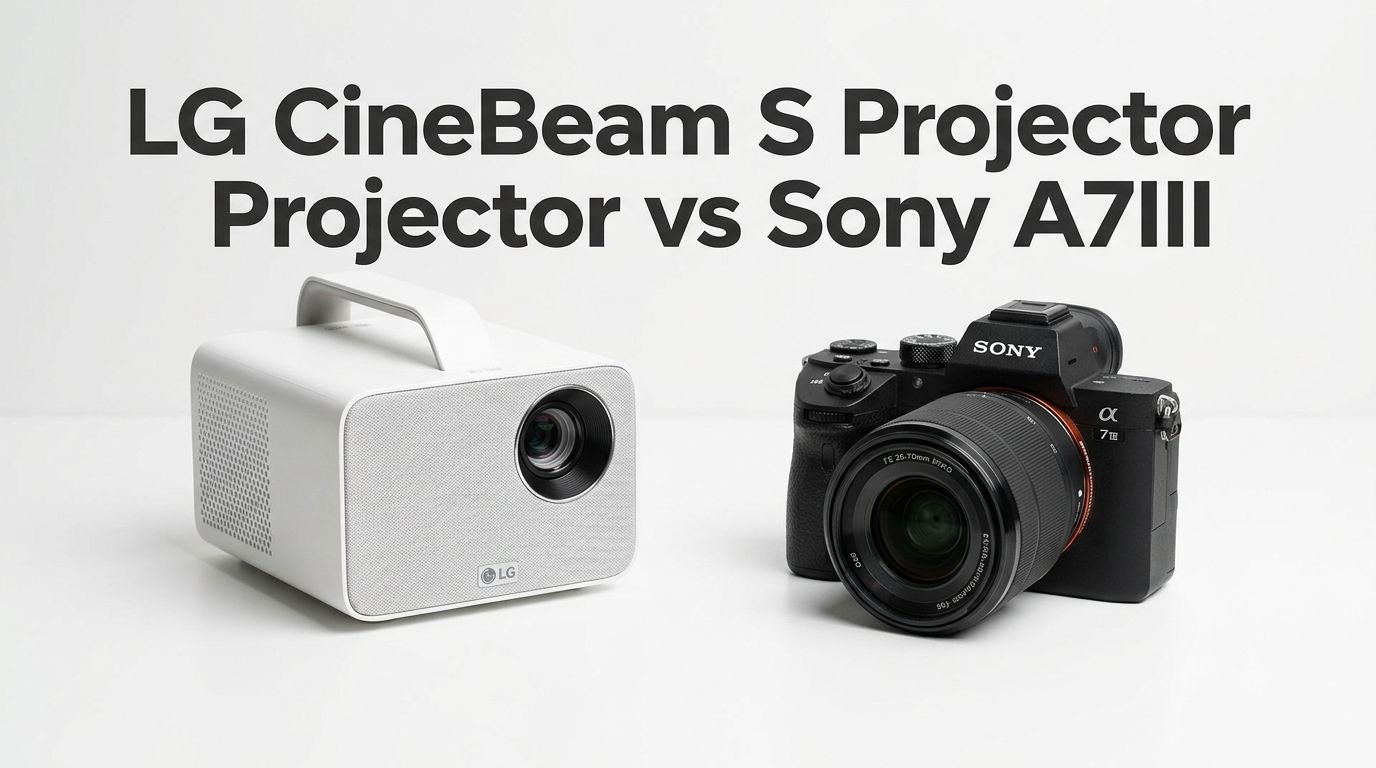
LG CineBeam S Projector vs Sony A7III: Which to Buy?
You want stunning visuals. You want a device that delivers a true cinematic experience. But you are stuck between two very different products.
The LG CineBeam S projector and the Sony A7III mirrorless camera both promise outstanding image quality, yet they serve different purposes.
One projects a massive 100 inch screen on your wall. The other captures breathtaking photos and videos with a full frame sensor. So which one should you buy?
Key Takeaways
- The LG CineBeam S is a compact ultra short throw 4K laser projector priced around $1,299. It produces a 100 inch image from just 22 inches away. It uses a triple RGB laser light source with 500 ANSI lumens and a 450,000:1 contrast ratio. It weighs only 4.2 pounds and runs webOS for built in streaming.
- The Sony A7III is a 24.2 megapixel full frame mirrorless camera. It features 693 phase detection autofocus points, 10fps continuous shooting, and 4K video recording. It weighs about 650 grams (body only) and has a battery life of roughly 710 shots per charge.
- Both products fall in a similar price range, making the decision harder for buyers with a fixed budget. The CineBeam S costs around $1,299 while the Sony A7III body can be found for around $1,500 to $1,800 depending on the retailer.
- The LG CineBeam S excels at home entertainment and presentations. If you want a big screen experience without mounting a TV, this projector delivers. The Sony A7III excels at content creation, photography, and videography. If you plan to shoot professional quality photos or videos, the A7III is the better pick.
LG CineBeam S Projector: Full Overview

Last update on 2026-08-31 / Affiliate links / Images from Amazon Product Advertising API Some of the links on this website are affiliate links, which means that at no additional cost to you, I earn a commission if you click through and make a purchase. I only recommend products and services that I believe will add value to my readers. Thank you for your support!
The LG CineBeam S (model PU615U) is one of the most impressive mini projectors available right now. It packs 4K UHD resolution into a remarkably small body that measures just 6.3 x 4.3 x 6.3 inches. You can literally pick it up with one hand.
This projector uses triple RGB laser technology to deliver accurate, vivid colors. LG claims it covers 154% of the DCI P3 color gamut. That means reds are richer, greens are deeper, and blues are more lifelike than what most projectors offer in this price range.
The ultra short throw design is a standout feature. You place the CineBeam S just inches from a wall and it projects a large, sharp image. A 100 inch screen requires only about 22 inches of distance. This eliminates the need for ceiling mounts or long room setups.
It also runs webOS, which gives you direct access to streaming apps like Netflix, Disney Plus, and Apple TV. You do not need an external streaming stick. The built in Dolby Atmos sound adds another layer of immersion without extra speakers.
Pros:
- Ultra short throw projects 100 inches from just 22 inches away
- 4K UHD resolution with triple laser for vivid color accuracy
- Incredibly compact and portable at only 4.2 pounds
- Built in webOS with popular streaming apps
- Dolby Atmos sound built in
- 20,000 hour laser light source lifespan
Cons:
- 500 ANSI lumens may struggle in bright rooms
- Limited physical ports (1 HDMI, 2 USB C)
- No optical zoom available
- Premium price for a mini projector
Sony A7III Camera: Full Overview


Last update on 2026-08-31 / Affiliate links / Images from Amazon Product Advertising API Some of the links on this website are affiliate links, which means that at no additional cost to you, I earn a commission if you click through and make a purchase. I only recommend products and services that I believe will add value to my readers. Thank you for your support!
The Sony A7III remains one of the most popular full frame mirrorless cameras on the market. Sony launched it in 2018, but it still holds up extremely well against newer competitors. The 24.2 megapixel back illuminated sensor delivers sharp, detailed images with impressive dynamic range.
The autofocus system uses 693 phase detection points that cover 93% of the frame. This makes the A7III fast and accurate for tracking moving subjects. Sports, wildlife, and street photography all benefit from this AF performance.
Video shooters get 4K recording at 24 and 30 frames per second. The footage uses full pixel readout without binning, which produces clean and detailed 4K video. S Log2 and S Log3 profiles give colorists plenty of room for post production grading.
Battery life is a strong point. The NP FZ100 battery provides roughly 710 shots per charge, which is a significant improvement over earlier Sony models. You can shoot all day without constant battery swaps.
Pros:
- 24.2MP full frame sensor with excellent low light performance
- 693 phase detection AF points for fast and accurate focus
- 4K video with S Log2 and S Log3 for professional color grading
- 710 shot battery life per charge
- Dual memory card slots
- 10fps continuous shooting speed
Cons:
- Aging menu system compared to newer Sony cameras
- Single SD card slot supports UHS II (second slot is UHS I only)
- No built in image stabilization for video at 4K 30fps crop
- Screen does not fully articulate for vlogging
- Body only purchase requires separate lens investment
4K Resolution: Projector vs Camera
Both devices handle 4K, but they do it in very different ways. The LG CineBeam S projects a 3840 x 2160 pixel image onto a wall or screen. It uses DLP pixel shifting technology to achieve this resolution. The result is a large, crisp picture that fills your living room.
The Sony A7III captures 4K video at 3840 x 2160 as well. It records this footage internally to an SD card. The camera oversamples from its full frame sensor, which produces sharp and detailed 4K footage with minimal aliasing.
The key difference is output versus capture. The CineBeam S displays 4K content from streaming services or connected devices. The Sony A7III creates 4K content that you can then edit and share. One is a display device. The other is a creation tool.
If you already have a library of 4K content and want to enjoy it on a massive screen, the CineBeam S is the clear winner. If you want to produce your own 4K videos for YouTube, social media, or client work, the A7III makes more sense.
Color Accuracy and Image Quality
The LG CineBeam S delivers impressive color performance with 154% DCI P3 coverage. This means it can display a wider range of colors than most projectors. Skin tones look natural, landscapes look vivid, and HDR content pops with detail.
The contrast ratio of 450,000:1 adds depth to dark scenes. Blacks appear deeper and highlights remain bright. This combination creates a rich, cinematic image that rivals many higher priced projectors.
The Sony A7III produces images with 15 stops of dynamic range. This means you can recover detail from shadows and highlights during editing. The BSI sensor architecture reduces noise at high ISO values, and the camera delivers clean images even at ISO 6400 and beyond.
For color accuracy in photos, the A7III provides outstanding results straight out of camera. It also supports 14 bit uncompressed RAW files, which give editors maximum flexibility. Video shooters can use S Log profiles for professional grade color grading.
Build Quality and Portability
The LG CineBeam S weighs just 4.2 pounds and fits easily in a backpack. Its cube shaped design looks modern and stylish. You can move it between rooms or take it to a friend’s house for movie night. The small footprint means it fits on a coffee table, nightstand, or shelf.
The Sony A7III weighs 650 grams (about 1.43 pounds) without a lens. Add a standard zoom lens and the total weight stays under 2 pounds. The magnesium alloy body provides solid build quality. It also features weather sealing against dust and moisture, which makes it suitable for outdoor shooting.
Both products score high marks for portability. The CineBeam S is larger but still compact for a projector. The A7III is lightweight and ergonomic for long shooting sessions. Your choice depends on what you need to carry and where you need to go.
Connectivity Options
The LG CineBeam S offers HDMI 2.0b, two USB Type C ports, Wi Fi, and Bluetooth. The USB C ports support screen mirroring from laptops and phones. Bluetooth lets you connect wireless headphones or external speakers. Wi Fi enables streaming and AirPlay 2 functionality.
The Sony A7III provides USB Type C, micro USB, micro HDMI, a 3.5mm headphone jack, and a 3.5mm microphone input. It also has Wi Fi and NFC for wireless image transfer. The dual card slots accept SD, SDHC, and SDXC memory cards.
The CineBeam S has better wireless connectivity for media consumption. The A7III has better physical connectivity for production work. The microphone and headphone jacks on the Sony are essential for video creators who need audio monitoring.
Smart Features and Software
The LG CineBeam S runs on webOS, the same operating system found on LG smart TVs. This platform gives you access to Netflix, Amazon Prime Video, Disney Plus, Apple TV Plus, YouTube, and more. The interface is clean and responsive.
Auto screen adjustment is another smart feature. The projector detects the wall surface and adjusts the image automatically. It corrects keystone distortion and fits the image perfectly without manual tuning. This saves setup time every time you move the projector.
The Sony A7III does not have a smart operating system. It runs Sony’s proprietary firmware. The camera connects to the Sony Imaging Edge app for remote shooting and image transfer. The app works on both iOS and Android devices.
The CineBeam S wins on smart features by a wide margin. It functions as a standalone entertainment center. The A7III relies on external devices for any media playback or smart functionality.
Price and Value for Money
The LG CineBeam S has a street price of approximately $1,297 to $1,299. For a 4K ultra short throw laser projector with smart features, this represents solid value. Competing UST projectors from Samsung and Hisense often cost significantly more.
The Sony A7III body retails for approximately $1,500 to $1,800 depending on the seller and condition. Keep in mind that you need to buy lenses separately. A basic Sony 28 to 70mm kit lens adds another $200 to $300. Higher quality lenses like the Tamron 28 to 75mm f/2.8 cost $800 or more.
The total investment for the Sony A7III system often exceeds $2,000 once you factor in lenses, memory cards, and batteries. The CineBeam S is more of an all in one package that works right out of the box. Budget conscious buyers should consider the total cost of each system.
Best Use Cases for the LG CineBeam S
The CineBeam S excels in several specific situations. Home movie nights become incredible with a 100 inch screen that fills your wall. The ultra short throw design means you do not need a dedicated theater room.
Small apartments and bedrooms benefit from the compact size. You can project onto a blank wall from your nightstand. The Dolby Atmos speakers provide decent sound without extra equipment.
Business presentations and gaming sessions also work well. The HDMI input connects to a laptop or gaming console. The 4K resolution keeps text sharp and gameplay immersive. The portability means you can bring it to different offices or rooms.
Best Use Cases for the Sony A7III
The Sony A7III shines for photography and videography. Portrait photographers love the shallow depth of field from the full frame sensor. Wedding photographers appreciate the reliable autofocus and long battery life.
YouTube content creators and filmmakers benefit from the 4K video quality and S Log profiles. The compact body makes it easy to rig on a gimbal or tripod. It records clean footage that looks professional after color grading.
Travel photographers value the lightweight body and weather sealing. You can take the A7III through rain, dust, and cold conditions. The ISO range of 50 to 204,800 handles extreme lighting situations from bright beaches to dark interiors.
Which One Should You Buy?
This decision comes down to your primary goal. Buy the LG CineBeam S if you want a stunning home entertainment experience. It delivers a massive, colorful 4K image in a small, portable package. Movie lovers, gamers, and presentation givers will love it.
Buy the Sony A7III if you want to create professional quality photos and videos. It captures beautiful images, tracks subjects with precision, and records clean 4K footage. Photographers, videographers, and content creators will get years of value from it.
If you already own a good camera and want to upgrade your viewing experience, the CineBeam S is a fantastic addition. If you already have a nice TV or monitor and want to start creating content, the A7III is the smarter investment.
Both products deliver exceptional quality at their respective price points. You cannot go wrong with either choice as long as it matches your intended use.
Final Verdict
The LG CineBeam S and Sony A7III are both outstanding products that serve very different needs. The CineBeam S is the best mini ultra short throw projector you can buy right now. The A7III remains one of the best value full frame cameras available.
Your lifestyle and goals determine the right pick. A home theater enthusiast should grab the CineBeam S without hesitation. A budding photographer or filmmaker should invest in the A7III and a good lens.
Consider your space, your creative ambitions, and your entertainment habits. Then pick the device that aligns with how you want to experience or create visual content. Either way, you are getting a high quality product that will serve you well for years.
FAQ
Can the LG CineBeam S replace a TV?
Yes. The CineBeam S can project a 4K image up to 100 inches. It runs webOS with built in streaming apps. For many users, it can completely replace a traditional television. However, its 500 ANSI lumens brightness works best in dimmer rooms.
Is the Sony A7III still worth buying in 2026?
The Sony A7III remains an excellent camera despite being several years old. Its full frame sensor, 693 point autofocus, and 4K video capabilities hold up well. It offers outstanding value compared to newer cameras that cost much more.
Can I use the Sony A7III for professional work?
Absolutely. Many professional photographers and videographers use the A7III for weddings, events, portraits, and commercial projects. The image quality, autofocus speed, and dynamic range meet professional standards.
Does the LG CineBeam S need a screen?
No. The CineBeam S can project directly onto a white or light colored wall. A dedicated projector screen improves image quality, but it is not required. The auto screen adjustment feature helps optimize the picture on any flat surface.
Can I connect a gaming console to the LG CineBeam S?
Yes. The CineBeam S has an HDMI 2.0b port that accepts connections from PlayStation, Xbox, and Nintendo Switch consoles. You can enjoy games on a massive projected screen. Keep in mind that the input lag may not satisfy competitive gamers.
Does the Sony A7III shoot slow motion video?
The Sony A7III records 1080p video at 120 frames per second, which allows 5x slow motion in a 24fps timeline. It does not support 4K slow motion. For slow motion at higher resolutions, you would need a newer Sony model like the A7IV or A7SIII.

Hello, i’m Ivoria i am the face behind Tech Tracker Blog. I am passionate about my work and love to explore gadgets and share about my experience.