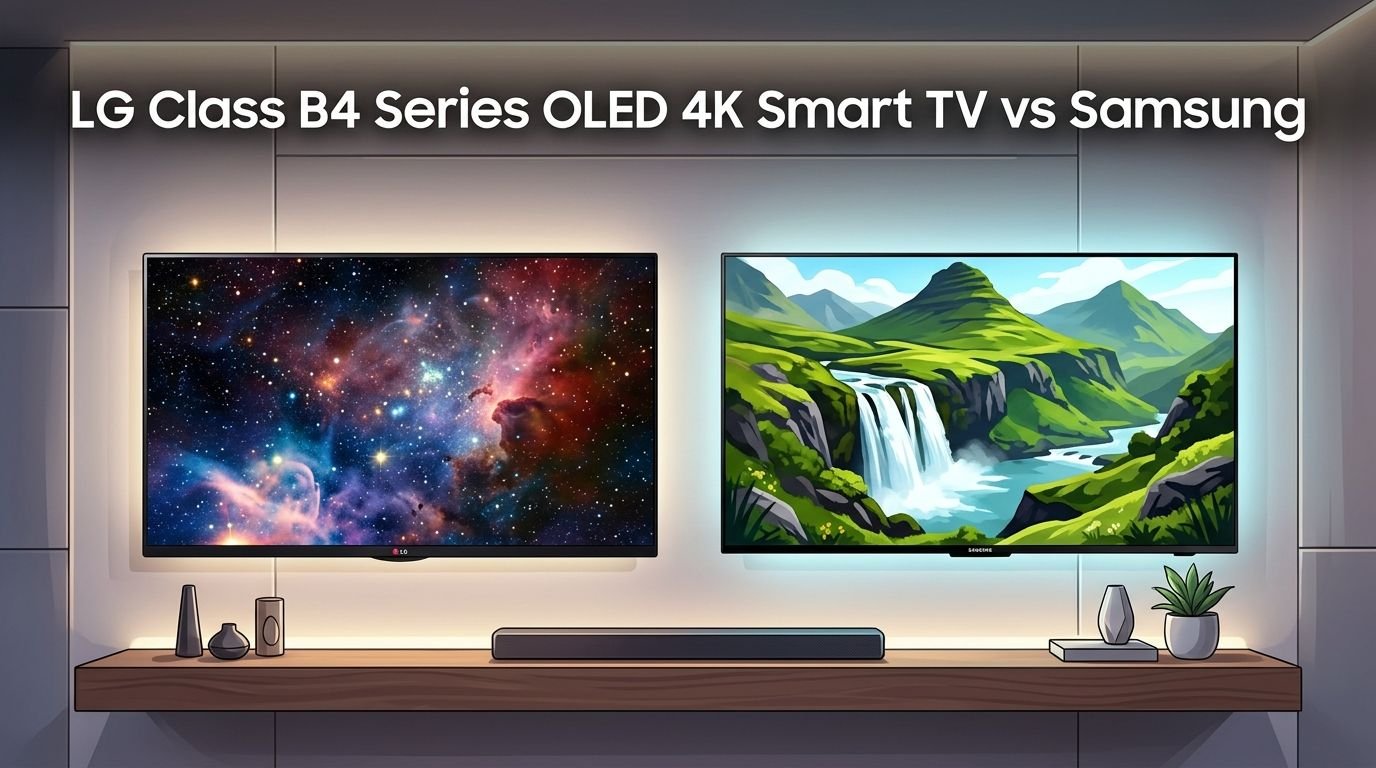
LG Class B4 Series OLED 4K Smart TV vs Samsung
Are you stuck between the LG B4 Series OLED and a Samsung OLED 4K Smart TV? You are not alone. These two brands dominate the OLED TV market, and each offers a strong set of features.
The LG B4 is LG’s entry point into OLED for 2024. Samsung counters with the S85D and the higher tier S90D OLED. Both brands promise perfect blacks, vivid colors, and smart TV features. But there are important differences in brightness, color accuracy, gaming performance, and price.
This guide breaks down every major area of comparison. You will learn which TV suits your room, your budget, and your viewing habits. Whether you love movies, gaming, or sports, this post gives you the facts you need. Read on to find the perfect OLED for your home.
Key Takeaways
- The LG B4 OLED is LG’s most affordable OLED TV for 2024. It uses a WOLED panel with the Alpha 8 AI Processor. It delivers perfect blacks, a 120Hz refresh rate, and support for Dolby Vision and Dolby Atmos. This makes it a strong pick for movie lovers and casual gamers on a budget.
- Samsung offers two direct competitors: the S85D and the S90D. The S85D uses a WOLED panel similar to the LG B4. The S90D uses Samsung’s QD OLED panel, which provides wider color coverage and higher HDR brightness. Your choice depends on how much you want to spend.
- HDR brightness is a key difference. The Samsung S90D gets noticeably brighter in HDR content than the LG B4. If you watch a lot of HDR movies or play HDR games, the S90D delivers a more impactful experience. The LG B4 and Samsung S85D are closer in brightness levels.
- Gaming features are strong on both sides. The LG B4 supports NVIDIA G Sync, AMD FreeSync Premium, and VRR with a 0.1ms response time. Samsung’s TVs support FreeSync Premium Pro and offer Motion Xcelerator 120Hz. Gamers will be happy with either brand.
- Smart TV platforms differ significantly. LG uses webOS 24 and Samsung uses Tizen OS. Both platforms support all major streaming apps. LG includes a Magic Remote with point and click navigation. Samsung uses a standard remote with voice control through Bixby and Alexa.
- Price plays a major role in this decision. The LG B4 often sells below $1,000 for the 65 inch model during sales. The Samsung S85D sits at a similar price point. The Samsung S90D costs more but delivers better picture quality for the premium.
LG B4 Series OLED 4K Smart TV Overview

Last update on 2026-10-06 / Affiliate links / Images from Amazon Product Advertising API Some of the links on this website are affiliate links, which means that at no additional cost to you, I earn a commission if you click through and make a purchase. I only recommend products and services that I believe will add value to my readers. Thank you for your support!
The LG B4 Series OLED is the entry level OLED from LG for 2024. It is available in 48, 55, 65, 77, and 83 inch sizes. The TV uses LG’s WOLED panel with over 8.3 million self lit pixels. Each pixel produces its own light and can turn off completely. This creates perfect blacks and infinite contrast.
The Alpha 8 AI Processor powers this TV. It handles AI picture and sound adjustments in real time. The processor upscales lower resolution content to near 4K quality. It also supports AI Sound Pro, which virtually upmixes audio to a 9.1.2 channel experience.
LG runs webOS 24 on the B4. The interface is clean and easy to use. You get quick access to Netflix, Disney Plus, Apple TV Plus, and other apps. The included Magic Remote lets you point and click like a mouse cursor. This makes navigation fast and smooth.
Pros:
- Perfect blacks and infinite contrast from OLED panel
- 120Hz native refresh rate with 0.1ms response time
- Supports Dolby Vision, Dolby Atmos, and Filmmaker Mode
- NVIDIA G Sync and AMD FreeSync Premium for gaming
- Magic Remote with intuitive point and click control
- Available in five screen sizes from 48 to 83 inches
Cons:
- Lower peak brightness compared to Samsung S90D
- Only one HDMI 2.1 port supports 4K 120Hz with full bandwidth
- Alpha 8 processor is less powerful than LG’s higher tier Alpha 11
- No QD OLED technology, so color volume is narrower
Samsung S85D OLED 4K Smart TV Overview

Last update on 2026-10-18 / Affiliate links / Images from Amazon Product Advertising API Some of the links on this website are affiliate links, which means that at no additional cost to you, I earn a commission if you click through and make a purchase. I only recommend products and services that I believe will add value to my readers. Thank you for your support!
The Samsung S85D is Samsung’s entry level OLED for 2024. It uses a WOLED panel, which is the same base technology found in the LG B4. Samsung offers this TV in 55, 65, and 77 inch sizes. The panel delivers deep blacks and excellent contrast like all OLED TVs.
Samsung equips the S85D with the NQ4 AI Gen2 Processor. This chip handles 4K AI upscaling and optimizes picture settings based on the content you watch. The TV supports HDR10, HDR10 Plus, and HLG. However, it does not support Dolby Vision, which is a notable omission.
The S85D runs Tizen OS. Samsung’s smart TV platform offers a wide range of apps and a clean home screen. You also get Samsung Gaming Hub, which lets you stream games from Xbox Cloud Gaming and NVIDIA GeForce Now without a console.
Pros:
- True OLED blacks with excellent contrast ratio
- NQ4 AI Gen2 Processor with smart upscaling
- Samsung Gaming Hub for cloud based gaming
- Object Tracking Sound Lite for immersive audio
- Slim Contour Design looks great on a wall
- HDR10 Plus support for compatible content
Cons:
- No Dolby Vision support
- WOLED panel lacks the color volume of QD OLED
- Fewer size options compared to LG B4
- Standard remote lacks LG’s point and click Magic Remote
- Peak brightness is similar to LG B4 and not class leading
Samsung S90D OLED 4K Smart TV Overview

Last update on 2026-10-18 / Affiliate links / Images from Amazon Product Advertising API Some of the links on this website are affiliate links, which means that at no additional cost to you, I earn a commission if you click through and make a purchase. I only recommend products and services that I believe will add value to my readers. Thank you for your support!
The Samsung S90D is a step above the S85D and represents Samsung’s mid range OLED for 2024. The 65 inch and larger models use a QD OLED panel. This panel combines quantum dots with OLED technology. The result is wider color coverage and higher brightness compared to standard WOLED panels.
The S90D uses the NQ4 AI Gen2 Processor, the same chip found in the S85D. But the QD OLED panel gives it a clear advantage in picture quality. Samsung claims Pantone validated color accuracy on this model. HDR content looks especially vibrant on this TV.
The 65 inch S90D produces a peak brightness around 1,000 to 1,300 nits in HDR mode. This is a meaningful step up from the LG B4 and Samsung S85D. The TV also features a 40W 2.1 channel speaker system with Object Tracking Sound.
Pros:
- QD OLED panel delivers wider color gamut and higher brightness
- Pantone validated color accuracy
- 40W 2.1 channel speakers with Object Tracking Sound
- Samsung Gaming Hub with cloud gaming support
- Strong HDR performance with HDR10 Plus
- Available in 42, 48, 55, 65, 77 inch sizes
Cons:
- No Dolby Vision support
- Higher price than LG B4 and Samsung S85D
- 42 and 48 inch models use WOLED, not QD OLED
- Tizen OS lacks some features found in webOS
- No Magic Remote style pointer navigation
Picture Quality Comparison
Picture quality is the most important factor for most TV buyers. All three TVs use OLED technology. This means they all produce perfect blacks and infinite contrast. A dark scene in a movie will look stunning on any of them.
The LG B4 delivers accurate colors and smooth gradients. LG’s color tuning is well regarded in the industry. The TV supports 100% color fidelity and 100% color volume according to LG’s own measurements. Dolby Vision content looks rich and detailed.
The Samsung S90D stands out for HDR performance. Its QD OLED panel produces a wider color gamut than the LG B4. Colors appear more saturated and vibrant, especially in reds and greens. The S90D also has less banding in HDR color gradients, which means smoother transitions between shades.
The Samsung S85D performs closer to the LG B4. Both use WOLED panels with similar brightness and color capabilities. The differences between these two are smaller than the gap between either one and the S90D.
Brightness and HDR Performance
Brightness matters for HDR content and bright room viewing. The LG B4 reaches a peak brightness of roughly 600 to 800 nits in small HDR highlights. This is good but not exceptional for an OLED TV.
The Samsung S85D performs in a similar brightness range as the LG B4. Neither TV will wow you in a very bright room. They work best in dimly lit or dark environments where OLED contrast can shine.
The Samsung S90D is the clear winner here. It can reach 1,000 to 1,300 nits in HDR peak brightness. This extra brightness makes HDR highlights pop with more intensity. Sunlight reflections, explosions, and bright sky scenes look more lifelike on the S90D.
If your room has large windows or lots of ambient light, the S90D handles it better than the B4 or S85D. The anti reflective coating on Samsung’s QD OLED panel also helps reduce glare from overhead lights.
Gaming Features and Performance
All three TVs support 4K resolution at 120Hz, making them solid choices for PS5, Xbox Series X, and PC gaming. The LG B4 offers a 0.1ms response time and supports NVIDIA G Sync, AMD FreeSync Premium, and VRR. These features reduce screen tearing and stutter during fast paced games.
Samsung’s TVs support AMD FreeSync Premium Pro and Motion Xcelerator 120Hz. The Samsung Gaming Hub is a standout feature. It gives you access to Xbox Cloud Gaming, NVIDIA GeForce Now, and Amazon Luna directly from the TV. You do not need a console or PC to play many popular titles.
The LG B4 supports Dolby Vision gaming, which Samsung TVs do not. Some Xbox Series X games output in Dolby Vision, and this gives the B4 an edge for those specific titles. The input lag on all three TVs is low in game mode, typically between 9 and 13 milliseconds.
Both platforms offer Auto Low Latency Mode (ALLM) for automatic game mode switching. Serious gamers should note that the LG B4 has only one full bandwidth HDMI 2.1 port. Samsung TVs provide four HDMI 2.1 ports, which is better if you connect multiple gaming devices.
Smart TV Platform and Interface
The LG B4 runs webOS 24. This platform has a horizontal app launcher at the bottom of the screen. You can customize it to show your favorite apps first. LG’s Magic Remote uses motion controls and a cursor. Many users find this faster and more intuitive than a traditional remote.
The Samsung S85D and S90D run Tizen OS. Samsung’s platform features a home screen with app recommendations and content suggestions. The Samsung Smart Hub organizes media, apps, and connected devices in one place. Samsung’s remote uses voice commands through Bixby, Alexa, and Google Assistant.
Both platforms support all major streaming apps including Netflix, Hulu, Disney Plus, Amazon Prime Video, YouTube, and Apple TV Plus. LG’s webOS also includes LG Channels, which offers free ad supported streaming. Samsung counters with Samsung TV Plus, a similar free streaming service.
One notable difference is AirPlay 2 and HomeKit support. Both LG and Samsung TVs support AirPlay 2 for Apple device streaming. This makes either brand a good fit for Apple users.
Sound Quality Comparison
The LG B4 has a 20W 2.0 channel speaker system. This is basic for a modern TV. The Alpha 8 AI Sound Pro feature virtually upmixes audio to simulate a surround sound experience. It works well for casual viewing but falls short for movies and music.
The Samsung S85D features Object Tracking Sound Lite. This technology uses multiple speakers to make sound follow the action on screen. It creates a more immersive experience compared to the LG B4’s standard speakers.
The Samsung S90D comes with a 40W 2.1 channel speaker system including a dedicated woofer. This gives it deeper bass and louder overall volume. Object Tracking Sound is also included. For built in TV speakers, the S90D provides the best audio experience among these three TVs.
All three TVs support Dolby Atmos passthrough to external soundbars. If you plan to use a soundbar or home theater system, the built in speaker differences matter less. However, for casual viewers who skip the soundbar, Samsung’s S90D has a clear edge in audio.
Design and Build Quality
The LG B4 features a slim OLED panel with a slightly thicker lower section that houses the electronics and speakers. The overall look is modern and clean. LG provides both a center pedestal stand and VESA mount compatibility. The bezels are thin but not the thinnest in LG’s lineup.
The Samsung S85D uses a Contour Design that gives it a sleek and uniform look from the front. The panel has very thin bezels and sits flush on its stand. Samsung’s design focus on aesthetics is clear with this model.
The Samsung S90D shares a similar slim profile. Both Samsung models offer a LaserSlim design that makes wall mounting look seamless. If wall mounting is your priority, Samsung’s slimmer and more uniform design may appeal more to you.
All three TVs are well built for their price range. Weight differences are minimal. Cable management varies by stand type, and both brands offer solutions to keep wires tidy.
Connectivity and Ports
The LG B4 includes four HDMI ports, but only one port (HDMI 3) supports HDMI 2.1 with full 48Gbps bandwidth. The other three ports are HDMI 2.0. This can be a limitation if you connect multiple 4K 120Hz devices. The TV also has two USB ports, an Ethernet port, Wi Fi 5, and Bluetooth 5.0.
The Samsung S85D and S90D both feature four HDMI 2.1 ports. This is a significant advantage over the LG B4. Every port supports 4K 120Hz signals at full bandwidth. Samsung TVs also include USB ports, Ethernet, Wi Fi 5, and Bluetooth 5.0.
For eARC (Enhanced Audio Return Channel), all three TVs dedicate one HDMI port to this function. eARC lets you send high quality audio from the TV to a soundbar or AV receiver. Samsung and LG both handle eARC well.
If you use multiple gaming consoles or a PC alongside a Blu ray player, Samsung’s four full HDMI 2.1 ports make it the better option for connectivity.
Price and Value for Money
The LG B4 65 inch model launched at around $1,699. It has since dropped below $1,000 during frequent sales. At this price, it offers excellent value for an OLED TV with gaming features, Dolby Vision, and a Magic Remote.
The Samsung S85D 65 inch model also launched near $1,899 but has seen similar price drops to the $900 to $1,000 range. It matches the LG B4 in many areas but lacks Dolby Vision. The choice here comes down to platform preference and feature priority.
The Samsung S90D 65 inch model launched higher at around $2,099. Sale prices often bring it down to the $1,100 to $1,300 range. The QD OLED panel, better brightness, and wider color gamut justify the premium for buyers who want the best picture quality in this price tier.
For budget focused shoppers, the LG B4 offers the best overall package. For those willing to spend more for better HDR and color, the Samsung S90D is worth the extra investment.
Who Should Buy Which TV?
The LG B4 is ideal for you if you value Dolby Vision support, enjoy LG’s Magic Remote, and want a great OLED at the lowest price. Movie enthusiasts who watch in dark rooms will love this TV. It is also a solid gaming TV with G Sync and FreeSync support.
The Samsung S85D suits buyers who prefer Samsung’s Tizen ecosystem and want the Samsung Gaming Hub. It performs similarly to the LG B4 in picture quality. If you already own Samsung devices and want easy integration, this is a smart choice.
The Samsung S90D is the pick for buyers who want the best picture quality in the mid range OLED category. The QD OLED panel delivers superior brightness and color. It is the best choice for bright rooms, HDR enthusiasts, and serious gamers who connect multiple 4K devices.
Consider your priorities. Dark room movie watching favors the LG B4. Bright room performance and HDR impact favor the Samsung S90D. Ecosystem preference may push you toward either brand regardless of specs.
Frequently Asked Questions
Is the LG B4 OLED better than the Samsung S85D?
The LG B4 and Samsung S85D perform very similarly in picture quality since both use WOLED panels. The LG B4 wins on Dolby Vision support and its Magic Remote. The Samsung S85D wins with four full HDMI 2.1 ports and Samsung Gaming Hub. Your preference depends on features and smart TV platform.
Does the Samsung S90D have Dolby Vision?
No. The Samsung S90D does not support Dolby Vision. Samsung uses HDR10 Plus as its preferred HDR format. If Dolby Vision is important to you, the LG B4 is the better choice among these options.
Which TV is better for gaming, LG B4 or Samsung S90D?
Both TVs are excellent for gaming. The LG B4 supports NVIDIA G Sync and Dolby Vision gaming. The Samsung S90D offers better brightness, wider colors, and four HDMI 2.1 ports. For multiple gaming devices, the Samsung S90D is more practical.
How bright is the LG B4 compared to Samsung OLED TVs?
The LG B4 reaches about 600 to 800 nits in HDR peak brightness. The Samsung S85D is similar. The Samsung S90D is significantly brighter at 1,000 to 1,300 nits. The S90D is the best choice for bright room viewing.
Are LG OLED TVs more reliable than Samsung OLED TVs?
Both brands produce reliable OLED TVs. LG has been making OLED panels since 2013 and has a longer track record. Samsung entered the OLED TV market more recently with QD OLED technology. Both brands offer standard manufacturer warranties and have strong customer support networks.
Which OLED TV has the best smart TV platform?
This is largely a matter of personal preference. LG’s webOS is praised for its clean layout and Magic Remote. Samsung’s Tizen OS is popular for its app selection and Gaming Hub integration. Both platforms receive regular updates and support all major streaming services.

Hello, i’m Ivoria i am the face behind Tech Tracker Blog. I am passionate about my work and love to explore gadgets and share about my experience.