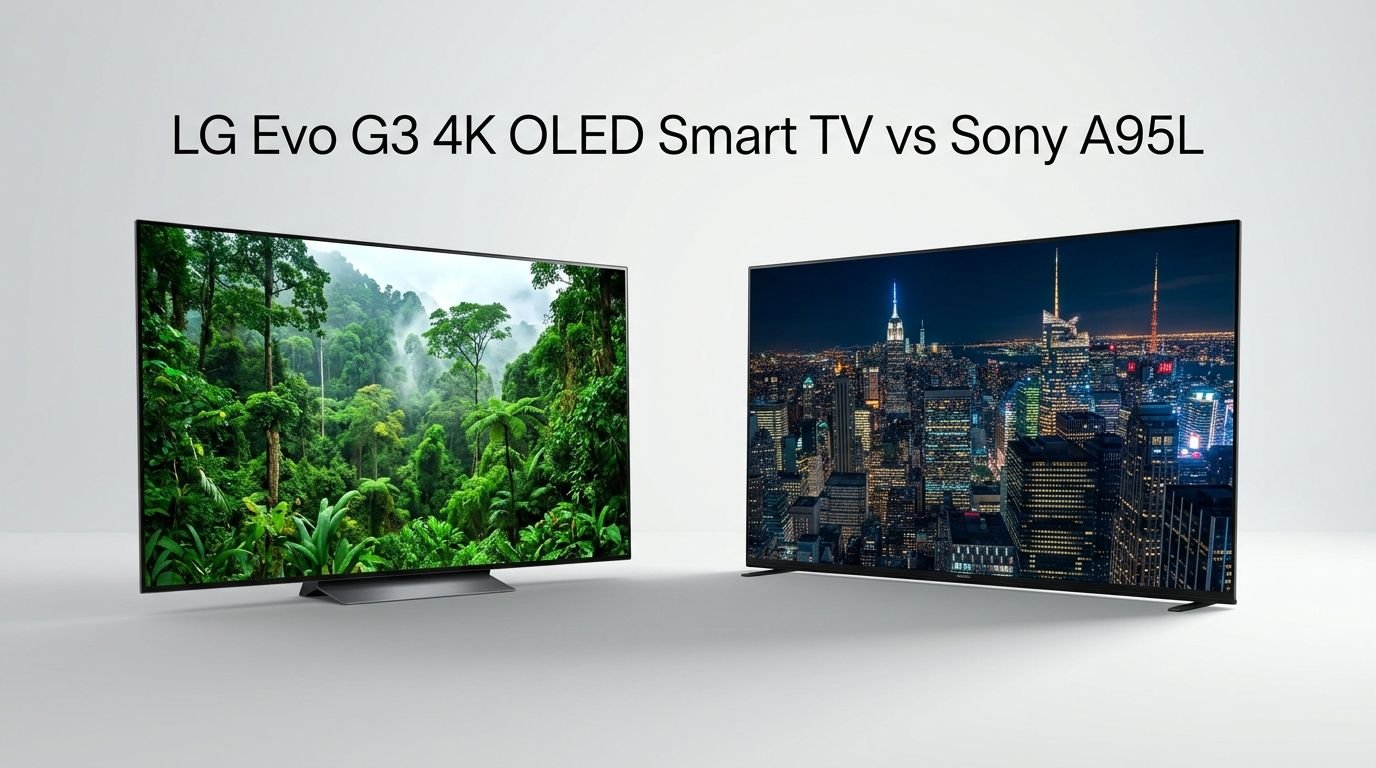
LG Evo G3 4K OLED Smart TV vs Sony A95L In 2026
The flagship OLED TV market has two clear heavyweights. The LG Evo G3 uses Micro Lens Array (MLA) technology to push OLED brightness to new limits. The Sony A95L fights back with a second generation QD-OLED panel and Sony’s legendary image processing.
Both TVs deliver jaw dropping 4K pictures, deep blacks, and premium designs. But they take very different paths to get there. One offers the best gaming experience money can buy. The other delivers picture processing that makes movies feel like real life.
So which one should you choose? This detailed comparison breaks down every important category. We cover picture quality, sound, gaming, smart features, design, and value. By the end of this post, you will know exactly which TV fits your setup, your budget, and your viewing habits. Let us dig in.
Key Takeaways
- The LG G3 uses MLA OLED technology that boosts peak brightness to around 1,500 nits in HDR. This makes it one of the brightest OLED TVs available. It handles well lit rooms with ease and makes HDR highlights pop off the screen.
- The Sony A95L uses a QD-OLED panel that delivers wider color volume and more saturated, accurate colors out of the box. Sony’s Cognitive Processor XR gives it superior image processing for upscaling and gradient handling.
- Gamers should lean toward the LG G3. It has four full HDMI 2.1 ports, lower input lag (around 9ms at 4K/120Hz with boost), and supports Dolby Vision gaming at 120Hz. The Sony A95L only has two HDMI 2.1 ports.
- Movie lovers may prefer the Sony A95L. Its image processing produces smoother gradients, better motion handling, and more natural looking pictures. The built in speakers on the A95L are also significantly better than the LG G3.
- The LG G3 runs webOS while the Sony A95L runs Google TV. Both platforms offer access to all major streaming apps. Google TV provides a more unified content search experience. WebOS offers faster navigation and a cleaner interface.
- Price is a major factor. The LG G3 is generally $500 to $1,000 cheaper than the Sony A95L at comparable screen sizes. The LG offers better value for most buyers, while the Sony justifies its premium for those who want the absolute best picture processing and sound.
LG Evo G3 4K OLED Smart TV Overview


Last update on 2026-08-04 / Affiliate links / Images from Amazon Product Advertising API Some of the links on this website are affiliate links, which means that at no additional cost to you, I earn a commission if you click through and make a purchase. I only recommend products and services that I believe will add value to my readers. Thank you for your support!
The LG Evo G3 is LG’s flagship OLED TV from the Gallery series. It uses a WOLED panel enhanced with Micro Lens Array (MLA) technology. This technology places tiny lenses over each pixel to direct more light toward the viewer. The result is a significant brightness boost over standard OLED panels.
The G3 runs on the α9 AI Processor 4K Gen6. This chip handles upscaling, noise reduction, and AI based picture optimization. It analyzes content in real time and adjusts settings for the best result.
LG designed the G3 as a gallery style TV. It sits flush against the wall with a slim profile of about 1 inch. The TV ships without a traditional stand. You need to purchase the stand separately or wall mount it.
The G3 is available in 55, 65, 77, and 83 inch sizes. It supports Dolby Vision, Dolby Atmos, HDR10, and HLG formats.
Pros:
- Exceptional brightness thanks to MLA technology (up to 1,500 nits peak)
- Four full bandwidth HDMI 2.1 ports
- Ultra slim gallery design for wall mounting
- Dolby Vision gaming at 4K 120Hz
- Low input lag around 9ms with boost mode
Cons:
- No stand included in the box
- Built in speakers sound average
- WebOS can show ads on the home screen
- Limited to 3.1.2 channel speaker configuration
Sony A95L QD OLED Smart TV Overview

Last update on 2026-08-04 / Affiliate links / Images from Amazon Product Advertising API Some of the links on this website are affiliate links, which means that at no additional cost to you, I earn a commission if you click through and make a purchase. I only recommend products and services that I believe will add value to my readers. Thank you for your support!
The Sony A95L is Sony’s flagship TV. It uses a second generation QD-OLED panel from Samsung Display. This panel combines quantum dots with organic light emitting diodes to produce extraordinary color saturation and wide viewing angles.
The Cognitive Processor XR powers the A95L. Sony designed this chip to process images the way the human brain perceives the world. It creates a focal point in the image and adjusts color, contrast, and clarity around it. The result is a picture that looks natural and three dimensional.
Sony built an Acoustic Surface Audio+ system into the A95L. This system uses actuators behind the screen to vibrate the panel itself. Sound comes directly from the screen, creating a more immersive experience than traditional speakers.
The A95L runs on Google TV. It is available in 55, 65, and 77 inch sizes. It supports Dolby Vision, Dolby Atmos, HDR10, HLG, and IMAX Enhanced formats.
Pros:
- Outstanding color accuracy and saturation from QD-OLED panel
- Best in class image processing with Cognitive Processor XR
- Acoustic Surface Audio+ delivers excellent built in sound
- Google TV offers a unified search experience
- Supports IMAX Enhanced content
Cons:
- Only two HDMI 2.1 ports
- Higher price than competing flagships
- Slightly higher input lag than the LG G3
- Stand takes up significant desk space
Picture Quality Comparison
Picture quality is where these TVs truly shine. The LG G3 reaches higher peak brightness thanks to its MLA technology. It can hit around 1,500 nits in small HDR highlights. This gives HDR content a more punchy and vivid look, especially in bright rooms.
The Sony A95L matches closely in brightness at around 1,300 nits peak. But its QD-OLED panel delivers wider color volume. Colors on the A95L are more saturated and vibrant. Reds look deeper. Blues look richer. Greens look more natural.
Both TVs produce perfect blacks since each pixel turns off individually. Contrast ratios are essentially infinite on both panels. The difference shows up in gradient handling. The Sony A95L produces smoother color transitions with less banding. This is thanks to Sony’s superior image processing.
The LG G3 handles bright room viewing slightly better. Its higher brightness and effective anti reflection coating reduce glare. The Sony A95L performs better in dark rooms where its color accuracy and processing shine.
Sound Quality Face Off
Sound quality is one area where these TVs differ greatly. The Sony A95L wins this category by a wide margin. Its Acoustic Surface Audio+ technology turns the screen into a speaker. Two actuators and two subwoofers produce a 60W system that fills a room with clear, detailed sound.
The sound on the A95L comes from the screen itself. Dialogue sounds like it originates from the characters on screen. This creates a more immersive viewing experience without an external sound system.
The LG G3 has a 3.1.2 channel speaker system rated at 60W total output. It includes up firing speakers for a simulated Dolby Atmos effect. However, the sound quality is average for a flagship TV. Reviewers noted the G3 sounds smooth but lacks the clarity and depth of the A95L.
Both TVs support Dolby Atmos and eARC for connecting external sound systems. If you plan to use a soundbar or home theater system, this difference matters less.
Gaming Performance
The LG G3 is the better gaming TV. It offers four HDMI 2.1 ports, each supporting 4K at 120Hz with full 48Gbps bandwidth. You can connect a PS5, Xbox Series X, and a gaming PC all at once without any compromises.
Input lag on the LG G3 measures around 9ms at 4K/120Hz with boost mode enabled. This is excellent for competitive gaming. The G3 also supports Dolby Vision gaming at 120Hz, AMD FreeSync Premium, and NVIDIA G-Sync compatibility.
The Sony A95L has only two HDMI 2.1 ports. One of these shares duty with the eARC connection. Input lag sits around 9ms at 4K/120Hz in game mode. The A95L supports VRR and ALLM but does not offer native G-Sync or FreeSync certification.
The LG G3 also includes a dedicated Game Optimizer menu. This gives you quick access to gaming settings like black stabilizer, low latency mode, and VRR toggles. Sony’s game menu is less feature rich.
Smart TV Platform and Interface
The LG G3 runs webOS 23. This platform is fast, smooth, and easy to use. It launches apps quickly and offers a customizable home screen. LG’s Magic Remote includes a pointer function that makes navigation feel intuitive.
However, webOS does show sponsored content and ads on the home screen. Some users find this annoying on a premium TV. LG offers all major streaming apps including Netflix, Disney+, Apple TV+, Amazon Prime Video, and YouTube.
The Sony A95L runs Google TV. This platform provides a unified content recommendation system. It searches across all your streaming services and shows relevant content in one place. The interface is content forward and well organized.
Google TV also gives you access to the Google Play Store. This means more app availability compared to webOS. The A95L supports Apple AirPlay 2 and works with Alexa and Google Assistant. Both platforms support voice control and smart home integration.
Design and Build Quality
The LG G3 features a gallery inspired design. The panel measures only about 1 inch thick. It sits perfectly flush against the wall using the included slim wall mount bracket. LG clearly designed this TV for wall mounting first.
The G3 does not include a stand in the box. You must purchase the stand separately. This adds to the overall cost. The slim design and flush mount make it look like a piece of art on the wall.
The Sony A95L has a more conventional design. It ships with a stand that allows two positions. The back panel is thicker due to the Acoustic Surface Audio+ system. The A95L looks elegant but is not as slim as the G3.
Both TVs use premium materials and feel well built. The LG G3 wins for wall mounted setups. The Sony A95L works better if you plan to place it on a media console.
HDR Performance
Both TVs handle HDR content beautifully. The LG G3 reaches higher peak brightness in HDR mode. Small highlights like sunlight reflections on water or explosions in an action movie appear brighter and more impactful.
The Sony A95L offers better tone mapping in HDR. Sony’s Cognitive Processor XR analyzes the entire image and maps brightness levels more accurately. This means you see more detail in both bright highlights and dark shadows simultaneously.
The LG G3 supports Dolby Vision, HDR10, and HLG. The Sony A95L adds IMAX Enhanced to that list. If you watch IMAX Enhanced content on Disney+ or other services, the A95L provides a more optimized experience.
Both TVs support Dolby Vision IQ, which adjusts HDR brightness based on room lighting conditions. The LG G3’s extra brightness gives it a slight edge in very bright environments. The A95L’s processing gives it the advantage in darker viewing conditions.
Viewing Angles and Reflection Handling
OLED TVs generally offer wide viewing angles. Both the LG G3 and Sony A95L maintain color accuracy and contrast at off center positions. However, the Sony A95L’s QD-OLED panel has a slight advantage here.
The QD-OLED technology in the A95L maintains color saturation better at extreme angles. Colors stay rich and vibrant even when you sit far to the side. The LG G3 is still excellent, but colors shift slightly more at very wide angles.
For reflection handling, the LG G3 performs slightly better. Its higher brightness combined with LG’s anti reflection coating reduces the impact of ambient light and glare. The A95L handles reflections well but cannot match the G3 in very bright rooms.
Both TVs work great for family viewing where people sit at different positions around the room. The differences are minor and only visible in direct side by side comparisons.
Connectivity and Ports
The LG G3 offers better connectivity overall. It has four HDMI 2.1 ports with full 48Gbps bandwidth on each. This means every port supports 4K at 120Hz, VRR, and ALLM. You also get three USB ports, an Ethernet port, and built in Wi-Fi 6E.
The Sony A95L has four HDMI ports total, but only two support HDMI 2.1. The other two are HDMI 2.0 ports limited to 4K at 60Hz. One HDMI 2.1 port doubles as the eARC connection. This limits your high bandwidth device options.
The A95L offers two USB ports, an Ethernet port, and Wi-Fi 5. The lack of Wi-Fi 6 on the Sony is a notable omission on a flagship TV. Both TVs support Bluetooth 5.0 for wireless audio connections.
If you have multiple gaming consoles, a 4K Blu-ray player, and other devices, the LG G3 gives you more flexibility with its four full HDMI 2.1 ports.
Price and Value
Price is where the LG G3 has a clear advantage. The 65 inch LG G3 originally launched at around $2,500. The 65 inch Sony A95L launched at approximately $3,500 to $4,000. That is a significant price gap for two TVs that compete closely in picture quality.
The LG G3 delivers outstanding value for a flagship OLED TV. You get MLA brightness, four HDMI 2.1 ports, and excellent gaming features at a lower price. It represents a smart purchase for most buyers.
The Sony A95L justifies its higher price for specific use cases. If you prioritize image processing, built in sound quality, and color accuracy above all else, the premium makes sense. Movie enthusiasts and home theater purists will appreciate what Sony offers.
Both TVs have seen price drops since their initial launch. You can often find them at discounted prices during sales events. Check current pricing before making your final decision.
Which One Should You Buy?
The answer depends on your priorities. Choose the LG G3 if you want the best gaming TV with four HDMI 2.1 ports, higher brightness, and better value. It is the smarter pick for most households.
Choose the Sony A95L if you prioritize picture processing, color accuracy, and built in sound quality. It is the better TV for dedicated home theater rooms and movie watching.
Both TVs deliver a premium 4K OLED experience. You will not be disappointed with either choice. The LG G3 leans toward versatility and value. The Sony A95L leans toward pure picture and audio quality.
Consider your room environment too. Bright living rooms favor the LG G3. Dark, dedicated viewing rooms favor the Sony A95L. Your budget will likely be the deciding factor for most buyers.
Frequently Asked Questions
Is the LG G3 brighter than the Sony A95L?
Yes, the LG G3 reaches slightly higher peak brightness at around 1,500 nits compared to the Sony A95L’s 1,300 nits. This difference is most noticeable in HDR highlights. Both TVs are very bright for OLED panels.
Does the Sony A95L have better color accuracy than the LG G3?
The Sony A95L produces wider color volume and more saturated colors thanks to its QD-OLED panel. It also offers better out of the box color accuracy. The LG G3 is still excellent after calibration, but the Sony has a natural advantage in this area.
Which TV is better for PS5 gaming?
The LG G3 is better for gaming overall. It has four HDMI 2.1 ports, lower input lag, and supports Dolby Vision gaming at 120Hz. The Sony A95L works well with PS5 and offers some exclusive PlayStation features, but its two HDMI 2.1 ports limit connectivity.
Do both TVs support Dolby Vision and Dolby Atmos?
Yes, both the LG G3 and Sony A95L support Dolby Vision for HDR video and Dolby Atmos for immersive audio. The Sony A95L also adds IMAX Enhanced support, which the LG G3 does not have.
Can the LG G3 be placed on a TV stand?
The LG G3 does not include a stand in the box. LG designed it for wall mounting. You can purchase a compatible stand separately from LG. This is an added expense you should factor into your budget.
Which TV has a better smart TV platform?
This comes down to preference. The LG G3 uses webOS, which is fast and intuitive. The Sony A95L uses Google TV, which offers better content discovery and a larger app store. Both platforms support all major streaming services and voice assistants.

Hello, i’m Ivoria i am the face behind Tech Tracker Blog. I am passionate about my work and love to explore gadgets and share about my experience.