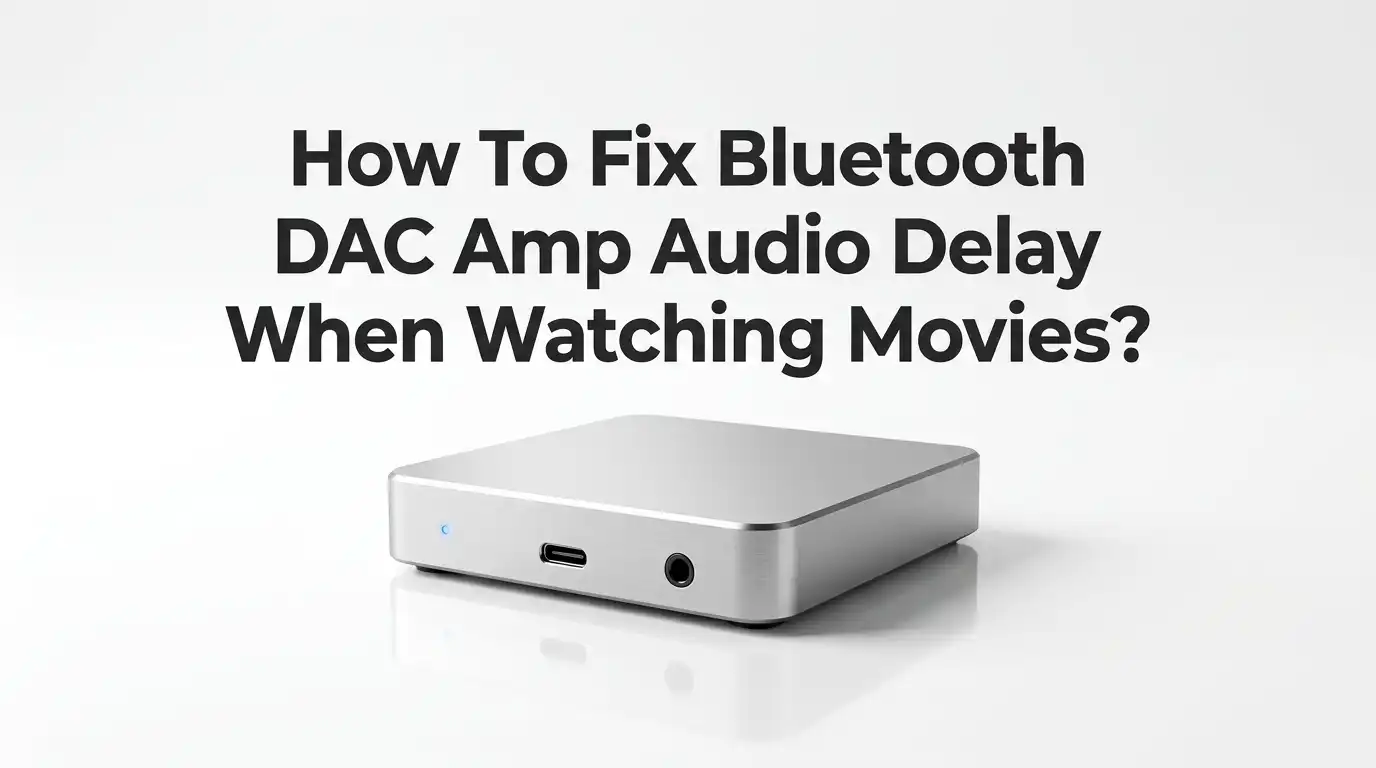
How To Fix Bluetooth DAC Amp Audio Delay When Watching Movies?
You sit down to watch a movie. The actor opens their mouth. The words arrive half a second later. Your Bluetooth DAC amp sounds amazing for music, but during films the audio drags behind the picture.
This mismatch is called lip sync delay, and it ruins the experience fast. The good news is that you can fix it. Most delay comes from how Bluetooth compresses and sends sound, and you have real control over those settings.
This guide walks you through every practical fix, from quick codec swaps to clever video offset tricks. Let us solve your audio delay problem together, step by step.
In a Nutshell:
- Bluetooth delay is normal. Standard codecs like SBC add 150 to 250 milliseconds of lag, which your eyes easily notice during movies. This is the root cause for most people.
- Low latency codecs are the best real fix. aptX Low Latency drops delay under 40 milliseconds. Both your source device and your DAC amp must support the same codec for it to work.
- Video offset is the easiest free trick. Most TVs, players, and apps let you delay the picture to match the sound. This needs no new hardware at all.
- Wired beats wireless every time for sync. A simple cable removes the delay completely because there is no codec processing involved.
- Your source device matters a lot. Phones, laptops, and TVs handle Bluetooth differently, so the same DAC amp can perform well on one device and poorly on another.
- Quick wins exist. Restarting devices, updating firmware, and reducing interference often cut delay without any cost or extra gear.
Why Bluetooth DAC Amps Cause Audio Delay During Movies
Your DAC amp itself is rarely the problem. A digital to analog converter adds tiny delay measured in microseconds, which no human can detect. The real delay comes from the Bluetooth link sitting in front of it.
When sound travels wirelessly, your source device must compress the audio, send it over radio waves, and let the DAC amp decode it again. This encode and decode cycle takes time, and that time stacks up to hundreds of milliseconds.
Movies expose this delay because your brain expects mouths and words to match perfectly. Music hides delay well since there is no visual reference. So the issue is the wireless pipeline, not the converter chip inside your amp.
How Bluetooth Codecs Create Lip Sync Problems
A codec is the language your devices use to send sound over Bluetooth. The codec you use decides how much delay you get. The default codec, SBC, is universal but slow, often adding 150 to 250 milliseconds of lag.
AAC performs well on Apple devices but varies wildly on Android phones. Standard aptX trims delay a little but still lingers near 100 milliseconds. Higher quality codecs like LDAC sound beautiful yet push latency past 200 milliseconds, which feels terrible during films.
The key lesson is simple: better sound quality often means worse delay. You must balance audio fidelity against sync accuracy depending on what you are watching.
Pros: understanding codecs lets you pick the right tool for the job.
Cons: you cannot change a codec your hardware does not support.
Solution 1: Switch to a Low Latency Codec Like aptX LL
This is the single most effective fix for true Bluetooth movie watching. aptX Low Latency keeps delay under 40 milliseconds, which your eyes cannot detect.
The newer aptX Adaptive sits around 50 to 80 milliseconds, still good enough for most films. To use these, both your source device and your DAC amp must support the same low latency codec.
Check the specs of your phone, laptop, or TV, then check your amp. If they match, enable the codec in your sound settings. Once paired correctly, the lip sync problem usually disappears completely. This is the cleanest wireless solution available today.
Pros: near perfect sync while staying fully wireless.
Cons: both devices must support the same codec, and many budget products do not.
Solution 2: Use a Wired Connection to Eliminate Delay Entirely
If wireless keeps fighting you, go wired. A physical cable removes Bluetooth from the chain entirely, so there is no codec, no compression, and no decode delay. Connect your DAC amp to your source using a USB cable, optical cable, or analog line out.
The sound travels almost instantly, and lip sync becomes perfect. This method works every single time, which is why audio professionals rely on it. Many DAC amps support both wired and wireless modes, so you keep flexibility. You only need a cable that matches your source and amp ports. For serious movie nights, wired is the safest choice you can make.
Pros: zero delay, best possible audio quality, and total reliability.
Cons: cables limit your movement and may not reach across a room.
Solution 3: Adjust the Audio Delay Setting on Your TV
Many televisions include a built in fix for this exact problem. Look in your TV sound menu for a setting called Audio Sync, Lip Sync, or A/V Delay. This control lets you shift the audio forward or the video back until the two match.
Set your DAC amp as the output, play a clip with clear speech, then nudge the slider until lips and words align.
Most TVs offer a range of zero to several hundred milliseconds, which covers nearly all Bluetooth delay. Save the setting once it looks right. This trick costs nothing and works with any DAC amp, making it one of the most accessible fixes available.
Pros: free, built in, and works with any wireless codec.
Cons: not every TV includes this menu, and the adjustment range can be limited.
Solution 4: Use Video Player Software to Offset the Picture
When your TV lacks a sync setting, your media player can step in. Apps like VLC, MPV, and Kodi let you delay audio or video manually. In VLC, the keyboard shortcuts J and K shift the audio in small steps until it matches the picture.
This gives you fine control down to single milliseconds, far more precise than most TV menus. Streaming apps rarely offer this, so it works best with downloaded files or local media.
Once you set the offset, the player remembers it for that session. This software approach turns your computer into a flexible fix. It is perfect for users who watch movies on a laptop or PC connected to a Bluetooth DAC amp.
Pros: very precise control and completely free to use.
Cons: streaming services usually block this option, limiting you to local files.
Solution 5: Pick the Right Source Device for Bluetooth Movies
Not all source devices handle Bluetooth equally. The same DAC amp can sync well on one device and lag badly on another. Windows computers generally manage Bluetooth latency well. iPhones and iPads perform best with AAC since Apple optimizes that codec heavily.
Android phones vary enormously, with some models adding far more delay than others. Smart TVs are often the worst offenders because their Bluetooth chips are basic and slow.
If one device frustrates you, try playing the movie from another. You may discover your tablet syncs perfectly while your TV does not. Choosing the right source can solve the problem without buying anything new.
Pros: a free fix if you own multiple devices.
Cons: you may be stuck if your only source handles Bluetooth poorly.
Solution 6: Use a Dedicated Low Latency Bluetooth Transmitter
Your TV or older source may not support fast codecs at all. A separate Bluetooth transmitter solves this by adding low latency codec support. You plug the transmitter into your TV optical or analog output, and it sends sound using aptX Low Latency to a matching DAC amp.
This bypasses your TV slow built in Bluetooth entirely. Pick a transmitter and amp that share the same low latency codec, or the delay returns.
Some transmitters also support two devices at once, which is handy for couples. This adds a small box and a little setup, but the payoff is strong. It often rescues older televisions that otherwise cannot do wireless movies well.
Pros: brings low latency to devices that lack it, with reliable results.
Cons: adds extra hardware, cost, and a few more cables to manage.
Solution 7: Update Your DAC Amp and Source Firmware
Outdated software causes more delay than people expect. Manufacturers regularly release firmware that improves Bluetooth stability and latency. Check your DAC amp brand website or companion app for available updates.
Do the same for your phone, laptop, or TV operating system. A single update can add support for a new codec or fix a known sync bug. Install updates over a stable connection and do not interrupt the process.
After updating, repair your devices fresh to apply the changes fully. This fix takes only a few minutes and costs nothing. Many users solve nagging delay simply by keeping their gear current, so never skip this easy step.
Pros: free, quick, and sometimes unlocks better codecs.
Cons: not all devices receive updates, and some products are abandoned by makers.
Solution 8: Reduce Wireless Interference Around Your Setup
Bluetooth shares crowded radio space with many household devices. Wi-Fi routers, microwaves, and other wireless gadgets can disrupt your audio stream. When interference rises, your DAC amp re sends lost data, which increases delay and causes stutters.
Move your source device closer to the amp and clear the line of sight between them. Keep your router and microwave a few feet away from your audio gear. Turn off Bluetooth on devices you are not using to free up the airwaves.
Walls, metal furniture, and aquariums also block the signal. A cleaner radio environment means a steadier, faster connection. Sometimes simply moving your phone fixes a delay you blamed on the amp.
Pros: free and improves both delay and audio dropouts.
Cons: helps with stability more than codec based delay, so results vary.
Solution 9: Restart and Repair Your Bluetooth Connection
Old connections sometimes get stuck in a slow state. A simple restart clears glitches that build up over time. Turn off Bluetooth on both your source and your DAC amp, then turn them back on.
If delay continues, remove the amp from your device list and pair it again from scratch. A fresh pairing often forces the devices to negotiate the best available codec. Reboot your phone, laptop, or TV too, since their Bluetooth stacks can hang.
This costs nothing and takes under five minutes. It will not beat physics if your codec is slow, but it removes software faults. Always try this before assuming your hardware is the problem.
Pros: free, fast, and fixes temporary software faults instantly.
Cons: it cannot reduce the baseline delay of a slow codec.
Solution 10: Disable Audio Enhancements and Effects
Hidden processing can quietly add to your delay. Sound enhancements, equalizers, and surround effects all take time to apply. Each effect adds a small processing step between your source and your ears.
On Windows, open your sound settings and turn off all enhancements for the playback device. On your TV, disable virtual surround, dialogue boosters, and night modes.
These features may improve tone but they often worsen lip sync. Test your movie after switching each one off to see what helps. Many DAC amps also have their own DSP modes worth disabling for video. A clean, direct audio path keeps delay as low as your codec allows.
Pros: free and can trim extra milliseconds from your delay.
Cons: you lose sound effects you may enjoy, and gains are usually small.
Solution 11: Match Your Codec Settings in Developer Options
Android users hold extra control most people never touch. Developer Options let you force a specific Bluetooth codec for your DAC amp. Enable Developer Options by tapping your build number several times, then open the Bluetooth audio codec menu.
Here you can select aptX, aptX Adaptive, or another low latency option if your amp supports it. Avoid choosing LDAC for movies since its high quality comes with heavy delay.
Setting the codec manually stops your phone from defaulting to slow SBC. Test each option while playing a clip with clear speech. This puts the decision in your hands instead of the system. It is a powerful free fix for Android movie watchers.
Pros: gives direct codec control without buying anything.
Cons: only available on Android, and the menu can confuse new users.
Solution 12: Choose a DAC Amp Built for Low Latency Use
If you are still shopping, plan ahead for movies. Some DAC amps are designed with low latency codecs as a core feature. When choosing one, confirm it lists aptX Low Latency or aptX Adaptive support clearly.
Also check that it offers wired input modes as a fallback for perfect sync. A versatile amp gives you several ways to beat delay depending on your source. Read the codec list carefully, since marketing often hides the details.
Match the amp to the devices you already own so the codecs align. This is a forward looking fix rather than a quick one. The right purchase prevents the delay problem before it ever starts.
Pros: solves the issue at the source with the most flexibility.
Cons: requires research, and low latency models can cost more than basic ones.
Solution 13: Combine Methods for the Best Results
No single fix works for every setup, so layering helps. Pairing a low latency codec with a small video offset often gives flawless sync. For example, use aptX Low Latency to cut most of the delay, then nudge your TV audio sync slider to clean up the last few milliseconds.
Reduce interference and disable enhancements at the same time for a stable, fast connection. Each fix removes a different piece of the delay puzzle.
Test your favorite movie after each change so you know what truly helped. Keep your firmware current to lock in the gains. A combined approach beats relying on one trick alone and delivers the smoothest movie experience.
Pros: addresses every delay source at once for the best outcome.
Cons: takes more time and patience to dial in correctly.
Frequently Asked Questions
Why does my DAC amp only lag during movies and not music?
Music has no visual reference, so your brain does not notice the delay. Movies show mouths moving, and your eyes instantly catch the mismatch between lips and sound. The delay exists in both cases, but only video makes it obvious.
Does a more expensive DAC amp reduce audio delay?
Not by itself. Price reflects sound quality, not low delay. What matters is whether the amp supports a low latency codec like aptX Low Latency. A cheaper amp with the right codec can sync better than a costly one without it.
Can I fix Bluetooth delay on streaming apps like Netflix?
Streaming apps rarely let you adjust audio offset directly. Use your TV audio sync setting instead, or switch to a low latency codec. A separate Bluetooth transmitter also helps when the app and TV give you no control.
How much delay can humans actually notice?
Most people detect lip sync errors once audio lags video by around 45 milliseconds or more. Under that threshold, the mismatch feels natural. This is why low latency codecs target the 40 millisecond mark or lower for clean movie playback.
Will wired headphones always beat Bluetooth for movies?
Yes, for sync purposes. A cable carries sound almost instantly with no codec delay. Bluetooth always adds some processing time, even with the fastest codecs. For perfect lip sync and the simplest setup, wired remains the most reliable option.
Does LDAC cause more movie delay than other codecs?
Yes. LDAC focuses on high audio quality, not speed. Its delay often passes 200 milliseconds, which feels terrible during films. For movies, choose aptX Low Latency or aptX Adaptive instead, and save LDAC for relaxed music listening.

Hello, i’m Ivoria i am the face behind Tech Tracker Blog. I am passionate about my work and love to explore gadgets and share about my experience.